
Front Garden Design UK: How to Create a Beautiful, Practical Front Garden
Your front garden is the first thing visitors, neighbours and potential buyers see. It sets the tone for your entire property, and in the UK it's also subject to planning rules that back gardens aren't. This guide covers the design principles that work, the plants that perform year-round in South East England, realistic costs for 2026, and how to balance parking with planting in a way that looks genuinely good.
We've designed front gardens across Kent, Surrey, Essex and London for over a decade. The patterns that make a front garden feel welcoming rather than neglected are consistent, regardless of whether you're working with 8 square metres or 80.
Why Front Gardens Need a Different Approach
Back gardens tolerate gaps. A herbaceous border can lie dormant from November to March and nobody minds. Front gardens don't have that luxury. Yours is on show twelve months of the year to every delivery driver, estate agent and passing neighbour.
The successful front garden designs we've delivered share three characteristics: they use evergreens as the structural backbone, they keep the route to the front door obvious, and they don't try to do too much. A front garden with six competing ideas looks chaotic. One with a clear design intention and three well-chosen plants looks designed.
Add to this the practical constraints, parking for one or two cars, bin storage that doesn't dominate the view from your front window, and planning regulations around paving, and you have a design problem that needs solving properly the first time.
Planning Permission and Paving Rules You Need to Know
Since 2008, if you lay more than 5 square metres of impermeable paving in your front garden, you need planning permission. This rule exists because paved front gardens contributed to the 2007 UK floods, which caused £3 billion in damage.
Impermeable paving includes concrete, asphalt, traditional block paving and most natural stone laid on a solid base. You can pave up to 5 sqm without permission, or an unlimited area if you use permeable materials.
Permeable options that don't require permission:
- Gravel on a permeable membrane (not on concrete)
- Permeable block paving with open joints
- Grass reinforcement grids
- Resin-bound surfacing (allows water through)
- Porous asphalt or concrete
The 5 sqm limit is cumulative. If you already have 3 sqm of paving and want to add 4 sqm, you need permission for the additional area beyond 5 sqm total.
In a conservation area, any wall, fence or gate over 1 metre high fronting a highway requires planning permission. Outside conservation areas, the limit is 2 metres. These rules apply even if you're replacing an existing boundary.
If you're in South East London, parts of Kent or Surrey with Article 4 directions (Dulwich, parts of Sevenoaks, areas of Reigate), additional restrictions may apply. Check with your local planning authority before ordering materials.
Design Principles That Work in UK Front Gardens
1. Evergreens First, Colour Second
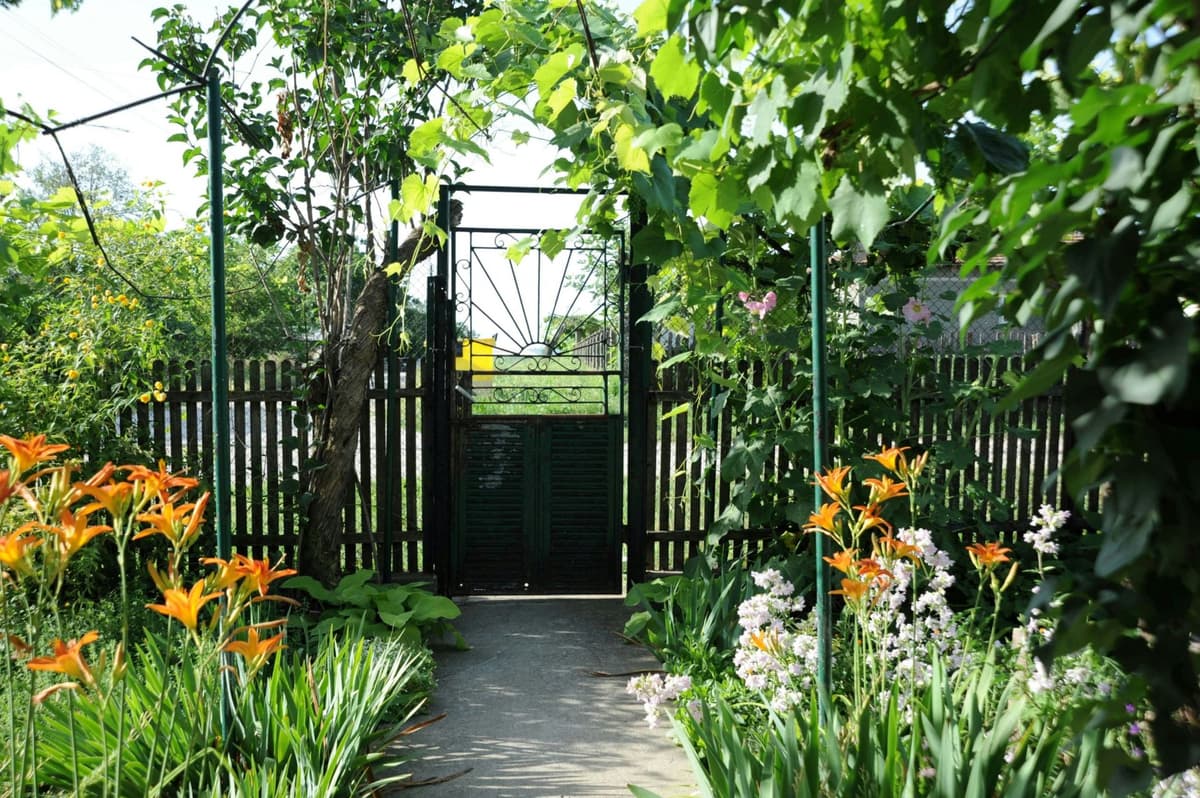
The single most common mistake in front garden planting is prioritising seasonal colour over year-round structure. A front garden planted with roses, delphiniums and daylilies looks spectacular in June and bare in January.
Start with evergreens that look deliberate in winter: box balls or cubes, lavender, Euonymus, Viburnum tinus, or architectural grasses like Stipa tenuissima. These provide the bones. Add seasonal colour as a layer on top, not as the foundation.
In our Kent and Surrey projects, box blight has become widespread enough that we now recommend Portuguese laurel (Prunus lusitanica 'Myrtifolia') as a more reliable evergreen alternative. It clips into formal shapes, tolerates shade, and isn't vulnerable to blight.
2. Keep the Path to the Door Obvious
A front garden path should be direct and wide enough for two people to walk side by side comfortably. That means 90cm minimum, 1.2 metres ideal. A narrow, winding path looks quaint in a cottage garden brochure but frustrates people carrying shopping bags or pushing a wheelchair.
The path surface should be level, non-slip when wet, and visually distinct from planted areas. We use brick edging, metal strips or a change in material to define the edge.
3. Symmetry Works in Front Gardens
Formal structure with informal planting is the combination that works best in front gardens across every property type we've worked on. A central path with matching planting on either side feels balanced even when the planting itself is soft and billowing.
Two matching pots flanking the front door, identical lavender hedges on both sides of the path, or a pair of clipped evergreens, these symmetrical touches create order without feeling stiff.
Front Garden Design by Property Type
Terraced House Front Garden (Typical 2m x 4m / 8 sqm)
Small terraced front gardens rarely have room for parking. The priority is a clear, attractive entrance that doesn't try to cram in a lawn (which never looks neat at this scale).
Layout:
- Straight paved path from gate to front door, 90cm wide
- Flanking planted areas, 40-60cm wide on each side
- Two pots or planted spaces either side of the door
Planting for a 2m x 4m terraced front garden:
- Structure: Two lavender plants (Lavandula angustifolia 'Hidcote') flanking the door – £8-12 each, 2-litre pot
- Climbers: Star jasmine (Trachelospermum jasminoides) on the house wall, evergreen, scented flowers May-July – £25-40, 3-litre
- Ground cover: Geranium macrorrhizum 'Bevan's Variety', evergreen, shade-tolerant, spreads to 50cm – £6-8, 2-litre
- Seasonal colour: Spring bulbs (100 mixed crocus, daffodils, tulips planted through ground cover) – £30-50 per 100 bulbs
Surface: York stone or Indian sandstone paving on the path (£40-65 per sqm supply only, £80-110 installed). Beds mulched with composted bark (£35 per bulk bag covering 10 sqm at 5cm depth).
Total planting cost: £180-280 including bulbs
Total landscaping cost: £900-1,600 (paving + soil prep + planting + mulch)
Semi-Detached Front Garden with Driveway (Typical 4m x 6m / 24 sqm)
Semi-detached properties often need parking for one car. The design challenge is incorporating a driveway without the garden becoming a car park with a token shrub.
Layout:
- Angled driveway to one side (10-12 sqm permeable block paving or gravel with plastic grid)
- Path from pavement to front door (separate from driveway)
- Planted bed along the front boundary, 60-80cm deep
- Corner planted bed opposite the driveway, triangular
Planting for a 4m x 6m semi-detached front garden:
- Small tree: Amelanchier lamarckii (snowy mespilus) – multi-stem, white spring flowers, autumn colour, 3-4m eventual height – £80-150, 12-litre
- Evergreen hedge: Portuguese laurel (Prunus lusitanicus 'Myrtifolia') along front boundary, 60-80cm height, 5 plants at 60cm spacing – £25-35 each, 5-litre = £125-175 total
- Structural perennials: 3 x Miscanthus sinensis 'Morning Light', ornamental grass – £18-25 each, 3-litre
- Evergreen filler: 6 x Euonymus fortunei 'Emerald Gaiety', variegated foliage – £8-12 each, 2-litre
- Seasonal colour: 5 x Geranium 'Rozanne' for summer blue flowers – £10-14 each
Driveway cost: Permeable block paving £60-85 per sqm installed, or gravel with plastic grid £35-50 per sqm
Total planting cost: £380-600
Total project cost: £2,800-4,200 (driveway + path + soil prep + planting)
Detached House Front Garden (6m+ deep, 40-80 sqm)
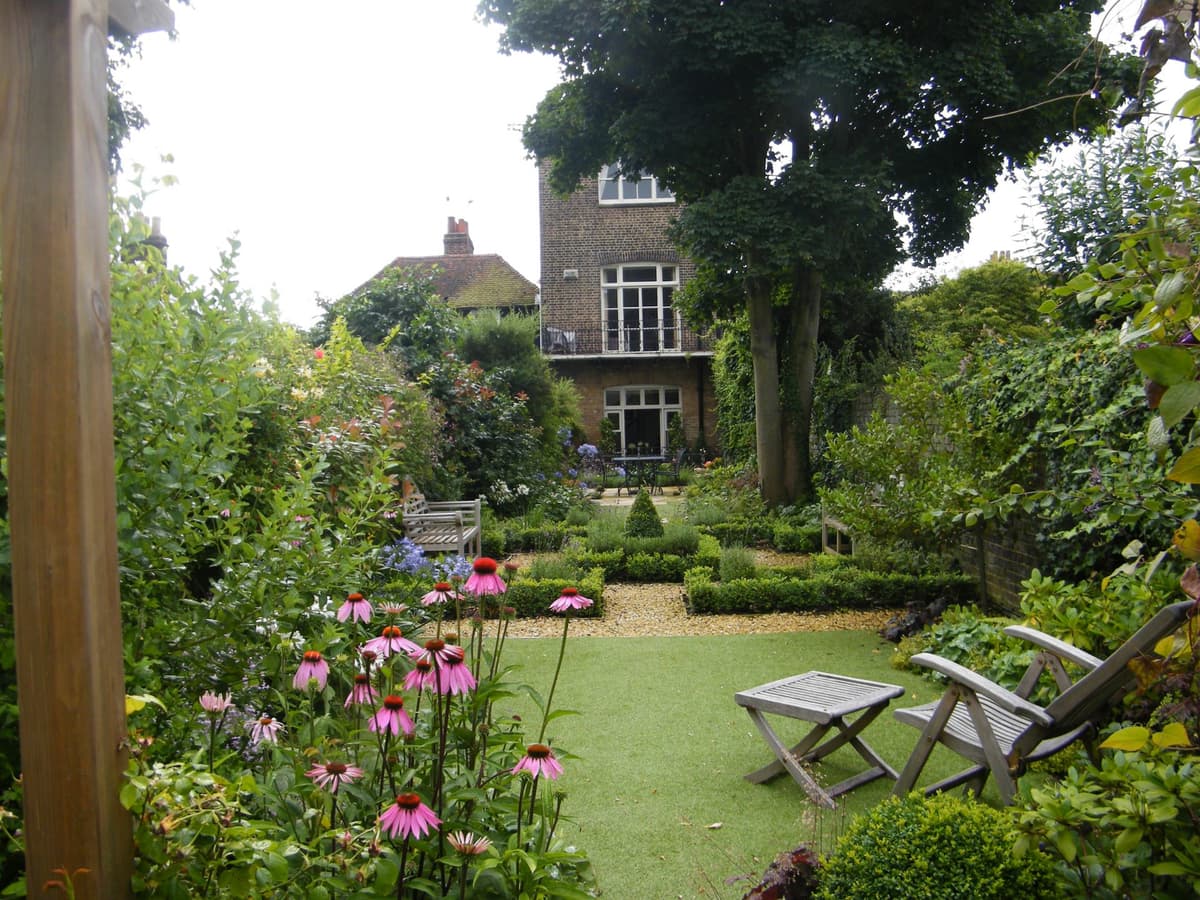
Larger detached front gardens offer space for layered planting, a specimen tree, and often parking for two cars. The design needs to ensure the garden doesn't read as "driveway with a bit of planting around the edge."
Layout:
- Driveway to one side or sweeping curve (15-20 sqm)
- Generous planted borders, minimum 1.2m deep
- Specimen tree positioned off-centre as focal point
- Low boundary hedge or wall, 60-100cm height
- Path from pavement to front door distinct from driveway
Planting for a larger detached front garden:
- Specimen tree: Betula utilis var. jacquemontii (Himalayan birch), white bark, 6-8m eventual height – £150-280, 12-14cm girth
- Boundary hedge: Box (Buxus sempervirens) or Portuguese laurel, 80-100cm height along front boundary, 8-10 plants – £200-400 total
- Shrub layer: 5 x Viburnum tinus, evergreen with winter flowers – £25-35 each, 5-litre
- Perennial layer: 15-20 mixed perennials (Nepeta, Salvia, Geranium, Alchemilla mollis) – £150-250 total
- Ground cover: 10 x Geranium macrorrhizum or Ajuga reptans – £60-80
- Climbers: Wisteria or climbing hydrangea on house wall – £30-50, 3-5 litre
Driveway cost: Resin-bound surfacing £60-90 per sqm, or natural stone setts £80-120 per sqm installed
Total planting cost: £800-1,400
Total project cost: £5,500-9,500 (driveway + paths + soil improvement + planting + mulch + lighting)
Screening Bins and Utilities Without Creating a Fortress
Bin storage should be close to the pavement for collection day but screened from the main view of the house. The most effective solutions we've used:
Purpose-built bin stores: Timber or metal enclosures for 2-3 bins, painted to match the house or fence. Cost: £150-350 depending on size and finish.
Trellis with evergreen climbers: A 1.8m trellis panel (£40-70) planted with star jasmine or evergreen clematis screens bins within two growing seasons while remaining open and light. Plant cost: £25-40 for a 3-litre climber.
Low hedge screen: A 60-80cm Portuguese laurel or Euonymus hedge hides bins at eye level without blocking light or feeling fortress-like. Establishment time: 2-3 years.
Position bin storage near the boundary, not next to your front door. This keeps the smell and visual clutter away from your entrance.
Boundary Options: Walls, Hedges, Railings or Open Plan
Your front boundary defines your property and affects how open or enclosed the garden feels. The right choice depends on your street context, privacy needs and the style of your house.
Low Walls
Brick or stone walls at 60cm to 1m height (up to 1m at the highway without planning permission) work well with Victorian, Edwardian and Georgian properties. They define the space, provide a planting backdrop, and add kerb appeal.
Cost: £180-450 per metre run for brick with coping, depending on brick choice and wall height. Reclaimed or handmade bricks cost more but suit period properties better.
Hedging
A clipped evergreen hedge at 60-80cm height is one of the most effective front boundaries. It defines the space without blocking light, filters traffic pollution, and provides habitat for birds.
Best hedging plants for South East England:
- Box (Buxus sempervirens): Traditional, dense, clips well. Vulnerable to box blight in damp sites. £15-25 per metre for 40-50cm plants at 3 per metre spacing.
- Portuguese laurel (Prunus lusitanica 'Myrtifolia'): Dark evergreen foliage, white flowers in spring, blight-free. £18-30 per metre at 40-60cm plants.
- Lavender (Lavandula angustifolia 'Hidcote'): Informal, silver-green year-round, purple flowers June-August, bee-friendly. £12-18 per metre for 2-litre plants at 40cm spacing.
Railings
Victorian or Edwardian-style railings suit period properties and create a defined boundary without blocking the view of the house. Black, dark grey or heritage green paint colours work best.
Cost: £120-280 per metre for mild steel railings, installed. Bespoke designs or cast iron cost significantly more.
Open Plan
No physical boundary, just a planting edge, works well in modern estates or where an open-plan street is the established norm. Use low ground cover (lavender, Nepeta, ornamental grasses at 30-50cm height) to define the edge without creating a barrier.
Year-Round Plant Combinations for South East England
The front garden planting schemes that look good twelve months of the year combine evergreen structure with layered seasonal interest. Here are three proven plant palettes for different light conditions.
Sunny Front Garden (6+ hours direct sun)
- Evergreen structure: Lavandula angustifolia 'Hidcote' (lavender), 40cm height, silver-green foliage, purple flowers June-August
- Seasonal colour: Nepeta 'Six Hills Giant' (catmint), blue-purple flowers May-September, 60cm height
- Architectural accent: Stipa tenuissima (feather grass), blonde seedheads catch light, 60cm height
- Ground cover: Thymus serpyllum (creeping thyme), evergreen mat, pink flowers June-July
- Spring bulbs: Tulipa 'Queen of Night' and Narcissus 'Jetfire', planted through ground cover
Total cost for 6 sqm border: £180-280 (plants + bulbs + mulch)
Part-Shade Front Garden (3-5 hours sun, or dappled light)
- Evergreen structure: Sarcococca confusa (Christmas box), glossy foliage, scented winter flowers, 80cm height
- Seasonal colour: Geranium 'Rozanne', blue flowers June-October, 40cm height
- Foliage interest: Hakonechloa macra 'Aureola', golden grass, 40cm height, autumn colour
- Ground cover: Epimedium x versicolor 'Sulphureum', evergreen, yellow spring flowers
- Spring bulbs: Anemone blanda (blue) and snowdrops, naturalise well in shade
Total cost for 6 sqm border: £210-320
Full-Shade Front Garden (North-facing, under 2 hours direct sun)
- Evergreen structure: Fatsia japonica, architectural leaves, white autumn flowers, 1.5m height
- Ferns: Polystichum setiferum (soft shield fern), evergreen fronds, 60cm height
- Seasonal colour: Digitalis purpurea (foxglove), biennial, pink/white flowers June-July, 1.2m height, self-seeds
- Ground cover: Pachysandra terminalis, evergreen carpet, 20cm height
- Spring bulbs: Muscari (grape hyacinth) and Galanthus (snowdrops)
Total cost for 6 sqm border: £190-280
Front Garden Costs: What to Budget in 2026
Front garden costs vary by size, materials and whether you're adding parking. These are realistic South East England prices for 2026 based on projects we've designed and project-managed.
| Project Type | Size | Cost Range |
|---|---|---|
| Terraced front garden makeover (planting only, no parking) | 6-10 sqm | £900-£1,800 |
| Semi-detached with new driveway and planting | 20-30 sqm | £3,500-£6,500 |
| Detached house full redesign (driveway, paths, planting, lighting, boundaries) | 50-80 sqm | £8,000-£18,000 |
| Design fees (front garden) | Small to medium | £600-£1,500 |
Material costs per sqm (supply + installation):
- Gravel with membrane: £25-40 per sqm
- Permeable block paving: £60-85 per sqm
- Natural stone paving (Indian sandstone): £80-110 per sqm
- Resin-bound surfacing: £60-90 per sqm
- Brick or stone wall: £180-450 per metre run
- Railings (mild steel): £120-280 per metre
Common Front Garden Design Mistakes to Avoid
1. Paving the entire area to avoid maintenance
This reduces your property value, increases flooding risk, requires planning permission and looks bleak. Use permeable paving and leave planted areas.
2. Planting only summer-flowering perennials
Your front garden looks bare eight months of the year. Start with evergreen structure, add seasonal layers on top.
3. A lawn under 15 sqm
Small lawns in front gardens rarely look neat. They're too small to mow efficiently and edges become scruffy. Use paving, gravel or low planting instead.
4. Narrow, winding paths
These frustrate people carrying bags. A path should be at least 90cm wide and reasonably direct.
5. Ignoring bin storage
Bins left in full view next to the front door are the fastest way to ruin kerb appeal. Plan screening from the start.
6. Over-planting
A front garden planted too densely looks chaotic within three years as plants mature and merge. Allow space for plants to reach their mature size.
Front Garden Design for Conservation Areas
If your property is in a conservation area (common across South East England, including parts of Greenwich, Sevenoaks, Canterbury, Reigate, and Central London), additional restrictions apply:
- Any boundary wall, fence or gate over 1 metre high fronting a highway requires planning permission
- Some conservation areas have Article 4 directions removing permitted development rights for paving
- Original front boundary walls, railings or hedges may be protected features
- Materials and colours may need to match the street context
Check with your local planning authority before starting work. Conservation officers generally support well-designed front gardens that maintain the character of the area, particularly if you're reinstating a boundary that was removed or repairing period railings.
How Long Does a Front Garden Redesign Take?
Design and build timelines for front gardens depend on scale and whether you need planning permission:
- Design phase: 2-3 weeks from initial meeting to final layout plan and planting scheme
- Planning permission (if required): 8 weeks from submission to decision
- Build phase: 1-3 weeks depending on hard landscaping scope
- Planting: 1-2 days
For a typical semi-detached front garden with a new driveway and planting, expect 6-8 weeks from initial consultation to completion (assuming no planning permission required). If you need planning permission for hard surfacing or a new boundary, add 10-12 weeks.
Front Garden Maintenance: What to Expect
A well-designed front garden should need no more than 1-2 hours of maintenance per month once established:
Monthly tasks:
- Weed planted borders (5-10 minutes if mulched properly)
- Deadhead perennials in growing season (10-15 minutes)
- Edge lawn if you have one (15 minutes)
Twice yearly:
- Clip lavender or box hedges (30-60 minutes, once after flowering, once in late summer)
- Refresh gravel if used (rake level, top up thin areas)
- Prune climbers (20-40 minutes)
Annual tasks:
- Apply fresh mulch to beds (1-2 hours, early spring)
- Divide overcrowded perennials (30 minutes, autumn or spring)
- Plant spring bulbs (30 minutes, October-November)
If you don't have time for regular maintenance, design for lower input: increase the proportion of evergreens, use gravel mulch (longer-lasting than bark), and avoid high-maintenance plants like roses or delphiniums that need regular deadheading.
Frequently Asked Questions About Front Garden Design
Do I need planning permission to pave my front garden?
If you lay more than 5 sqm of impermeable paving (concrete, asphalt, traditional block paving), you need planning permission. Permeable materials (gravel, permeable block paving, grass grids) don't require permission regardless of area. In conservation areas or if your property has an Article 4 direction, additional restrictions may apply.
How much does it cost to redesign a front garden?
A terraced front garden makeover with planting and paving costs £900-£1,800. A semi-detached property with a new driveway and planting costs £3,500-£6,500. A detached house full redesign (driveway, paths, planting, lighting, boundaries) costs £8,000-£18,000. Design fees for a front garden are typically £600-£1,500.
What are the best low-maintenance plants for a front garden?
Lavender (Lavandula angustifolia 'Hidcote'), Sarcococca confusa (Christmas box), Geranium macrorrhizum, Viburnum tinus, Portuguese laurel (Prunus lusitanica 'Myrtifolia'), and ornamental grasses like Stipa tenuissima all provide year-round structure with minimal maintenance. Choose evergreens over herbaceous perennials for the lowest input.
Can I park a car on a small front garden?
A parking space needs to be at least 2.4m wide by 4.8m deep (11.5 sqm). If your front garden is smaller than 15 sqm and you need a path to the door plus planted areas, parking is usually not practical. Consider on-street parking or a garage if available.
How do I screen my bins in a front garden?
Position bin storage near the pavement boundary, not next to the front door. Use a purpose-built bin store (£150-350), a trellis with evergreen climbers like star jasmine (£65-110 total), or a low hedge (Portuguese laurel or Euonymus at 60-80cm height). All three options screen bins without creating a fortress feel.
Should I have a lawn in my front garden?
Lawns work in front gardens larger than 20 sqm where you have space for a mower to turn and edges to look crisp. Below 15 sqm, a lawn is too small to maintain neatly and is better replaced with paving, gravel or low planting. Reinforced grass grids allow occasional parking while keeping a green surface.
What style of front garden suits a Victorian terraced house?
Victorian terraced houses suit formal, symmetrical front gardens with a central path, matching planting on either side, and traditional materials (York stone paving, brick edging, railings or low brick walls). Period-appropriate plants include box, lavender, roses, and cottage garden perennials. Avoid modern materials like resin-bound surfacing or rendered walls.
Get Professional Help with Your Front Garden Design
If you're in Kent, Surrey, Essex, or London and want a front garden that balances parking, planting and planning rules properly, we can help. We design front gardens that look good twelve months of the year, comply with regulations, and suit the way you actually use the space.
Our process starts with a free consultation at your property. We measure the garden, discuss how you want to use it, cover any planning constraints, and give you an honest view of what's achievable within your budget. From there we produce a scaled layout plan, a planting scheme with specific plant names and quantities, and a build cost estimate.
We offer design-only services if you have your own landscaper, or design and build if you want us to project-manage the whole installation. Most front garden projects are completed within 6-8 weeks from initial consultation.
Service areas: Kent, Surrey, Essex, South East London, South West London, East London
Book your free consultation or call 0203 834 9807 to discuss your front garden project.