
Shade is not a problem. It's a design opportunity most gardens ignore.
Across London, Kent, Surrey and Essex, nearly 60% of back gardens have at least half their plot in shade for most of the day. North-facing gardens. Side returns. Trees from next door. Victorian terraces with high walls. You know the story.
The mistake most people make is treating shade as a compromise. Plant a few hostas, stick in some tired-looking impatiens, and hope for the best. Then wonder why the garden feels like a damp afterthought rather than a place you actually want to sit.
A well-designed shade garden does not look like it is making do. It looks lush, layered, and more interesting than most sunny borders. Foliage takes the lead. Texture and structure do the work. You get twelve months of presence instead of eight weeks of bedding and then nothing.
This guide covers how to design a shade garden that works in SE England conditions. Real plant choices for London clay and shallow soil over chalk. Costs. Layout principles. What thrives in dry shade under trees, and what needs moist shade by a north wall. No fluff.
Understanding Your Shade Type
Not all shade is the same. The difference between dappled shade under a silver birch and deep shade under a leylandii changes everything about what you can plant.
Three categories matter:
Dappled shade is filtered light through an open tree canopy. You see moving shadows on the ground. This is the easiest shade to work with. Silver birch, amelanchier, ornamental cherries and most fruit trees create this. You can grow nearly anything marketed as 'partial shade'.
Partial shade means 2 to 4 hours of direct sun, usually morning or late afternoon. North-facing gardens that back onto open ground often get this. The RHS calls anything under 6 hours 'shade', but the 2 to 4 hour band is a sweet spot. Huge plant range. Hydrangeas, astilbes, hostas, Japanese anemones, most ferns, climbing hydrangea, and half the woodland perennials at a good nursery.
Full shade is under 2 hours of direct sun per day. Dense tree canopies (beech, holly, mature conifers), between buildings, deep north-facing courtyards. This is the hardest condition. You are working with ferns, ivy, aucuba, sarcococca, and a short list of tough ground cover.
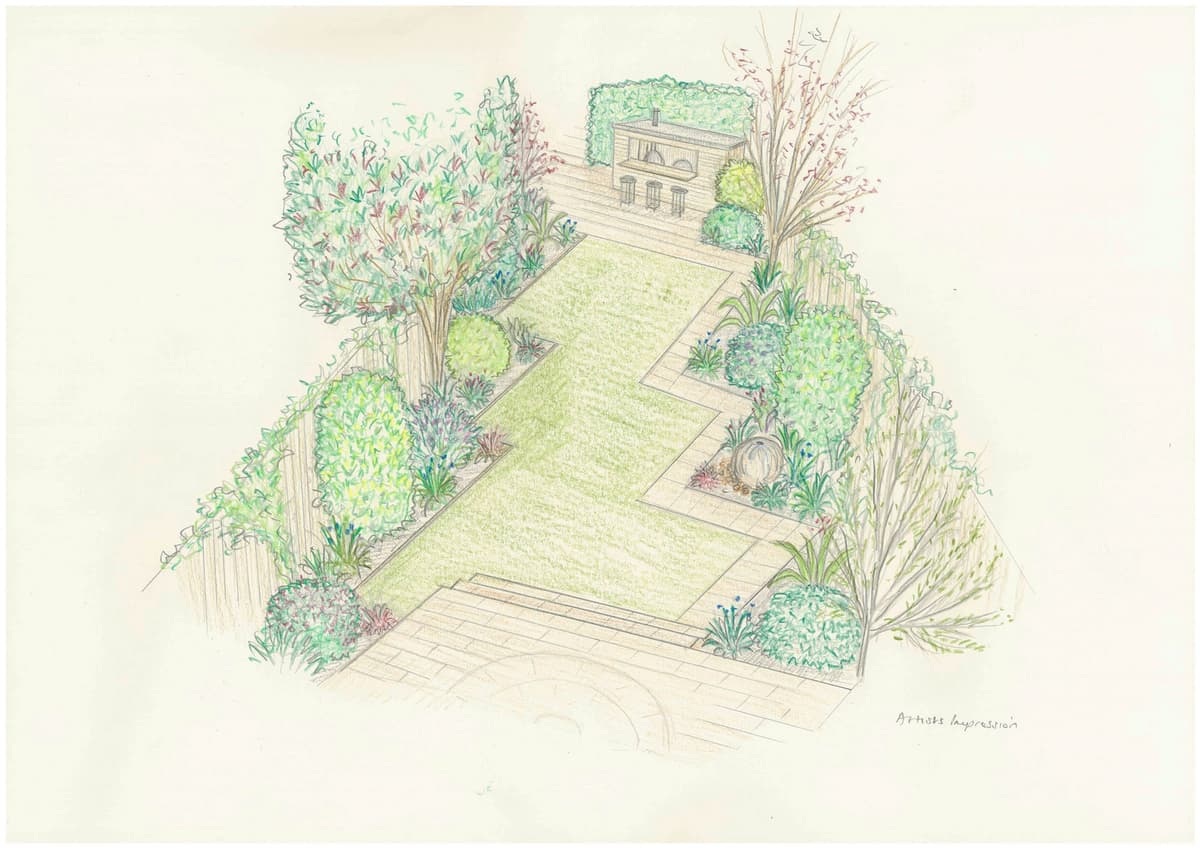
The Dry Shade Problem (And How to Solve It)
Dry shade is worse than deep shade. It is the toughest gardening condition in the UK.
You find it under mature trees (root competition sucks the soil dry), along the base of walls and fences (rain shadow), and in any shaded spot where the soil is sandy or chalky and drains fast.
Most shade plants are sold as 'shade-loving' but actually need moist shade. Stick a hosta under a beech tree and it will sulk. The leaves go crispy at the edges by July.
For dry shade, you need plants that tolerate both low light and drought. Short list:
- Epimedium (barrenwort) - delicate flowers in spring, heart-shaped evergreen or semi-evergreen leaves. Spreads slowly. Tough as boots once established.
- Cyclamen hederifolium - autumn-flowering, marbled leaves through winter, dormant in summer. Plant corms 2cm deep in July. They self-seed under trees where nothing else will grow.
- Geranium phaeum (mourning widow) - dark purple flowers in May, tolerates root competition. Variety 'Samobor' has maroon-blotched leaves.
- Vinca minor (lesser periwinkle) - evergreen ground cover, blue flowers April-May. Do not plant the major species, it is thuggish.
- Iris foetidissima - evergreen strap leaves, orange seed pods in winter that last for months. Thrives in dry shade under trees.
You will not get lush growth in dry shade. The goal is coverage and year-round presence, not abundance.
Before planting, dig in as much garden compost or well-rotted manure as you can. It holds moisture and gives new plants a chance to establish before tree roots dominate. Mulch every spring with composted bark or leafmould (free if you collect autumn leaves and let them rot for a year in a wire cage).
Design Principles for Shade Gardens
Shade gardens succeed on foliage, structure, and layering. Flowers are a bonus.
Foliage First
In sun, you can get away with flower-led planting. Roses, salvias, daylilies, whatever peaks in June and July. Shade will not let you do that. Most shade-tolerant plants flower for 4 to 6 weeks. The rest of the year, you are looking at leaves.
That makes foliage the primary design material. Leaf shape, texture, and colour carry the scheme.
Combine:
- Bold architectural leaves - fatsia (glossy, lobed, 40cm across), hostas (ribbed, rounded or heart-shaped), bergenia (leathery, evergreen paddles)
- Fine feathery texture - ferns (soft shield fern, lady fern), astilbes (dissected leaves before the plumes)
- Variegation and colour - brunnera 'Jack Frost' (silver-veined), aucuba 'Crotonifolia' (gold-spotted), heuchera (burgundy, lime, silver)
The contrast between bold and fine, plain and patterned, creates interest without needing flowers.
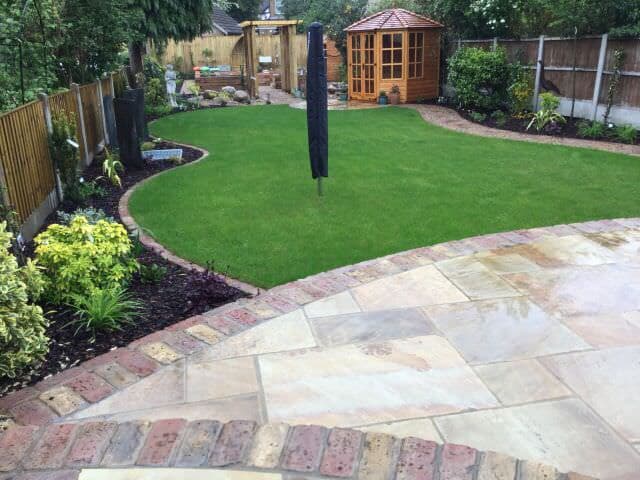
Layering Height
Shade gardens feel flat when everything sits at the same level. You need vertical structure.
Three layers work:
- Canopy or backdrop - existing trees, tall shrubs (fatsia, hydrangea petiolaris on a wall, large ferns like Dicksonia). This is 1.5m to 3m+ high.
- Mid-layer perennials and medium shrubs - 40cm to 90cm. Hostas, astilbes, hydrangeas, Japanese anemones, taller ferns.
- Ground cover - 10cm to 30cm. Epimedium, hardy geraniums, small ferns, ajuga, lamium, heuchera.
A layered planting reads as full and intentional, even when it is newly planted and not yet mature.
Repetition and Rhythm
Use the same plant in multiples. Repetition creates rhythm and stops a shade border looking like a jumble sale.
Example: if you are planting hostas, use three or five of the same variety in a drift, not one each of twelve different types. Repeat that drift elsewhere in the border. Same with ferns, astilbes, brunnera.
Repetition makes a scheme feel designed, not collected.
Light Surfaces and Reflectivity
Dark corners benefit from light-coloured hard landscaping and pale mulches.
Pale York stone or buff sandstone paving reflects more light back into the planting than dark grey slate or black limestone. Gravel in light colours (cotswold buff, Yorkshire cream) does the same.
White painted walls or pale render opposite a shaded border bounce diffused light into the space. It is subtle but measurable.
Avoid dark mulches in shade. Black dyed bark or dark composted bark absorbs light. Use natural bark chips in mid-brown tones, or better still, leafmould which is pale grey-brown when fresh.
Plant Selection for Different Shade Conditions
For Dappled Shade (Easiest Condition)
- Hydrangea macrophylla - mophead and lacecap types. Flowers July to September. Blue in acid soil (pH under 5.5), pink in alkaline. Plant 1.2m apart. Mature size 1.5m x 1.5m. Prune in late March, cut back to first strong buds. Cost: £15 to £25 per plant in a 5L pot.
- Astilbe varieties - feathery plumes in pink, red, white, purple. June to August. Need moist soil. Try 'Fanal' (deep red, 60cm), 'Bridal Veil' (white, 80cm). Plant 30cm apart. Cost: £8 to £12 per plant.
- Japanese Anemones (Anemone x hybrida) - pink or white flowers August to October. Fills the late summer gap. Variety 'Honorine Jobert' (white, single, 90cm) is outstanding. Plant 45cm apart. Spreads slowly by runners once established. Cost: £8 to £12 per plant.
- Brunnera macrophylla - blue forget-me-not flowers April to May, then large heart-shaped leaves through summer. Variety 'Jack Frost' has silver-veined foliage. Tolerates dry shade once established. Plant 40cm apart. Cost: £9 to £14 per plant.
- Hostas (all types) - 'Halcyon' (blue-grey, 40cm), 'Sum and Substance' (gold-green, 80cm, slug resistant), 'Frances Williams' (blue with gold edge, 60cm). Plant 45cm to 60cm apart depending on variety. Herbaceous, die back in winter. Cost: £8 to £18 per plant depending on size.
For Partial Shade (2 to 4 Hours Sun)
All the dappled shade plants above, plus:
- Hydrangea petiolaris (climbing hydrangea) - best shade climber for UK. Clings to walls and fences without support. White lacecap flowers June. Grows to 10m+ but slow for the first 2 to 3 years. Perfect for north-facing walls. Plant 2m from base of wall. Cost: £20 to £35 for a 5L pot.
- Polystichum setiferum (soft shield fern) - elegant evergreen fern with finely divided fronds, 60cm to 80cm. Tolerates dry shade once established. Plant 50cm apart. Cost: £8 to £12 per plant.
- Hellebores (Lenten rose, Helleborus x hybridus) - flowers February to April in white, pink, purple, near-black. Evergreen foliage. Self-seeds. Toxic to cats. Plant 40cm apart. Cost: £10 to £18 per plant for named varieties in flower.
- Tiarella (foamflower) - white or pink flower spikes April to June, maple-like leaves, semi-evergreen. Excellent ground cover. Plant 30cm apart. Cost: £7 to £10 per plant.
For Full Shade (Under 2 Hours Sun)
Plant choice narrows significantly. Focus on evergreens and structural foliage, not flowers.
- Dryopteris filix-mas (male fern) - native, semi-evergreen, 90cm. Grows anywhere. The first fern to try in any shade garden. Plant 60cm apart. Cost: £8 to £12 per plant.
- Asplenium scolopendrium (hart's tongue fern) - glossy, undivided strap-like fronds, evergreen, 45cm. Grows in wall crevices and deep shade. Plant 40cm apart. Cost: £8 to £12 per plant.
- Fatsia japonica - bold architectural evergreen shrub, 3m x 3m at maturity. Glossy lobed leaves 30cm to 40cm across. White flower clusters November. Tolerates pollution and coastal conditions. Plant 2m apart. Cost: £18 to £30 for a 5L pot.
- Aucuba japonica (spotted laurel) - virtually indestructible evergreen shrub. Variety 'Crotonifolia' has gold-spotted leaves that brighten dark corners. Grows 2m x 2m. Tolerates pollution, neglect, deep shade. Plant 1.5m apart. Cost: £12 to £20 for a 3L pot.
- Sarcococca confusa (sweet box) - evergreen shrub, 1.5m x 1.5m. Intensely fragrant white flowers January to February. Thrives in deep shade. Plant 1m apart. Cost: £12 to £18 for a 3L pot.
- Hedera helix (common ivy) - native climber and ground cover. Self-clinging. Evergreen. Grows in the deepest shade. Varieties 'Glacier' (variegated) and 'Buttercup' (yellow-green) lighten dark spots. Free if you take cuttings from existing plants. Otherwise £5 to £8 per plant.
Layout and Structure
A shade garden needs hard structure to hold the design together when perennials are dormant.
Paths and Paving
Paths define the layout and give you access to maintain the planting. In shade, surfaces stay damp longer. Avoid smooth stone that goes slippery. Buff or cream sandstone with a riven (textured) finish works well. So does pale gravel, but you will need edging to stop it migrating into beds.
Cost for sandstone paving: £45 to £65 per sqm supply and fit, more in London.
For informal paths through a shaded border, bark chip paths (10cm deep, edged with treated timber) cost £15 to £25 per sqm including excavation and edging.
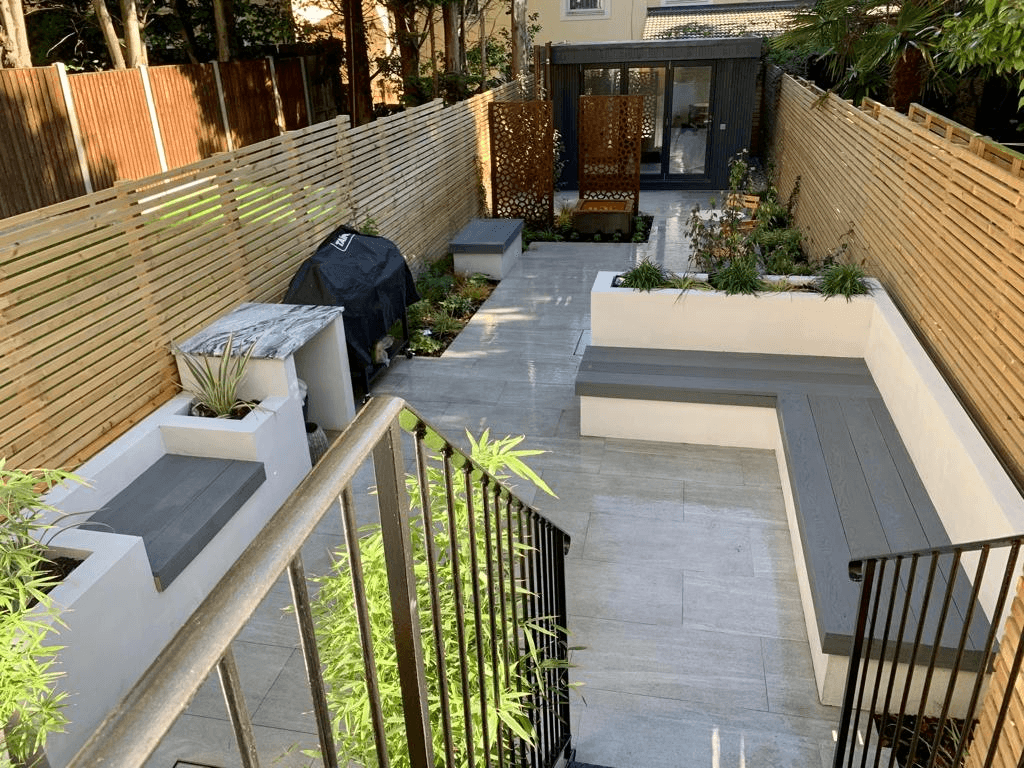
Evergreen Anchors
In a sunny border, structure often comes from roses, grasses, or herbaceous clumps. In shade, most perennials disappear in winter. You need evergreen shrubs as anchors.
Position them first. Fatsia, aucuba, sarcococca, box balls (if you are in an area without box blight), or clipped yew. These sit at key points in the design: corners, path junctions, either side of a focal point.
Then fill around them with perennials and ferns.
Focal Points
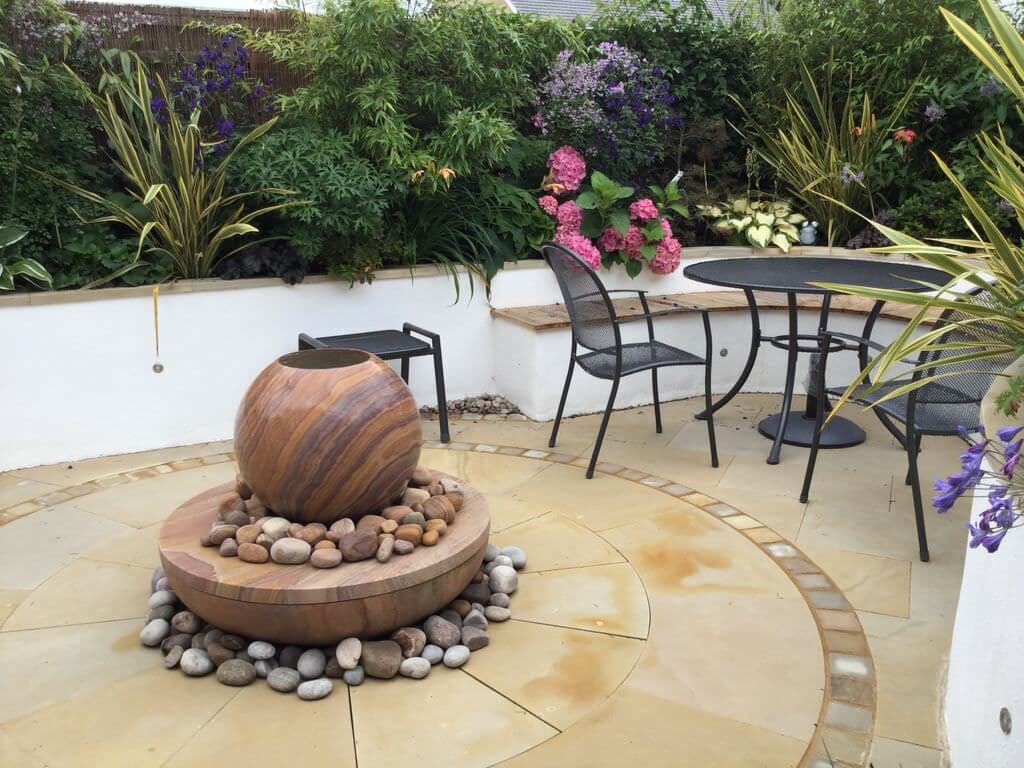
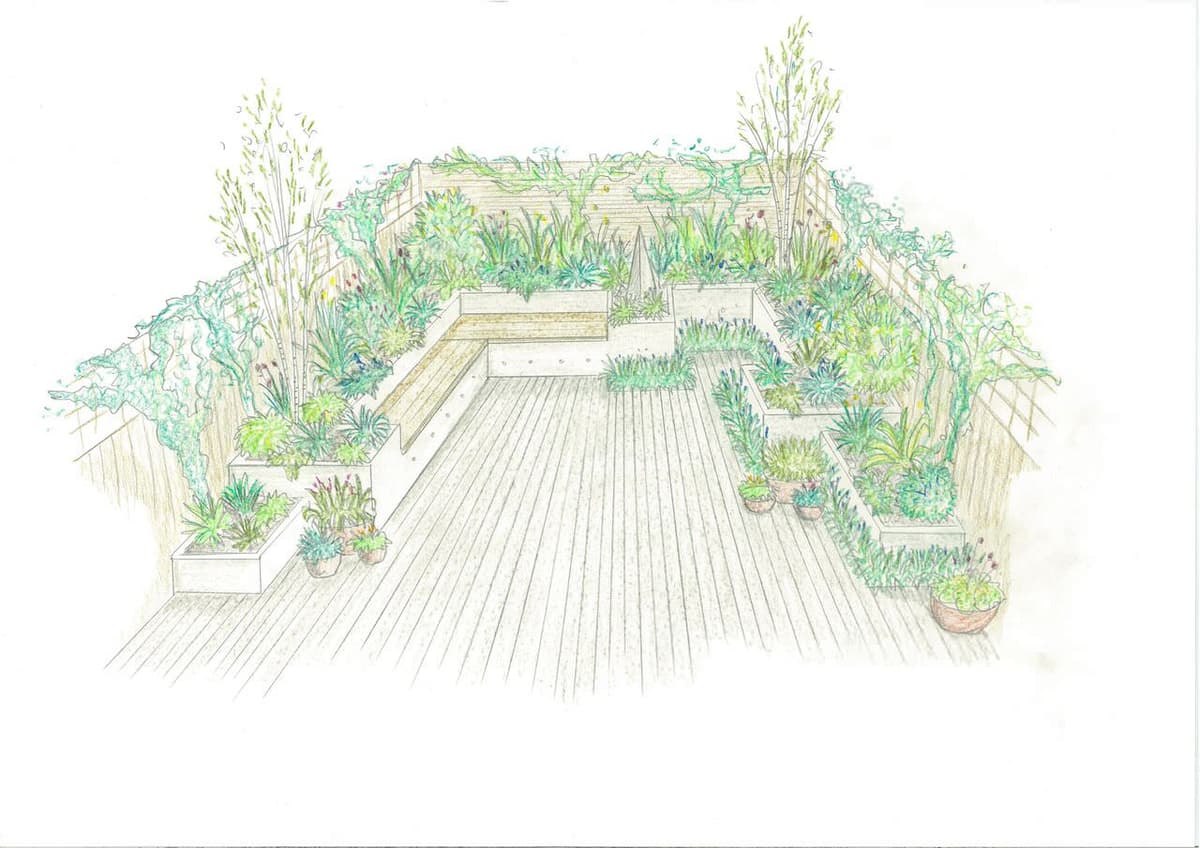
A shade garden benefits from a single strong focal point. A seat. A piece of sculpture. A large pot planted with ferns. Something that draws the eye and gives the space a destination.
In a north-facing courtyard, this might be a pale stone bench against a dark painted wall. In a woodland garden, it could be a simple stone sphere on a plinth, surrounded by low ferns and epimedium.
The focal point does not need to be elaborate. It needs to be clear.
Costs and Timescales
For a typical London or SE England shade garden (15 to 20 sqm planted border):
- Plants: 40 to 60 perennials, ferns and shrubs at £8 to £18 each = £400 to £800
- Soil improvement: 2 to 3 bulk bags of soil conditioner or composted manure at £50 to £80 per bag delivered = £100 to £240
- Mulch: composted bark or wood chip, 50L bags at £6 each, need 8 to 12 bags for initial coverage = £50 to £75
- Hard landscaping (if needed): sandstone path or paving = £500 to £1,200 depending on area
Total: £1,000 to £2,300 for materials if you plant it yourself.
Add design and installation by a garden designer: £1,500 to £3,500 for a scheme of that size, depending on complexity and access.
Timescale: A shade border planted in autumn (October to November) establishes faster than one planted in spring. Roots grow through winter while the top growth is dormant. By the following summer, plants look a year ahead of spring-planted equivalents.
Expect a shade garden to look 70% full after one growing season, fully mature after three years.
SE England Specific Considerations
London Clay
Heavy clay is common across much of London, parts of Kent, and Surrey. It holds moisture well, which helps in shade, but it is dense and slow-draining in winter.
Improve it before planting. Dig in grit (horticultural sharp sand, not building sand) and organic matter. Aim for a 50:50 mix of existing clay and added material in the top 30cm.
Plants that cope well with clay in shade: astilbes, hostas (love moisture), Japanese anemones, hydrangeas, ferns (most types).
Avoid: alpines, Mediterranean plants, anything listed as needing 'free-draining soil'.
Shallow Chalk Soils
Parts of Surrey, the North Downs, and east Kent sit on chalk. Soil is often thin, alkaline (pH 7.5 to 8.5), and free-draining.
Shade over chalk is often dry shade. Root competition from trees and shrubs makes it worse.
Best plants for shade on chalk: epimedium, hardy geraniums (G. phaeum, G. macrorrhizum), cyclamen, hellebores, brunnera, box, yew, native ivy.
Add organic matter annually. Mulch in early spring with garden compost or composted bark. It does not change the pH but improves moisture retention.
Rainfall and Watering
SE England averages 600 to 750mm of rain per year, most of it in winter. Summers can be dry.
Newly planted shade gardens need watering through their first summer, even in shade. Tree roots, wall rain shadows, and free-draining soils all reduce available moisture.
Water deeply once or twice a week rather than lightly every day. Aim for 15 to 20 litres per sqm per session. Soaker hoses on a timer work well.
After two growing seasons, most shade-tolerant perennials and shrubs are established enough to cope with dry spells, as long as the soil was improved at planting.
Common Mistakes
Planting sun-lovers in shade and hoping. Lavender, roses, salvias, most grasses. They do not 'adapt'. They struggle, flower poorly, and look miserable. Accept the shade and plant accordingly.
Using only hostas. Hostas are excellent, but a border of nothing but hostas looks one-note. Mix in ferns for vertical texture, astilbes for flower interest, and evergreen shrubs for winter structure.
Ignoring soil prep. Shade does not forgive poor soil. In sun, plants grow fast enough to compensate. In shade, they just sit there. Improve the soil before you plant, not after.
Planting too close to tree trunks. Keep at least 60cm clear of the trunk. Root flare and surface roots make it impossible to dig properly, and new plants cannot compete for moisture.
Forgetting about winter. A shade garden in summer can look fantastic with hostas, astilbes, and ferns. In winter it can look like bare earth if you did not include evergreens. Plan for twelve months, not six.
Overplanting. Shade-tolerant plants grow slowly for the first year. It is tempting to pack them in to get instant coverage. Do not. They will be overcrowded in three years and you will spend time thinning. Follow the spacing guidelines above.
Maintenance
Shade gardens are lower maintenance than sunny borders once established.
Twice a year:
- Early spring (March): Cut back dead perennial stems and foliage. Mulch with composted bark or garden compost (5cm depth). Prune hydrangeas (cut old flower heads and weak stems). Divide overcrowded hostas and astilbes if needed (every 3 to 5 years).
- Late autumn (October to November): Cut back dead stems on Japanese anemones, brunnera, hardy geraniums. Leave fern fronds standing until March, they protect the crown from frost.
Occasional tasks:
- Weed by hand. Mulch suppresses most weeds, but you will get self-seeded sycamore, ash, and brambles. Pull them while small.
- Deadhead hellebores in May after seed has set (or earlier if you do not want seedlings).
- Remove spent flower stems on hostas and astilbes unless you like the seed heads for winter structure.
Shade gardens need less watering, less deadheading, and less staking than sunny borders. Most shade perennials have strong stems that do not flop.
Final Thoughts
Shade is not a gardening problem. It is a set of design constraints that push you toward foliage, texture, and structure. The result, if you lean into it, is a garden that looks intentional, layered, and restful. Not shouty. Not seasonally peaky. Present all year.
Most of the best urban gardens in London, Kent, and Surrey are at least half in shade. They succeed because they were designed for shade from the start, not planted as if the sun might show up eventually.
If your garden is shaded, accept it. Then work with it. The plants in this guide thrive in SE England shade. The design principles apply to any shaded plot from 10 sqm to 100 sqm. You do not need to compromise. You need a plan.
Start with the shade type. Improve the soil. Choose plants that want to be there. Layer them by height. Add evergreen structure. Give it two growing seasons.
You will have a shade garden that works.
For professional planting design services in London and the South East, or to discuss a garden design project for your shaded plot, get in touch. We have created dozens of shade gardens across Kent, Surrey and London that thrive year-round. If your garden includes elements like water features, explore our guide to sustainable garden design. For small urban plots where shade is common, see our small London garden design guide. Shade-loving plants also play a key role in wildlife gardens and Japanese garden design.