
If you've ever watched someone you love struggle with steps in their own garden, or noticed that your knees don't bend the way they used to, you'll understand why accessible garden design matters. It isn't about compromise. It's about making outdoor space work properly for the people who actually use it.
We design gardens across Kent, Surrey, Essex and London, and a growing number of our clients come to us because their garden has become difficult to use. Sometimes it's a wheelchair. Sometimes it's a hip replacement. Sometimes it's a parent with dementia who needs a safe, stimulating outdoor space. Whatever the reason, the brief is always the same: make it beautiful and make it work.
This guide covers everything we've learned about designing accessible gardens in South East England, from path widths and raised bed dimensions to plant choices that engage every sense without demanding hours of maintenance.
What Makes a Garden Accessible?
An accessible garden is one that can be used comfortably by people with a range of physical and cognitive abilities. That sounds broad because it is. The RHS and Thrive (the UK's leading gardening-for-health charity) both define accessible garden design around the same core principles: safe movement through the space, activities at reachable heights, sensory engagement, and reduced maintenance burden.
What it doesn't mean is clinical. The best accessible gardens we've designed have been among the most beautiful. When you remove the obstacles, what's left is a garden that flows naturally, feels generous, and invites people to spend time outdoors. That's good design for anyone.

Paths, Surfaces and Getting Around the Garden
This is where accessible design starts. If you can't move through the garden safely, nothing else matters.
Path Width
For wheelchair access, paths need to be at least 1.2 metres wide. If two people need to pass each other (a wheelchair user and a companion, for example), you're looking at 1.5 metres. Turning circles need a minimum of 1.5 metres diameter, ideally 2.4 metres if someone is using a powered chair.
For ambulant users with walking aids, 900mm is the practical minimum, but we always recommend going wider. Paths feel more generous, and you're future-proofing the garden for changing needs.
Surface Materials
This is where a lot of gardens go wrong. Loose gravel is one of the worst surfaces for anyone with mobility issues. Wheelchair wheels sink, walking sticks slip, and it's exhausting to push through. We've lost count of the number of gardens we've redesigned where the first job was ripping out decorative gravel.
The best surfaces for accessible gardens:
- Resin-bound gravel gives you the look of gravel with a smooth, permeable, joint-free surface. Typically £60-£90 per square metre installed in the South East.
- Large-format porcelain paving (600x900mm or larger) with joints no wider than 5mm. Expect to pay £80-£130 per square metre including installation.
- Smooth natural stone such as sawn sandstone or limestone. Budget £90-£150 per square metre laid.
- Brushed concrete is the most cost-effective option at £40-£70 per square metre, and when done well it looks clean and contemporary.
Whichever material you choose, joints should be flush and narrow. Recessed pointing or wide gaps between slabs catch wheels and stick tips. We specify a maximum 5mm joint width on all our accessible projects.
Gradients and Level Changes
For unaided wheelchair access, gradients should be no steeper than 1:20 (a 5% slope). With assistance, you can go to 1:12, but anything steeper than that needs a ramp with handrails. If your garden has significant level changes, our guide to designing sloping gardens covers terracing and retaining wall options in detail.
Where steps are unavoidable, pair them with a ramped alternative. Handrails should start 300mm before the first step and extend 300mm beyond the last one. Contrasting nosings on each step help people with visual impairments judge the edge.

Raised Beds: The Heart of Accessible Planting
Raised beds solve the biggest single barrier to gardening with reduced mobility: getting down to ground level and back up again. But the dimensions matter enormously.
Dimensions That Actually Work
| Measurement | Seated/wheelchair user | Standing with limited mobility |
|---|---|---|
| Bed height | 60-75cm (65cm ideal) | 45-60cm |
| Maximum reach depth (one side) | 50cm | 60-70cm |
| Maximum reach depth (both sides) | 100cm total width | 120cm total width |
| Undercut for wheelchair footrests | 10-15cm deep, 20cm high | Not required |
| Path alongside | 1.2m minimum | 900mm minimum |
The undercut at the base is the detail most people miss. Without it, a wheelchair user has to reach forward from 30-40cm back, which cuts their useful planting depth dramatically. A 10-15cm recess at the bottom of the bed lets the footrests tuck under, bringing the gardener close enough to work comfortably.
Materials and Costs
Sleeper-built raised beds are the most common option and cost roughly £150-£300 per linear metre in the South East, depending on timber quality. Brick or rendered block beds look more permanent and typically run £200-£400 per linear metre. Corten steel is beautiful and extremely durable, but expect £400-£700 per linear metre for bespoke fabrication.

For a sense of total project costs, our garden design budget guide breaks down what to expect at different price points.
Planting for Accessible Gardens
The planting design in an accessible garden has to do more than look good. It needs to engage the senses, require manageable maintenance, and perform across all four seasons so the garden rewards attention year-round, even from a window.
Sensory Planting at Reachable Heights
One of the most common mistakes in accessible garden planting is putting fragrant plants at ground level. If someone is in a wheelchair or can't bend easily, those scents are wasted. We plant fragrance at elbow and nose height: raised beds, table-height containers, and climbers on supports.
Plants we use regularly for scent in accessible gardens:
- Sarcococca confusa (sweet box). Evergreen, shade-tolerant, intensely fragrant in winter. Perfect near a back door or along a frequently used path. Around £12-£18 for a 2-litre pot.
- Lavandula angustifolia 'Hidcote'. The classic English lavender. Plant at raised bed height for both scent and texture. £6-£10 per plant.
- Trachelospermum jasminoides (star jasmine). Evergreen climber with jasmine-scented flowers June to August. Needs a south or west-facing wall. £15-£25 for a good-sized plant.
- Hamamelis mollis (witch hazel). Spidery yellow flowers with a beautiful spicy scent from December to February. Slow-growing, so buy the biggest you can afford. £35-£60.
- Rosa 'Gertrude Jekyll'. One of the most fragrant David Austin roses. Deep pink, repeat-flowering. £22-£28 bare root.
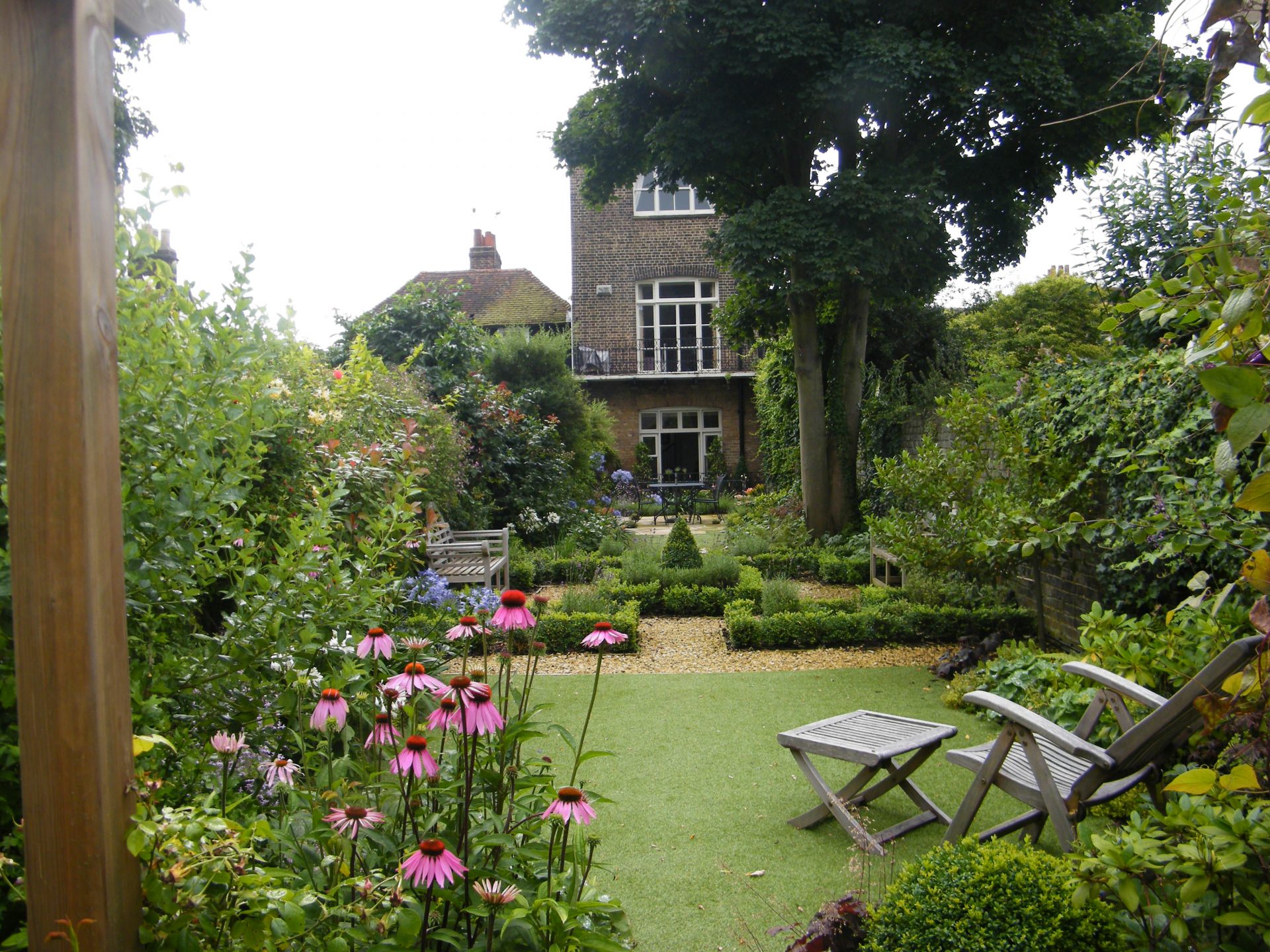
Tactile Plants Along Path Edges
Texture is enormously important for people with visual impairments, but honestly, everyone enjoys running their hand along a plant. We use these along path edges at hand height:
- Stachys byzantina (lamb's ear). Soft, silvery leaves that children and adults both reach for instinctively. £5-£8.
- Pennisetum alopecuroides 'Hameln'. Feathery grass heads from late summer. Plant where they catch backlight. £7-£12.
- Hakonechloa macra. Cascading Japanese forest grass. Beautiful in a raised bed where it can spill over the edge. £8-£14.
Low-Maintenance Choices
An accessible garden shouldn't create work that the gardener can't manage. We favour:
- Perennials and shrubs over bedding plants (no seasonal replanting)
- Groundcover plants like Geranium macrorrhizum to suppress weeds
- Evergreen structure from plants like Fatsia japonica, Viburnum tinus and Pittosporum tobira 'Nanum'
- Climbers on walls instead of hedges (less clipping, more vertical interest)
- Mulching with bark or composted material to reduce weeding
If you're interested in gardens that look after themselves as much as possible, our sustainable garden design guide covers permeable surfaces, native planting and water-wise approaches that overlap heavily with accessible design thinking.
Designing for Specific Needs
Wheelchair Users
Beyond paths and raised beds, think about where a wheelchair user will actually spend time. Seating areas need a 1.5m x 1.5m clear space alongside any bench or table so someone in a chair can sit with companions rather than being parked at the end. Dining tables should have a clear underside height of at least 700mm.
Consider the view from seated height. Planting that looks wonderful at 1.7m may be a wall of foliage at 1.1m. We use contoured planting, gently mounding beds so that they wrap around a seated person rather than towering above them.
Visual Impairment
High-contrast colour choices make a significant difference. Dark fencing with light-coloured planting in front of it creates depth and definition. Yellow and white flowers are the most visible to people with deteriorating sight. Rudbeckias, white hydrangeas, and variegated grasses all read well.
Wayfinding matters too. Different surface textures can signal transitions (smooth path to textured patio, for example). Sound features like a water blade or wind chimes act as orientation markers. Our garden lighting design guide covers how to light paths and features for safety without creating glare, which is particularly important for cataracts and macular degeneration.
Dementia
The RHS recommends simple loop paths with no dead ends for dementia-friendly gardens. The idea is that someone can walk continuously without getting confused or needing to retrace their steps. Bright handrails in a contrasting colour to the path surface provide both physical support and visual orientation.
Planting familiar, recognisable species helps. Roses, lavender, honeysuckle, and apple trees connect with long-term memories in a way that exotic or unusual plants may not. Colour-coded zones (the blue area, the yellow bed) give people a framework for describing where they've been or where they want to go.

Reduced Mobility and Ageing in Place
Many of our clients in Kent and Surrey aren't designing for a specific condition right now. They're thinking ahead. They want a garden that will still work for them in ten or twenty years, whatever happens.
This is where the concept of future-proofing comes in. The decisions you make now about path widths, surface materials, bed heights and planting density will determine whether the garden adapts with you or becomes a barrier. We always recommend:
- Laying paths wide enough for a wheelchair even if you don't need one today
- Choosing surfaces that won't become slippery or uneven with settlement
- Keeping at least one route from the house to the garden completely step-free
- Installing outdoor power points for potential future lighting, irrigation or powered equipment
- Planting trees and large shrubs at distances that allow for mature spread without blocking paths
Seating, Shelter and Social Space
Rest is part of the design, not an afterthought. We place seating at regular intervals along paths, always with something to look at: a planting pocket, a view through the garden, a water feature. The RHS uses the term "prospect and refuge" for this, meaning each seat should offer a good forward view (prospect) with shelter behind (refuge).
Armrests at 68-72cm height make standing up from a bench significantly easier. Where budget allows, we include at least one covered seating area so the garden can be used in light rain or strong sun. A simple timber pergola with a polycarbonate or fabric canopy costs from £2,000-£5,000 installed, depending on size.
What Does Accessible Garden Design Cost?
An accessible garden typically costs more than a standard garden of the same size because of the hard landscaping requirements. Wider paths, more paving, raised beds and potentially ramps all add to the build budget. Here's what we see across our South East projects:
| Garden size | Design fee | Build cost (accessible spec) | Total |
|---|---|---|---|
| Small courtyard (15-30 sqm) | £1,500-£2,500 | £8,000-£15,000 | £9,500-£17,500 |
| Medium suburban (50-100 sqm) | £2,500-£4,500 | £18,000-£35,000 | £20,500-£39,500 |
| Large garden (150+ sqm) | £4,000-£7,000 | £35,000-£75,000+ | £39,000-£82,000+ |
These figures are for 2025/2026 pricing in Kent, Surrey and London. London projects typically carry a 20-30% premium on build costs due to access constraints and labour rates.
It's worth noting that some local authorities offer Disabled Facilities Grants (DFGs) for essential garden adaptations. The maximum grant in England is currently £30,000, and it covers work that is "necessary and appropriate" to meet the needs of a disabled person. Your occupational therapist can support the application. The grant covers hard landscaping like ramps, paths and handrails, though not planting or purely aesthetic improvements.
Accessible Garden Ideas for Different Spaces
Small Courtyard or Town Garden
In a compact space, every centimetre counts. We use L-shaped or U-shaped raised beds around the perimeter to maximise planting area while keeping the central space clear for movement. A single large-format paving material across the whole ground plane makes the space feel bigger and eliminates trip hazards between different surfaces.
Our courtyard and small garden design guide has more detail on making compact spaces work, including shade-tolerant plants and vertical planting ideas.
Suburban Family Garden
The challenge here is usually balancing accessibility with family use. We create distinct zones: a hard-surfaced area near the house for dining and wheelchair access, transitioning to more informal planting further out. Lawn areas (if wanted) get a mowing-strip edge so powered mowers can handle them without manual edging.
Larger Rural Garden
You don't need to make every square metre of a large garden fully accessible. Focus on the spaces that matter most: the route from the house to a seating area, the kitchen garden, the favourite view. Then treat the wilder areas as visual amenity rather than spaces that need to be reached on foot.

Working with a Garden Designer on Accessible Projects
If you're commissioning an accessible garden, the most important thing you can do is be specific about needs. "Accessible" means different things to different people. Tell your designer exactly what the limitations are, what equipment is used, what activities the garden needs to support, and whether needs are likely to change over time.
A good designer will ask about all of this. They'll also want to understand the medical or therapeutic context if relevant, particularly for dementia gardens where an occupational therapist's input can be invaluable.
We offer 3D visualisations on all our projects, which are particularly useful for accessible design because they let you experience the garden at different eye heights and check sightlines before anything is built. You can see exactly how a raised bed looks from a wheelchair, or whether a path feels wide enough, before a single slab is laid.
If you're thinking about making your garden more accessible, or you want to future-proof an outdoor space so it works for decades to come, we'd love to talk. We design and build gardens across Kent, Surrey, Essex and London. Get in touch for a free consultation and we'll come out, look at what you've got, and talk through what's possible.

Frequently Asked Questions
Do I need planning permission to make my garden accessible?
Generally no. Most accessibility adaptations, including ramps, raised beds, resurfacing and handrails, fall under permitted development. You only need planning permission if the garden is in a conservation area and the works significantly alter the property's appearance, or if you're building a substantial structure like a covered therapy space. Our garden room planning permission guide covers the rules around garden structures in detail.
Can I get a grant for accessible garden design?
Disabled Facilities Grants from your local council can cover essential adaptations up to £30,000 in England. You'll need an occupational therapy assessment and the work must be deemed necessary and appropriate. Grants cover hard landscaping and access improvements but typically not planting or decorative elements.
What's the best surface for a wheelchair in a garden?
Resin-bound gravel or large-format paving with narrow joints (5mm or less). Both provide a smooth, joint-free or near-joint-free surface that's comfortable for manual and powered wheelchairs. Avoid loose gravel, cobbles, and any surface with wide or recessed joints.
How wide should a garden path be for wheelchair access?
Minimum 1.2 metres for single wheelchair access. 1.5 metres if a wheelchair user and a walking companion need to use the path side by side. Turning areas need at least 1.5 metres diameter.
What height should raised beds be for wheelchair users?
60-75cm, with 65cm being the sweet spot for most wheelchair users. Include a 10-15cm undercut at the base so footrests can tuck underneath. The bed should be no wider than 50cm from the access side, or 100cm total if accessible from both sides.