
If you have ever stood at the top of your garden and felt slightly defeated by the slope running away from you, you are not alone. Sloping gardens are one of the most common briefs we get at Soil Sisters. Across Kent, Surrey and the wider South East, the geology practically guarantees it. The North Downs chalk ridge, the Greensand Ridge running through Sevenoaks and Haslemere, the Weald clay valleys between them. These landscapes are beautiful to look at and genuinely tricky to garden on.
But here is the thing we tell every client who rings us about a slope: a flat garden gives you one level to work with. A sloping garden gives you three, four, five. The slope is not the problem. It is the opportunity.
This guide covers everything we have learned from designing and building on slopes across the South East. Terracing options, retaining wall materials, planting that holds banks together, drainage that actually works on clay, and the practical costs involved. Whether your garden drops half a metre or five metres from house to boundary, the principles are the same.
If your sloping garden design includes a garden room, office or studio on a terraced level, check the planning permission rules for garden rooms before you commit. Height limits and site coverage rules are especially relevant on sloping sites where the effective height of a structure differs depending on which side you measure from.
Why Sloping Gardens Need a Design, Not Just a Lawnmower

A flat garden can get away with minimal planning. Lay a patio, plant a border, put the shed at the bottom. A slope changes everything. Water runs downhill, obviously, and it takes your topsoil with it. Mowing a steep bank is unpleasant at best and dangerous in wet weather. Access becomes awkward. Sitting areas tilt. Planting washes out after heavy rain.
The South East gets around 700-800mm of rainfall per year on average. On clay soils, which cover much of Kent and Surrey, that water sits on the surface and moves sideways rather than draining down. A sloping garden on Weald clay without proper drainage can lose 2-3mm of topsoil annually. Over a decade, that is a significant chunk of your best growing medium sliding to the bottom of the garden and pooling against the back fence.
The answer is not to fight the slope. It is to work with it. And that starts with understanding what you have got.
Assessing Your Slope: The First Step Before Spending Anything
Before you call a landscaper or even sketch a plan, measure the gradient. This one step determines whether you need simple planting, light terracing, or engineered retaining walls.
The simplest method: place a two-metre spirit level horizontally at the top of the slope, one end resting on the ground. Measure the gap between the free end and the ground below. Divide the height by the length and you have your gradient.
Gradient Assessment Guide
Here is what different gradients mean in practical terms and what intervention each needs:
| Gradient | Drop per 2m | Description | What You Need |
|---|---|---|---|
| 1:20 or gentler | 100mm | Gentle slope | Planting alone may suffice |
| 1:10 | 200mm | Moderate slope | Ground cover plus drainage recommended |
| 1:6 | 333mm | Steep slope | Terracing needed |
| 1:4 | 500mm | Very steep | Engineered retaining walls required |
| 1:3 or steeper | 667mm+ | Severe slope | Structural engineer recommended |
Most of the gardens we design across the North Downs and Greensand Ridge fall somewhere between 1:10 and 1:5. Steep enough to need intervention, not so steep that you need to remortgage. The chalk-over-clay geology around Sevenoaks, Westerham and Oxted creates some particularly interesting gradients where the soil type can change dramatically over a short distance.

Terracing: Creating Usable Levels from a Single Slope
Terracing is the single most transformative thing you can do with a sloping garden. Instead of one unusable tilted plane, you create a series of flat platforms connected by steps or gentle ramps. Each terrace becomes its own garden room with its own purpose.
We typically design terraces at a minimum depth of 2.5 metres. Any shallower and the space feels cramped, more like a wide step than a usable area. For a dining terrace you want at least 3.5 metres to fit a table and chairs with room to move. For a lawn terrace, 4 metres minimum gives enough space for children to play or a sun lounger to sit without feeling perched on a ledge.
The number of terraces depends on the total height drop and the gradient. A garden that falls 3 metres over 15 metres of length might work beautifully as three terraces with 1-metre retaining walls between them. Or you might prefer four shallower terraces with 750mm walls, which feel less imposing and do not require structural engineering calculations.
How we approach terracing at Soil Sisters
Every sloping garden project starts with a site survey. We measure the gradient at multiple points because slopes are rarely uniform. We check the soil type. We note where water collects after rain. We look at where the sun falls at different times of day, because on a slope this changes dramatically between the top and bottom of the garden.
Then we design with function first. The terrace nearest the house is almost always the entertaining space, a patio or deck at a level that flows from the kitchen or living room. Below that, a planting terrace or lawn. At the bottom, perhaps a wilder area, a shed, or a wildlife-friendly planting scheme that benefits from the moisture that naturally collects at the base of slopes.
Retaining Wall Options: Materials, Costs and What Works in the South East

The retaining wall is the backbone of any terraced garden. Get the material and construction right and it will last decades. Get it wrong and you are looking at cracked walls, bulging faces, and waterlogged terraces within a few winters.
Retaining Wall Material Comparison
| Material | Cost per Linear Metre | Max Wall Height | Lifespan | Best For |
|---|---|---|---|---|
| Railway sleepers | £80-£120 | 600mm (900mm with reinforcement) | 15-20 years | Budget terracing, contemporary gardens, vegetable beds |
| Natural stone | £150-£300 | 1.2m (dry stone), 2m+ (mortared) | 50-100+ years | Cottage gardens, period properties, Kent ragstone areas |
| Gabion baskets | £150-£250 | 2m+ (engineered) | 50+ years | Modern gardens, steep slopes, clay soils, wildlife habitat |
| Rendered blockwork | £200-£350 | 2m+ | 30-50 years | Contemporary minimalist gardens, clean architectural lines |
| Planted banks (no wall) | £15-£30 (plants only) | Any gradient up to 1:6 | Permanent | Gentle slopes, naturalistic gardens, wildlife-friendly |
Railway sleepers are the most popular choice for domestic gardens and for good reason. New oak or softwood sleepers give a clean, contemporary look. Reclaimed sleepers have more character but can be unpredictable in quality. They suit gradients up to about 1:4 and last 15-20 years before the timber starts to deteriorate. Not suitable for walls over 1 metre without steel reinforcement.
Natural stone is our favourite for gardens in Kent and Surrey where the local Kentish ragstone or sandstone ties the garden into the wider landscape. More expensive, but the result is permanent and gets better with age as moss and lichens colonise the surface. Dry stone walls (no mortar) also provide incredible habitat for insects and small reptiles.
Gabion baskets, steel mesh cages filled with stone, are excellent for larger slopes. They are porous so they handle drainage naturally, they flex slightly with ground movement rather than cracking, and they last 50 years or more. They suit a more contemporary design and work brilliantly on steep sites where a solid wall would need much heavier foundations.
Rendered blockwork gives you the cleanest, most architectural look. A concrete block core is built and then rendered smooth and painted. This works well for modern, minimalist gardens but needs good drainage behind the wall and proper foundations.
Whatever material you choose, the wall needs proper drainage behind it. A 100mm layer of gravel against the back face of the wall with a perforated drainage pipe at the base is essential. Without it, water pressure builds up behind the wall over winter and eventually pushes it over. We have been called to fix too many retaining walls where the original builder skipped the drainage. For a deeper look at choosing between these materials, our guide to garden build materials covers the trade-offs in detail.
Drainage on Slopes: The Invisible Work That Makes Everything Else Possible
Drainage is the least glamorous part of any garden project and the most important on a slope. Get it wrong and everything above it fails. Retaining walls crack. Lawns turn to mud. Planting drowns. Patios flood.
On clay soils, which are the norm across much of Kent and the Surrey Weald, water moves across the surface rather than percolating downward. On a slope, this means runoff. After a heavy downpour you can watch a sheet of water skating across the surface carrying soil and mulch with it.
What works
French drains are the workhorse solution. A trench dug across the slope at each terrace level, 400-450mm deep, filled with 20mm gravel around a perforated pipe. The pipe collects water and moves it to a soakaway or drain at the bottom of the garden. On a typical three-terrace garden, you might install three runs of French drain plus the drainage behind each retaining wall. Total cost for drainage alone on a medium-sized project runs 1,500-3,000 pounds.
Surface channels, also called aco drains or channel drains, work at the base of each retaining wall to catch water that runs down the wall face. These are particularly useful next to patios and seating areas where you do not want standing water.
Soakaways, large gravel-filled pits that water drains into and slowly disperses from, work well at the lowest point of the garden. On clay, they need to be larger than on sandy or chalky soil because the clay releases water slowly. A typical domestic soakaway on clay needs to be at least one cubic metre.

Planting on Slopes: What Works and What Slides Off
Plants are your best long-term defence against erosion on a slope. Their roots bind the soil together, their foliage breaks the impact of rainfall, and their canopy shades the soil surface and reduces moisture loss. But not every plant works on a slope. You need species that root deeply, spread readily, and tolerate the specific conditions, fast-draining at the top of the slope, potentially waterlogged at the bottom.
Ground Cover for Bank Stabilisation: Plant Comparison
For pure slope-holding on a bank you do not want to terrace, these are the plants we reach for again and again:
| Plant | Spread Rate | Root Depth | Sun/Shade | Evergreen | Key Features |
|---|---|---|---|---|---|
| Geranium macrorrhizum | 1m in 2 years | Deep | Sun to part shade | Semi-evergreen | Aromatic foliage, pink/white flowers, spreads by rhizomes |
| Cotoneaster horizontalis | 2m in 3 years | Deep | Full sun to part shade | Semi-evergreen | Herringbone pattern, red berries for birds, tolerates chalk |
| Vinca minor | 1.5m in 2 years | Moderate | Part shade to full shade | Evergreen | Blue/white flowers spring, dense mat, suppresses weeds |
| Pachysandra terminalis | 1m in 3 years | Moderate | Shade to dry shade | Evergreen | Glossy foliage, white spring flowers, thrives under trees |
| Hypericum calycinum | 2m in 2 years | Deep | Any | Semi-evergreen | Yellow flowers June-Sept, fast coloniser, very low maintenance |
| Juniperus horizontalis | 2m in 4 years | Deep | Full sun | Evergreen | Low-growing (30cm max height), drought-tolerant, aromatic |
Geranium macrorrhizum is close to bulletproof. Dense, aromatic foliage, pink or white flowers in early summer, semi-evergreen, spreads by rhizomes. It will colonise a bank within two growing seasons and hold it firm. Works in sun or partial shade and tolerates the dry, lean soil you often find on the upper part of a slope.
Cotoneaster horizontalis is the classic bank-cover shrub. It grows in a herringbone pattern that looks architectural even in winter, produces red berries that birds love, and roots deeply enough to anchor itself on steep gradients. It also tolerates the chalky soils found on the North Downs around Westerham and Sevenoaks.
Vinca minor (lesser periwinkle) spreads fast, flowers blue or white through spring, and forms a dense mat that suppresses weeds and holds soil. It does well in the shadier spots at the base of slopes or under tree canopy.
Pachysandra terminalis is another shade-tolerant spreader. Glossy evergreen foliage, neat white flower spikes in spring, and an ability to thrive in dry shade under trees. It takes longer to establish than geranium or vinca but once settled, it is there for good.
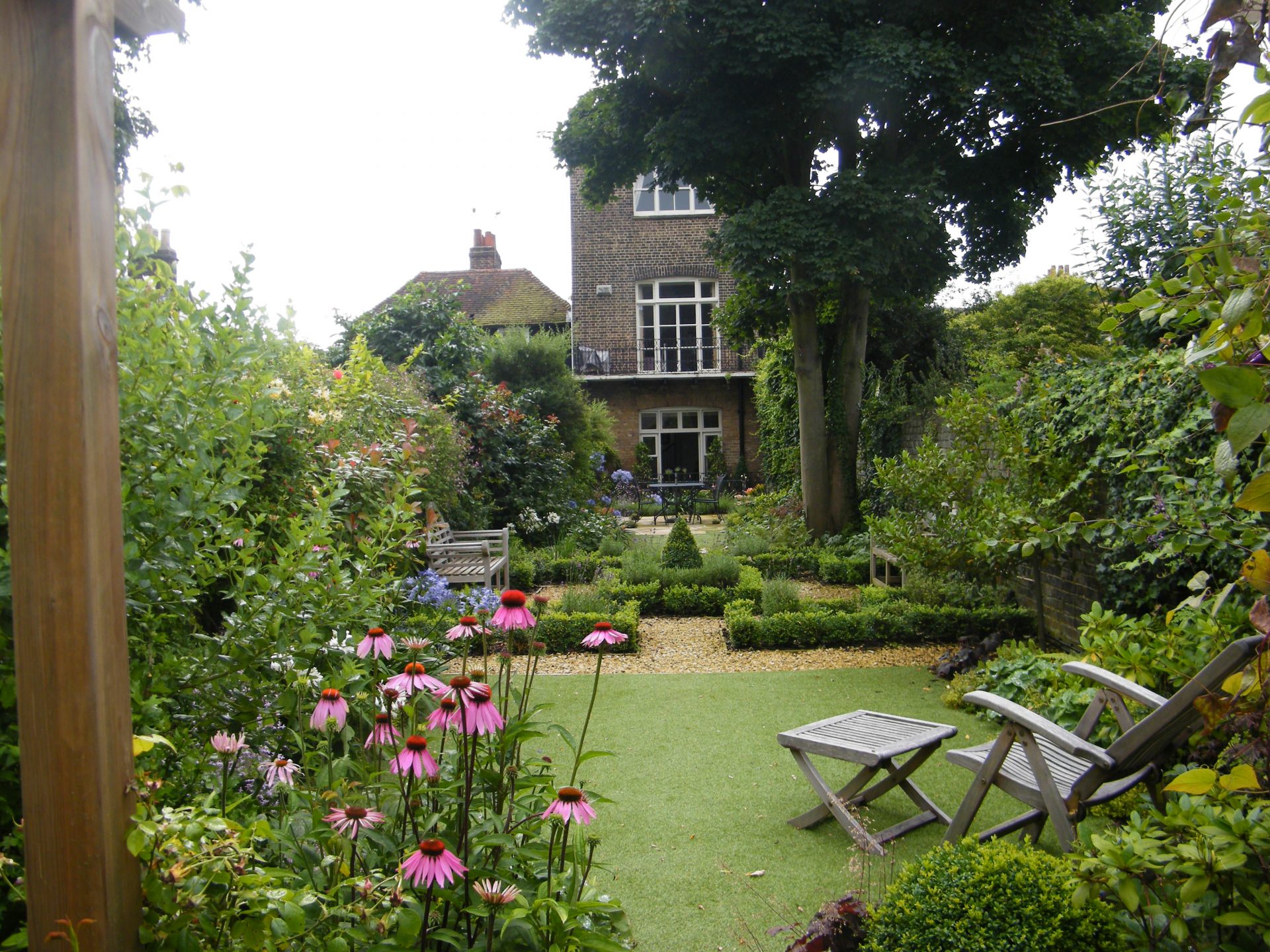
Structural planting for terraced slopes
Once you have terraced a slope, each level becomes a planting opportunity. We like to use the height changes to create drama. Tall grasses like Miscanthus sinensis 'Morning Light' at the back of a lower terrace catch the light from above. Structural evergreens like Pittosporum tenuifolium or clipped box give year-round framework. And flowing, soft planting, lavender, nepeta, salvias, spills over the edges of retaining walls to soften the hard lines.
On south-facing slopes, and there are plenty across the Surrey Hills and North Downs, you can push the planting towards Mediterranean garden design territory. The free drainage and sun exposure suit rosemary, cistus, santolina, and ornamental grasses beautifully. These plants actually perform better on a lean, well-drained slope than they do on the flat, which is worth remembering if you are trying to find the positive in a challenging site.
Steps and Paths: Connecting Your Terraces
Steps are the joints that hold a terraced garden together. Get the proportions right and moving between levels feels effortless. Get them wrong and you will notice every single time you walk down the garden.
The golden ratio for garden steps is a riser height of 130-160mm and a tread depth of 350-400mm. This is shallower and deeper than indoor stairs, which is deliberate. Garden steps should feel generous and relaxed. You are not climbing a staircase. You are strolling between garden rooms.
Wider steps, 1.2 metres or more, also double as casual seating. We often design extra-wide steps between the main patio terrace and the garden below, creating an informal amphitheatre effect where people naturally sit during parties and barbecues. This is one of those details that costs very little extra but transforms how the garden gets used.
For gentler slopes where full terracing is not needed, a meandering path with a gentle gradient (no steeper than 1:12 for comfortable walking) can work beautifully. Gravel paths with timber or stone edging follow the contour of the slope rather than fighting it. Our guide to garden pathways and walkways covers material choices and design principles for paths in more detail.

DIY vs Professional: What Can You Realistically Do Yourself?
Many homeowners look at terracing costs and wonder if they can do some or all of the work themselves. The honest answer is that it depends on the scale, your skill level, and how much time you can commit.
For gentle slopes under 1:10, a motivated DIYer with basic landscaping experience can handle most of the work. Planting ground cover, laying a simple gravel path, installing a small sleeper retaining wall up to 600mm high, these are all within reach if you are prepared to read up, rent the right tools, and take your time.
For steeper slopes requiring walls over 1 metre, multiple terraces, or significant drainage work, get a professional landscaper involved. The cost of getting retaining walls wrong, either because they fail structurally or because drainage was inadequate, far exceeds the cost of hiring someone who has done it before. A collapsed retaining wall is not just expensive to fix. It can damage neighbouring property, cause flooding, and in extreme cases poses a safety risk.
If budget is tight, consider a phased approach. Get a professional to design the full scheme and install the structural elements (retaining walls, drainage, steps). Then do the finishing work yourself (planting, mulching, lawn seeding). This gives you the best of both worlds: professional foundations with DIY savings on the less critical elements.
What Does Sloping Garden Design Cost?
This is the question everyone asks first, and the honest answer is: it depends on the gradient, the size, and what you want to achieve. But we can give you realistic ranges based on the projects we deliver across Kent and Surrey.
A light intervention on a gentle slope, ground-cover planting, a French drain, and some path edging, might cost 3,000-6,000 pounds for a typical suburban rear garden.
A mid-range terracing project with two or three levels, sleeper or stone retaining walls up to 600mm, new steps, drainage, and planting, typically runs 15,000-30,000 pounds. This is the most common brief we work on.
A full transformation of a steep slope with engineered retaining walls, multiple terraces, integrated lighting, water features, and comprehensive planting sits at 30,000-60,000 pounds or more depending on access and site conditions.
Access is often the hidden cost. If materials have to be carried through the house or craned over a wall because there is no side access, that adds 10-20% to the build cost. Worth checking before you fall in love with a design.
For a broader picture of how garden design costs break down, including our own fee structure, take a look at our garden design budget guide. If you are planning a full garden renovation, hard landscaping project, or patio design in London, the costs may be higher due to access constraints and material transport.
Planning Permission: When Do You Need It?
Most domestic terracing and retaining walls fall under permitted development and do not need planning permission. But there are exceptions worth knowing about.
Retaining walls over one metre high adjacent to a highway or public footpath, or over two metres high anywhere on the property, may need Building Regulations approval. If your garden is in a Conservation Area, as many are across the Weald and the prettier parts of Kent and Surrey, there are additional restrictions on materials and visual impact. Listed building curtilage adds another layer.
If you are building retaining walls over 1.2 metres high, it is sensible to get a structural engineer involved regardless of the planning position. A wall that height is holding back a serious weight of wet soil, and the consequences of failure are expensive and dangerous.
Seasonal Maintenance and Long-Term Care
A well-designed sloping garden needs less maintenance than you might expect, but there are seasonal jobs worth staying on top of.
In autumn, clear fallen leaves from drainage channels and behind retaining walls. Leaves that pack down and decompose can block drainage pipes and cause waterlogging over winter. Check that French drain outlets are clear and that soakaways are not silted up.
During winter, inspect retaining walls after heavy rain for any signs of movement, bulging, or cracks. Small problems caught early are easy to fix. Left for a year or two, they become expensive structural repairs.
In spring, top up mulch on planted banks to suppress weeds and retain moisture during the growing season. Mulch also protects the soil surface from erosion during spring downpours. A 50-75mm layer of composted bark or wood chip does the job. If you are establishing new garden borders on a slope, mulching becomes especially important.
Through summer, keep on top of weeding on newly planted banks. Ground-cover plants take one to two seasons to fully establish. Until they do, weeds will try to colonise bare soil. Once your geranium, vinca or cotoneaster has filled in, the maintenance drops to almost nothing.
Frequently Asked Questions About Sloping Gardens
How do I measure the slope in my garden?
Use a two-metre spirit level placed horizontally at the top of the slope with one end on the ground. Measure the vertical gap between the free end and the ground below. Divide the height by the length (e.g. 200mm drop over 2000mm = 1:10 gradient). Gradients of 1:20 or gentler need minimal intervention. 1:10 to 1:6 benefit from ground cover and drainage. Steeper than 1:6 usually needs terracing.
What is the cheapest way to deal with a sloping garden?
Plant it. Dense ground-cover plants like Geranium macrorrhizum, Vinca minor or Cotoneaster horizontalis will stabilise a bank for 300-600 pounds in plants alone. Add a French drain (1,000-1,500 pounds) if water runoff is an issue. This approach works on gentle to moderate slopes (up to about 1:6) and costs a fraction of terracing. For steeper slopes, you will need retaining walls, and costs start from around 15,000 pounds for a typical mid-sized project.
Do I need planning permission to terrace my sloping garden?
Most domestic terracing falls under permitted development and does not need planning permission. Exceptions: retaining walls over one metre high next to a highway, over two metres high anywhere on the property, or any work in a Conservation Area or Listed Building curtilage. In these cases, contact your local planning authority before starting work. Even where planning is not required, retaining walls over 1.2 metres should be checked by a structural engineer.
How much does it cost to terrace a sloping garden?
A mid-range terracing project with two or three levels, sleeper or stone retaining walls up to 600mm, steps, drainage and planting typically costs 15,000-30,000 pounds for a suburban rear garden in the South East. Light interventions (ground cover, a French drain, path edging) run 3,000-6,000 pounds. Full transformations with engineered walls, multiple terraces, lighting and comprehensive planting sit at 30,000-60,000 pounds or more depending on access and site conditions.
What are the best plants to stop soil erosion on a slope?
Deep-rooted ground covers that spread quickly work best. Geranium macrorrhizum colonises a bank in two growing seasons and holds it firm. Cotoneaster horizontalis roots deeply and tolerates chalky soils. Vinca minor thrives in shade at the base of slopes. Pachysandra terminalis handles dry shade under trees. All four are evergreen or semi-evergreen, low maintenance once established, and available from most garden centres for 3-8 pounds per plant.
Can I have a lawn on a sloping garden?
Yes, but gradient matters. Slopes up to about 1:10 can be mown with a standard rotary mower, though it is hard work. Steeper than that and mowing becomes unpleasant and potentially dangerous, especially in wet conditions. The best approach for steep slopes is to create a flat lawn terrace with retaining walls above and below. A lawn terrace needs to be at least 4 metres deep to feel usable. Alternatively, plant the slope with low ground cover and save the lawn for flat areas.
How long do timber sleeper retaining walls last?
New oak or softwood sleepers last 15-20 years before the timber starts to deteriorate, longer if treated regularly. Reclaimed sleepers have more character but variable lifespan depending on their previous use and treatment history. The key to longevity is drainage. A 100mm gravel layer and perforated pipe behind the wall prevents water pressure building up, which is what causes most sleeper walls to fail. Sleeper walls are suitable for heights up to 600mm without reinforcement, and up to 1 metre with steel backstays.
What drainage do I need for a sloped garden on clay soil?
Clay sheds water sideways rather than absorbing it, so drainage is essential. Install French drains across the slope at each terrace level: 400-450mm deep trenches filled with 20mm gravel around a perforated pipe. Run pipes to a soakaway (minimum one cubic metre on clay) at the lowest point. Add surface channels at the base of retaining walls. Budget 1,500-3,000 pounds for drainage on a typical three-terrace garden. Skip this and you will have waterlogged terraces, failed retaining walls and lost topsoil within two winters.
What ideas work for sloping gardens in small spaces?
In small sloping gardens, focus on creating two distinct zones rather than cramming in multiple terraces. A raised deck or patio near the house for seating, then a lower planted area with a focal point like a water feature or sculpture. Use wide, shallow steps (150mm risers, 400mm treads) to make the levels feel connected. Vertical planting on retaining walls softens hard edges. Mirrors or reflective water features placed at the bottom create depth. Keep the colour palette simple and use evergreen structure plants to make the space feel bigger.
Can I do sloping garden terracing myself or do I need a professional?
For gentle slopes (1:10 or less) with low sleeper walls up to 600mm, a competent DIYer can manage the work if you rent the right tools and take your time. For steeper slopes requiring walls over 1 metre, multiple terraces, or significant drainage work, hire a professional landscaper. The cost of getting retaining walls wrong far exceeds the cost of hiring someone experienced. Consider a phased approach: professional design and structural work (walls, drainage, steps), then DIY the finishing elements (planting, mulching, lawn seeding).
How Soil Sisters Can Help With Your Sloping Garden
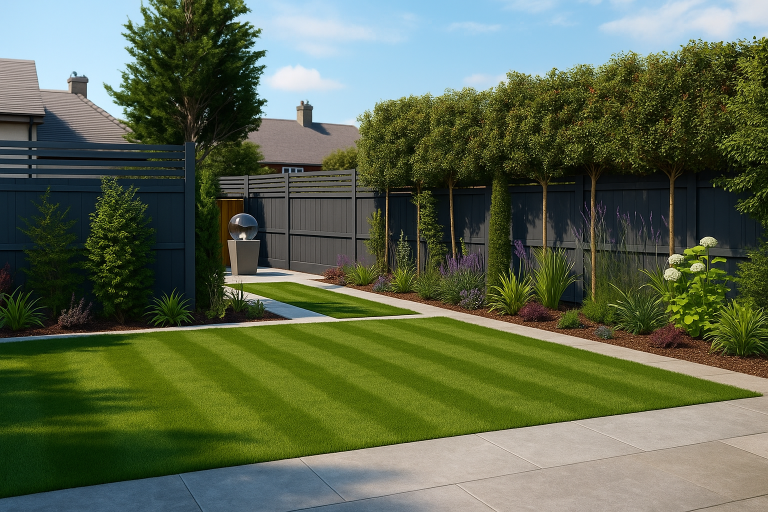
We have designed and delivered sloping garden projects right across our patch, from the steep chalk gardens of the North Downs to the clay slopes of the Weald. We know the soils, we know the drainage challenges, and we know which contractors do this kind of work properly.
Our process starts with a free consultation where we visit the site, take measurements, and talk through what you want from the space. From there, we produce a full design package including planting plans, 3D visuals, and build specifications. We work with trusted landscapers across Kent, Sevenoaks, Surrey, Essex and Buckinghamshire to make sure the build matches the design. Our landscaping service in London covers design and build for sloping sites across all London zones. For sloping gardens specifically in North London, Muswell Hill, Highgate and Crouch End are especially common, see our garden design North London page for borough-specific detail.
If you are staring at a slope and wondering where to start, get in touch. The consultation is free, and we would love to show you what is possible. Call us on 0203 834 9807.