
Contemporary garden design is defined by clean lines, geometric shapes, a restrained colour palette and an emphasis on form over ornamentation. Unlike traditional cottage gardens with their abundant planting and curved borders, contemporary gardens embrace minimalism, using fewer but more carefully selected plants to create a calm, uncluttered outdoor room.
The style emerged in the mid-20th century alongside modernist architecture and has evolved to suit urban living, small plots and busy homeowners who want a beautiful garden without the maintenance demands of traditional planting. Contemporary design works brilliantly for townhouse courtyard gardens, terraced back gardens, new-build plots and anywhere you want a seamless transition between indoor and outdoor spaces.
At its heart, contemporary garden design is about restraint, repetition and rhythm. Where a cottage garden might feature fifty different plant species, a contemporary garden might use five, repeated in bold blocks or linear drifts. The effect is calmer, more architectural and easier to maintain.
Core Design Principles for a Contemporary Garden
Clean Lines and Geometric Forms
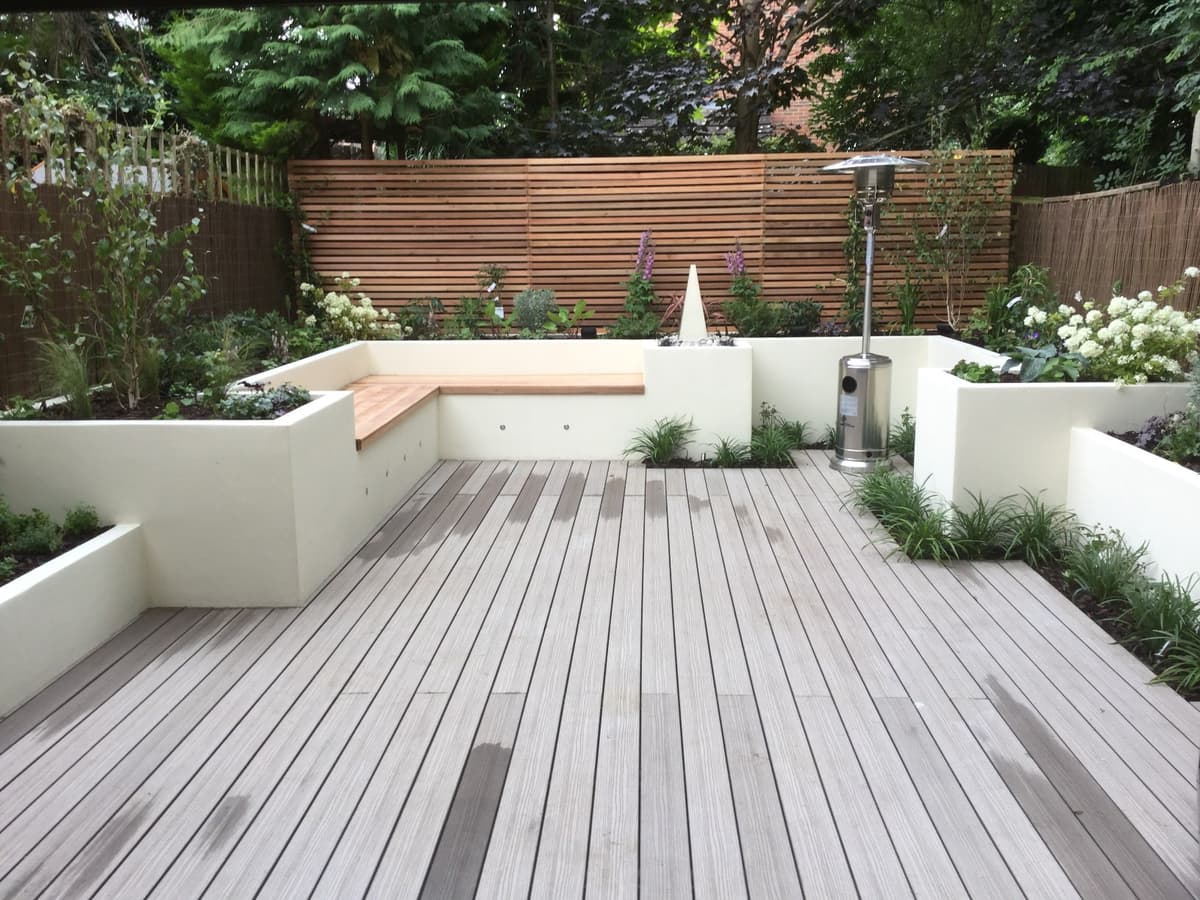
Contemporary gardens rely on strong structural elements. Rectangular patios, straight-edged raised beds, linear pathways and geometric water features create a framework that looks intentional year-round, even when plants are dormant.
Avoid curves unless they're part of a deliberate circular motif. The geometry should be crisp and confident. If you're working with an awkward shape, divide the space into zones using clean horizontal or vertical planes rather than trying to disguise it with planting.
Restrained Colour Palette
Contemporary planting leans towards greens, silvers, whites and muted tones rather than bright, multicoloured displays. When colour is used, it's often in bold, repeated blocks rather than scattered through a border.
A contemporary garden might pair white-flowering perennials with silver foliage and black-stemmed bamboo, or use a single dramatic colour like acid-yellow euphorbia against dark timber screening. The palette should feel cohesive and intentional.
Emphasis on Form and Texture
With fewer flowering plants, contemporary gardens rely heavily on foliage form, texture and structure. Architectural plants with strong silhouettes, grasses that catch the light, clipped topiary that provides year-round shape, and the interplay of hard materials (steel, stone, timber) with soft planting.
Think about how plants look from autumn through to spring, not just their summer peak. Evergreens, ornamental grasses and plants with interesting winter structure are essential.
Hard Landscaping as a Feature
In traditional gardens, hard landscaping (paths, patios, walls) serves a functional purpose. In contemporary design, it's a key aesthetic element. Corten steel planters, rendered walls, smooth concrete paving, timber slatted screens and water features are showcased, not hidden.
The ratio of hard to soft landscaping is often higher than in traditional gardens. A contemporary courtyard might be 60% paving and 40% planting, whereas a cottage garden flips that balance.
Repetition and Rhythm
Contemporary design uses repetition to create calm and coherence. The same plant species repeated in blocks, identical planters spaced evenly, a single material (like Yorkstone or porcelain) used throughout the paving.
Rhythm comes from alternating elements: paving, planting, paving, planting. The effect is ordered and intentional, never random or fussy.
Best Plants for a Contemporary UK Garden
Architectural Evergreens
Bamboo (Phyllostachys nigra, P. bambusoides 'Castillonii')
Black-stemmed P. nigra is the classic choice for contemporary gardens, reaching 3-4m with elegant, upright canes. Golden P. bambusoides 'Castillonii' offers a warmer tone. Both are clump-forming (not invasive) and provide year-round screening with movement and sound. Plant in groups of 3-5 for impact.
Phormium (Phormium tenax, P. cookianum)
New Zealand flax offers bold, sword-like foliage in shades from bronze to variegated cream and green. 'Platt's Black' (P. tenax) is near-black with a dramatic vertical form to 2m. 'Tricolor' (P. cookianum) has multicoloured leaves edged in red. Excellent in large containers or as focal points in gravel gardens. Frost-hardy to -10�C.
Fatsia japonica
Large, glossy, palmate leaves create a tropical effect in shaded courtyards. Reaches 1.5-2m tall and wide. White autumn flowers. Looks superb underplanted with black Ophiopogon planiscapus 'Nigrescens'. Evergreen, shade-tolerant, architectural.
Ornamental Grasses
Miscanthus sinensis 'Gracillimus', 'Flamingo', 'Morning Light'
Tall, feathery plumes in late summer that fade to buff through winter. 'Gracillimus' is narrow-leaved and upright to 1.8m. 'Flamingo' has pink-tinged flowers. 'Morning Light' has white-variegated foliage. Plant in bold groups of 5-7 for impact. Cut back in March. �8-�15 each.
Stipa tenuissima (Mexican feather grass)
Fine, hair-like foliage that moves in the slightest breeze. Grows to 60cm tall, perfect for edging contemporary patios or filling gaps in gravel gardens. Self-seeds moderately. Short-lived perennial (3-5 years). �6-�10 each.
Festuca glauca 'Blaufuchs'
Blue fescue forms tight tussocks of steel-blue foliage to 30cm. Plant en masse (25-30 per sqm) for a modern ground cover effect. Evergreen, drought-tolerant, low maintenance. �4-�7 each.
Clipped Topiary and Structural Shrubs
Box (Buxus sempervirens) and Yew (Taxus baccata)
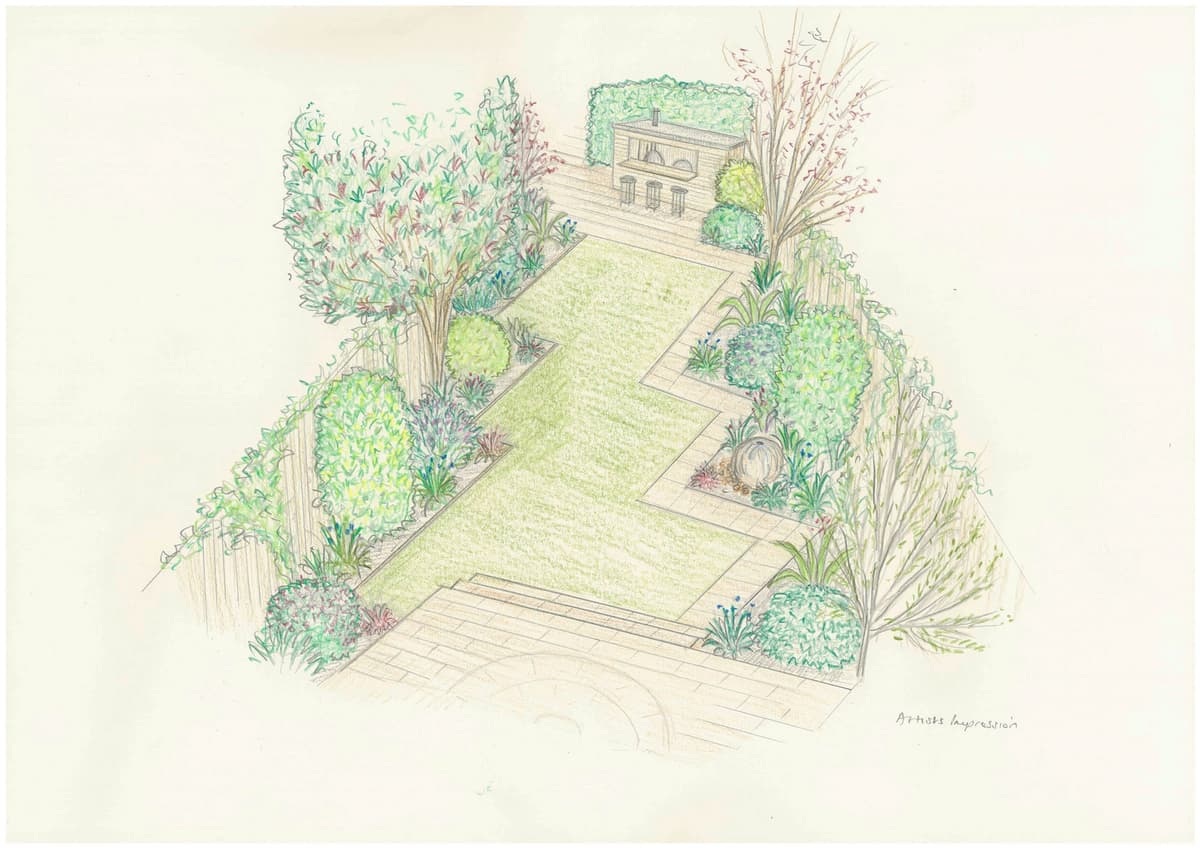
Clipped into spheres, cubes or low hedging, these evergreens provide year-round structure. Box is traditional but vulnerable to box blight and caterpillar. Yew is slower-growing but more resilient. For contemporary parterre-style planting, use yew clipped into different-sized domes (30cm, 45cm, 60cm) with repeated spacing.
Ilex crenata 'Dark Green'
A box alternative with small, dark green leaves. Clips well into geometric shapes. Fully hardy, disease-resistant, slower-growing than box. �12-�25 depending on size.
Perennials for Naturalistic Planting
Echinacea purpurea 'Ruby Giant', 'White Swan'
Prairie-style perennials with daisy-like flowers and prominent seed heads that look good into winter. Plant in groups of 5-7, repeated through a border. 60-90cm tall. Full sun, well-drained soil. �8-�12 each.
Euphorbia (E. characias subsp. wulfenii 'John Tomlinson', E. griffithii 'Dixter')
Acid-yellow flower bracts in spring provide a contemporary zing. 'John Tomlinson' forms rounded mounds to 1m with glaucous foliage. 'Dixter' spreads via rhizomes with pink-tinged leaves. Avoid milky sap. �10-�15 each.
Salvia nemorosa 'Caradonna', 'Amethyst'
Upright spikes of purple-blue flowers from June to September. Plant in linear drifts (20-30 per sqm) for a modern herbaceous border. Cut back after first flush for repeat flowering. �7-�10 each.
Trees for Contemporary Gardens
Betula utilis var. jacquemontii (Himalayan birch)
Brilliant white bark provides year-round interest. Multi-stem specimens (3-5 stems) work beautifully underplanted with black Ophiopogon or silver Stachys byzantina. Reaches 8-10m but can be pollarded. �80-�250 depending on size.
Acer palmatum 'Bloodgood', 'Sango-kaku'
Japanese maples offer elegance and structure. 'Bloodgood' has deep purple foliage; 'Sango-kaku' has coral-red winter stems. Slow-growing to 4-5m. Shelter from cold winds. �60-�200+.
Pleached trees (lime, hornbeam, plane)
Roof-trained trees on clear stems create living architecture, providing shade and privacy without blocking light at ground level. Planted in linear rows at 2-3m spacing. Expensive (�300-�800+ per tree depending on size) but dramatic.
Materials and Hard Landscaping
Paving
Porcelain tiles (20mm frost-rated)
Large-format tiles (900x600mm or 1200x600mm) in grey, charcoal or sandstone create a sleek, uninterrupted surface. Slip-rated for outdoor use. �45-�80 per sqm supplied, �80-�120 per sqm installed.
Concrete slabs (natural stone effect)
Concrete paving in pale grey or buff tones, often with a sawn or lightly textured finish. More affordable than porcelain. �30-�50 per sqm supplied, �60-�90 per sqm installed.
Resin-bound gravel
Smooth, permeable surface in shades from pale cream to dark charcoal. Good for driveways and large patios. �60-�100 per sqm installed.
Boundaries and Screening
Corten steel panels
Weathering steel develops a rust-coloured patina that stabilises after 6-12 months. Used for planters, raised beds, screens and water features. Expensive but dramatic. Panels from �150-�400 per sqm depending on thickness and finish.
Timber slatted screens
Western red cedar or Accoya (acetylated softwood) in horizontal or vertical slats with gaps for filtered views. Screens from �200-�500+ per linear metre depending on height and timber spec.
Rendered block walls
Painted in white, pale grey or charcoal. Provides a clean backdrop for planting. �120-�180 per sqm built and rendered.
Planting Containers
Large, geometric planters in fibreglass (lightweight, frost-proof, �80-�300 each), Corten steel (�200-�800+), or zinc/galvanised steel (�100-�400). Mono-planting (one species per container) is typical. Use multiples of the same planter for repetition.
Contemporary Garden Design Costs (2026, South East England)
Small courtyard (15-25 sqm)
- Design only: �1,500-�3,000
- Design + build: �12,000-�25,000
- Key costs: paving (�3,000-�6,000), raised beds (�1,500-�3,000), planting (�2,000-�4,000), containers (�800-�2,000), lighting (�1,200-�2,500)
Medium garden (40-70 sqm)
- Design only: �2,500-�5,000
- Design + build: �25,000-�55,000
- Includes paving, bespoke planters, water feature or fire pit, mature specimen trees, lighting
Large garden (100+ sqm)
- Design only: �4,000-�10,000+
- Design + build: �60,000-�150,000+
- Multi-zone contemporary gardens with outdoor kitchen, pergola, naturalistic planting schemes
How to Create a Contemporary Garden: Step-by-Step
1. Assess Your Space and Define Zones
Measure the garden accurately. Identify microclimates (sunny vs shaded areas, wind tunnels, damp spots). Decide how you'll use the space: dining, lounging, planting, circulation.
Divide the garden into functional zones using clean horizontal planes. A 6m x 10m garden might have: 3m x 6m paved terrace, 3m x 4m gravel garden with ornamental grasses, linear raised bed along one boundary.
2. Choose Your Materials
Select 2-3 primary materials that complement your house and each other. Grey porcelain paving + Corten steel planters + Western red cedar screening is a classic contemporary palette.
Avoid mixing too many materials. Consistency creates coherence.
3. Design the Hard Landscaping First
Contemporary gardens are structure-led. Plan patios, paths, raised beds, boundaries and water features before thinking about plants.
Use large-format paving to minimise joints. Align edges and create clean sight lines. Consider levels: sunken seating areas or raised planting beds add interest.
4. Select Plants for Year-Round Structure
Choose evergreens and structural perennials first (bamboo, phormium, grasses, clipped topiary). These are your 'bones'. Then add seasonal interest with perennials (echinacea, salvia, euphorbia).
Plant in groups of 3, 5 or 7 for impact. Repeat the same species in different areas of the garden for rhythm.
5. Light the Garden
Contemporary gardens rely on garden lighting to showcase materials and planting at night. Use spike-mounted uplighters for trees, recessed lights in paving for pathways, and linear LED strips under bench seating or along raised bed edges.
Budget �80-�150 per light plus installation (�60-�120 per light for electrician labour).
6. Maintain Minimalism
Once established, contemporary gardens are relatively low-maintenance, but they demand discipline. Prune grasses in March, clip topiary twice a year (May and September), deadhead perennials, keep hard surfaces clean.
Weeds or overgrown plants break the illusion immediately. A contemporary garden must look intentional.
Common Mistakes to Avoid
Over-planting
The temptation to fill every gap leads to clutter. Leave breathing space. Contemporary design values negative space as much as planting.
Using too many materials
Stick to 2-3 paving/cladding materials. Mixing natural stone, porcelain, decking, gravel and brick creates visual chaos.
Ignoring maintenance
Contemporary gardens look effortless but require regular attention. Clipped hedges, pristine paving and weed-free gravel don't maintain themselves.
Choosing the wrong scale
Large-format paving (900x600mm tiles) works in most gardens. Tiny setts or cobbles look fussy. Match the scale of materials to the size of your space.
Forgetting winter
A contemporary garden must look good in February. If your planting relies on summer flowers, it will fail. Prioritise evergreens, grasses and plants with winter structure.
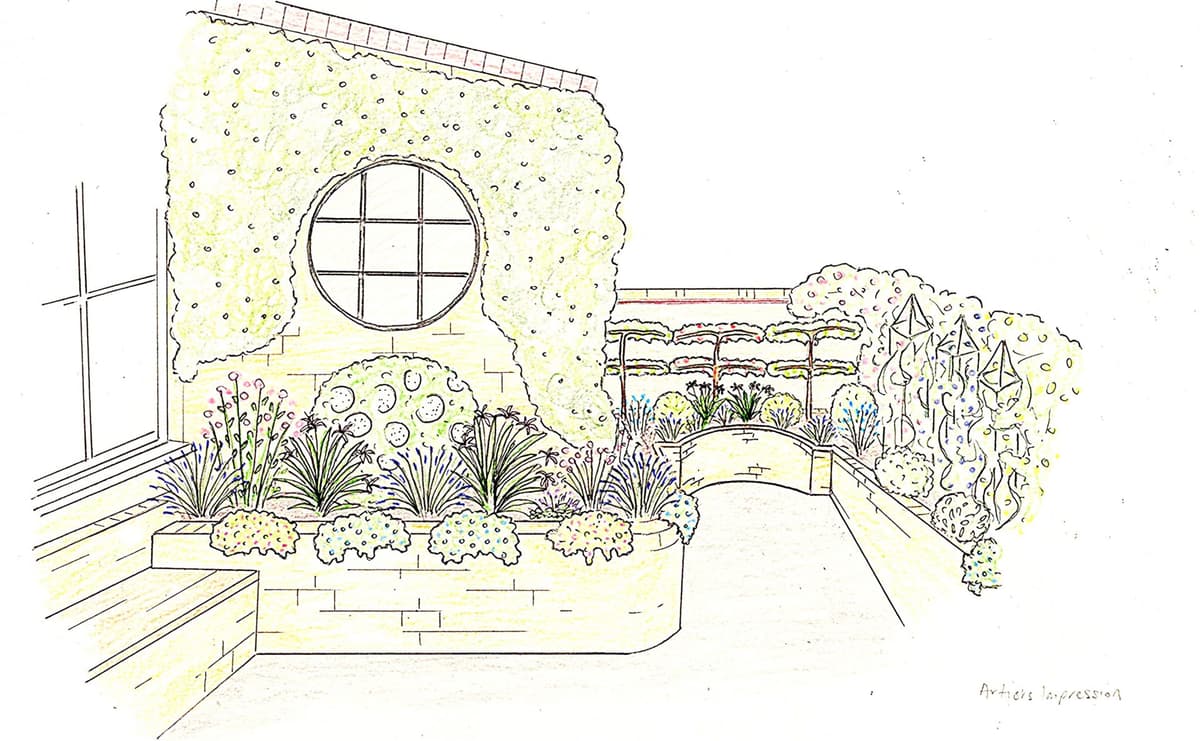
Contemporary Garden Design for Small Spaces
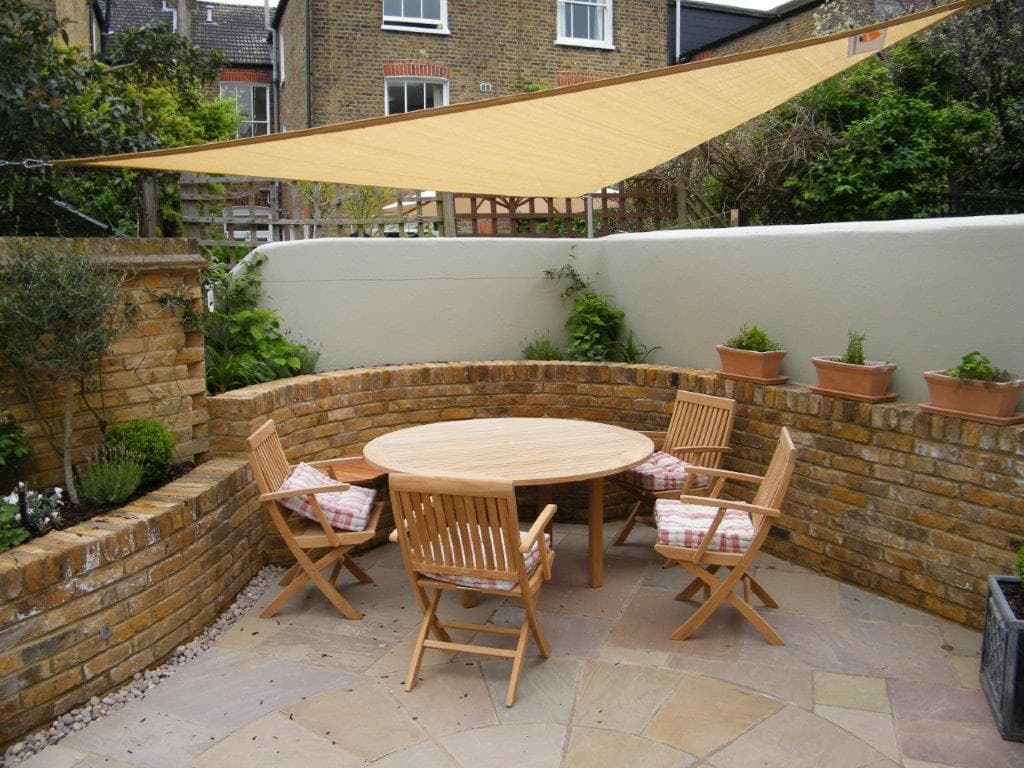
Small courtyards (under 30 sqm) suit contemporary design particularly well. The clean lines and minimal palette prevent the space feeling cluttered.
Key tactics:
- Use pale paving to reflect light and make the space feel larger
- Vertical planting: climbers on walls, tall narrow bamboo, slatted screens with planting pockets
- One dramatic focal point (water feature, sculpture, specimen tree) rather than multiple small features
- Built-in seating with storage underneath to maximise floor space
- Mirrors on boundary walls (carefully positioned to reflect planting, not blank fencing)
Why Choose Contemporary Garden Design?
Contemporary design suits modern lifestyles. It's lower-maintenance than traditional planting, works brilliantly for small urban plots, complements modern architecture and creates a calm, sophisticated outdoor room that feels like an extension of your house.
If you value clean lines, uncluttered spaces and a garden that looks intentional year-round, contemporary design might be perfect for you. It's not about having no plants or colour, it's about using them with discipline and purpose.
For homeowners in Kent, Surrey, Essex and London, contemporary gardens work particularly well with new-build properties, Victorian terraces (where the contrast with period architecture creates drama) and courtyard spaces where every square metre counts.
Getting Started with Your Contemporary Garden
If you're considering a contemporary garden design for your property in Kent, Surrey, Essex or London, the first step is understanding how you want to use the space and what aesthetic resonates with you. Look at contemporary show gardens (RHS Chelsea, Hampton Court), study materials in person (visit stone yards, garden centres with display areas), and think about maintenance honestly.
Contemporary design requires planning. Unlike a cottage garden where you can add plants incrementally, a contemporary garden is conceived as a whole. Hard landscaping, planting and lighting should all be designed together for a cohesive result.
At Soil Sisters, we specialise in creating contemporary gardens that work with the realities of South East England: London clay soil, unpredictable weather, limited space and busy lives. We'll help you choose materials that suit your budget, plants that thrive in your microclimate and a design that you'll love for years.
Book a free consultation to discuss your contemporary garden project. Call 0203 834 9807 or get in touch via our contact page.