
There's a reason the cottage garden has never gone out of fashion. Long before garden design became an industry, ordinary people were mixing flowers, herbs and food plants together in plots that were as practical as they were pretty. The cottage garden style traces back to medieval England, when labourers' gardens grew everything from medicinal herbs to climbing roses on the same patch of ground. Nothing was wasted. Nothing was purely ornamental. And that unselfconscious mix of beauty and usefulness is exactly what makes the style so appealing today.
We design cottage-style gardens across Kent, Surrey, London and the wider South East, and it remains one of the most requested styles we work with. People are drawn to the relaxed, abundant look of it. But what appears effortless actually takes careful planning. A good cottage garden is structured underneath all that abundance, and getting the bones right makes the difference between a garden that looks romantic and one that just looks untidy.
This guide covers everything you need to design and plant your own cottage garden, whether you have a full country plot in the Weald or a small town garden in Sevenoaks.
What Makes a Cottage Garden a Cottage Garden
The cottage garden is defined less by a rigid set of rules and more by a set of principles. Dense planting. Layers of height. Flowers and food growing together. Informal groupings rather than regimented lines. Self-seeding plants filling in gaps on their own terms. A sense that the garden has evolved rather than been imposed.
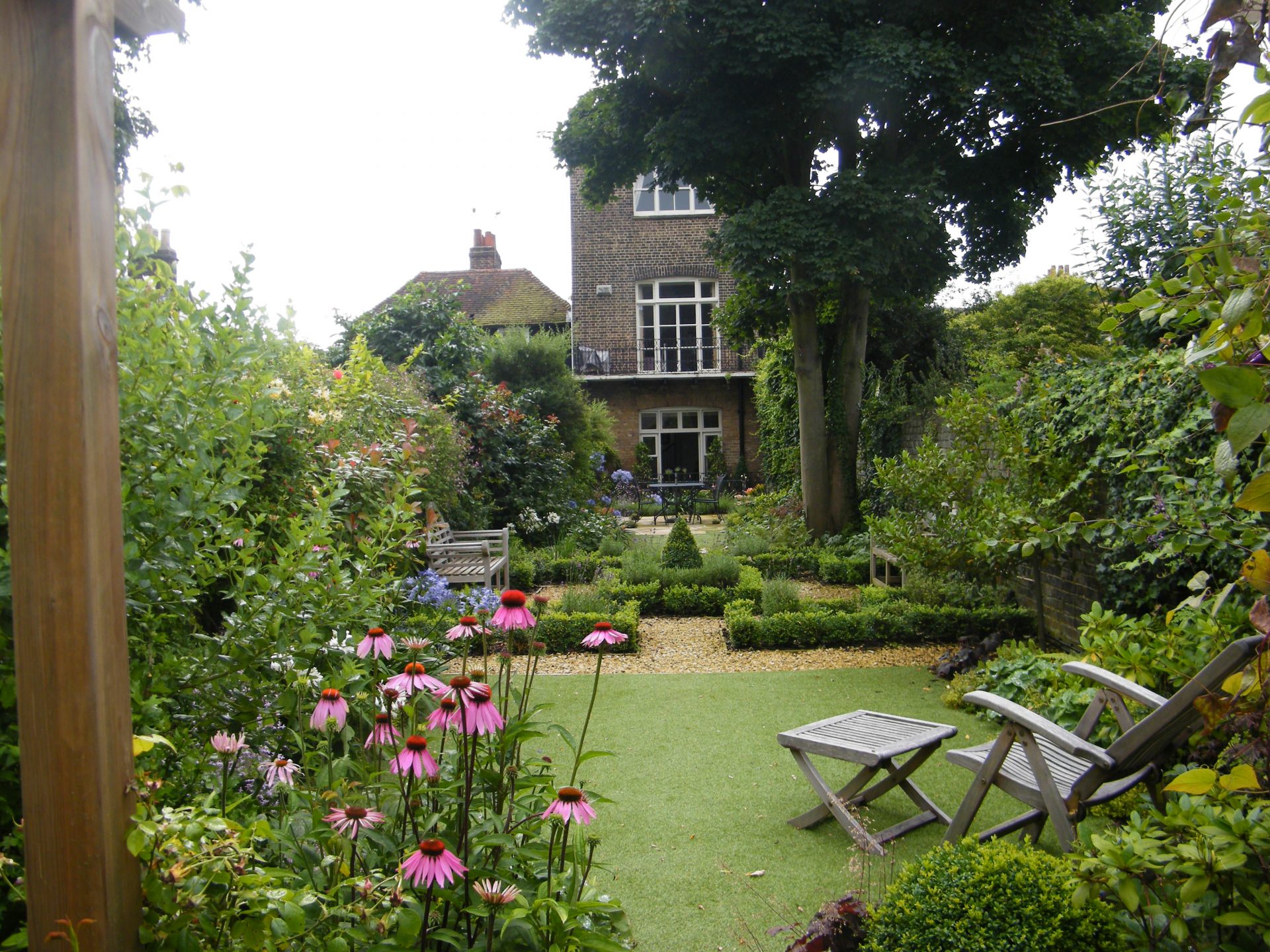
If you compare it with a traditional formal garden design, the differences are clear. Where formal gardens use symmetry, box hedging and restrained colour palettes, a cottage garden embraces a certain chaos. Paths wind rather than run straight. Borders spill over onto gravel. Roses and foxgloves grow next to runner beans and sweet peas. The overall effect is generous, loose and a little wild.
That said, there is always structure underneath. The best cottage gardens use repeated planting to create rhythm. Three groups of lavender spaced along a border. Climbing roses anchoring each end. Tall delphiniums drawing your eye upward at regular intervals. Without that backbone, you end up with a jumble rather than a garden.
Designing the Layout
Before you think about plants, think about paths. The cottage garden layout traditionally centres on a path leading to the front door, with deep borders on either side. That simple framework, a central axis with generous planting either side, works at almost any scale.

Paths and Hard Landscaping
Natural materials suit the style best. Reclaimed brick, York stone, hoggin, or simple gravel. Avoid anything too slick or modern. Cottage clay pavers are a favourite of ours for projects in Kent, where they pick up the warm tones of local brick and ragstone. Tumbled sandstone also works beautifully and weathers into the planting within a season or two.
Keep paths narrower than you might in a contemporary scheme. A 900mm path with plants billowing over the edges from both sides is part of the charm. You should be brushing past lavender as you walk to the door. Leave room for this in your planting plan rather than fighting it.
Borders
Getting the depth and structure of your borders right is essential. For a full breakdown of edging materials, planting densities and seasonal plant choices, see our complete guide to garden border ideas.
Go deep. Shallow borders of 60cm or a metre never look right in a cottage scheme because you can't build up the layers. Aim for 2 metres minimum, and 3 metres if you have the space. This gives you room for three clear planting tiers: tall plants at the back (1.5m and above), mid-height plants through the middle (60 to 90cm), and low, spreading plants at the front (under 40cm).
Island beds also work well in larger cottage gardens. A freestanding oval or kidney-shaped bed in a lawn, planted with the tallest material in the centre and heights graduating outward, gives you 360-degree interest and a sense of abundance from every angle.
Vertical Structures
Arches, obelisks, pergolas and trellised walls are essential cottage garden kit. They let you grow climbing roses, honeysuckle, jasmine and sweet peas upward, adding height and scent without taking up border space. A hazel arch over a path, covered in Rosa 'Generous Gardener' or Clematis montana, is one of those details that makes a cottage garden feel like it belongs in a painting.
Rustic materials work best. Woven hazel, oak posts, simple metal arches. Nothing too polished.
Choosing Plants for a Cottage Garden in the South East
Plant selection is where a cottage garden really lives or dies. The key is choosing plants that thrive in your specific conditions, not just plants that look right on a mood board.

Understanding Your Soil
Across Kent, Surrey and much of the South East, the dominant soil types are clay and chalk. The Weald of Kent sits on heavy Wealden clay. The North Downs are chalky and alkaline. Surrey ranges from sandy heathland around Farnham and Weybridge to heavier clay in the valleys. Knowing what you're working with changes your plant palette entirely.
For heavy clay, you need plants that tolerate waterlogging in winter and drying out in summer. Roses actually love clay, as long as drainage isn't standing-water bad. Geraniums, astrantia, persicaria and Japanese anemones all thrive. For chalky soils, lean toward lavender, scabious, verbascum, campanula and dianthus, all of which prefer alkaline conditions.
If you're not sure of your soil type, the simplest test is to grab a handful when it's damp and roll it between your fingers. Clay forms a smooth, sticky ball. Sandy soil falls apart. Chalky soil feels gritty and pale. Or pick up a pH testing kit from any garden centre for a few pounds.
The Essential Cottage Garden Plants
There's a core group of plants that form the backbone of virtually every cottage garden. These are the reliable performers that give you months of colour, tolerate our climate, and look after themselves with minimal fuss.
Roses. The absolute heart of a cottage garden. For scent and repeat flowering, David Austin English roses are hard to beat. 'Gertrude Jekyll' (deep pink, extraordinary fragrance), 'The Generous Gardener' (soft pink climber), and 'Munstead Wood' (rich crimson) are all outstanding. For a climbing rose over an arch, 'Constance Spry' gives you enormous old-fashioned blooms in June, or 'New Dawn' for a paler pink that flowers right through to autumn.
Foxgloves (Digitalis purpurea). A biennial that self-seeds freely once established. The native species gives you those tall spires of purple-pink bells in June. 'Excelsior Group' offers a wider range of colours. They're happy in partial shade and on most soil types, making them genuinely fuss-free.
Delphiniums. The vertical exclamation marks of the cottage border. 'Black Knight' (deep violet), 'Blue Jade', and 'Magic Fountains' are all reliable choices. They do need staking in exposed gardens, and slugs love the new growth in spring, so protect young shoots with copper tape or organic pellets.
Lavender (Lavandula angustifolia). 'Hidcote' is the classic choice for deep purple-blue flowers and a compact habit. 'Munstead' is slightly shorter. Both thrive on free-draining soil, especially chalk, and hate sitting in wet clay over winter. If you have heavy soil, either improve drainage with grit or grow them in raised beds.
Hardy geraniums. The workhorses of the cottage border. 'Rozanne' (violet-blue, flowers from June to November) is probably the single most useful cottage garden perennial you can buy. 'Johnson's Blue' and the magenta Geranium psilostemon are also superb.
Alchemilla mollis (lady's mantle). Lime-green frothy flowers, beautiful heart-shaped leaves, happy anywhere. Self-seeds generously. Perfect for softening path edges and border fronts.
Catmint (Nepeta 'Six Hills Giant'). Clouds of lavender-blue flowers from May to September. Bees absolutely love it. Cut it back hard after the first flush and you'll get a strong second flowering.
Aquilegia. Another prolific self-seeder that gives you nodding, bonnet-shaped flowers in every colour from white through pink, purple and near-black. Let it seed around and you'll get natural-looking drifts within a couple of years.
Plants for Height
In the back row of your border, you want drama. Hollyhocks (Alcea rosea) are the classic choice, growing to 2 metres or more, though they can be short-lived and prone to rust fungus. Verbascum bombyciferum gives you enormous silver-leaved rosettes and tall yellow flower spikes. Thalictrum 'Elin' reaches 2.5 metres with a haze of lilac-purple flowers that seem to float above the border. Macleaya cordata (plume poppy) is another tall option for the back of bigger borders, though it spreads and needs managing.
Plants for the Front Edge
Low, spreading plants that soften the transition between border and path are essential for the cottage look. Erigeron karvinskianus (Mexican fleabane) is a tiny daisy that seeds into every crack and gap and flowers non-stop from May to October. Viola cornuta provides long-lasting colour in purple, white or lilac. Dianthus gratianopolitanus (cheddar pink) gives you silver foliage and scented pink flowers on chalky soils. And don't overlook herbs: low-growing thyme, marjoram and sage all earn their place at a border's front, bringing scent and attracting pollinators.
Planting for Year-Round Interest
The biggest mistake with cottage gardens is planting solely for the summer peak. June and July will take care of themselves. It's the rest of the year that needs thought.
Spring. Underplant borders with bulbs for early colour. Narcissus 'Thalia' (white, elegant), Tulipa 'Spring Green' (white and green, works in any scheme), and alliums for that brief window between the spring bulbs fading and the perennials hitting their stride. Allium 'Purple Sensation' is cheap, reliable, and the seed heads look good for months after flowering.
Late summer and autumn. This is where many cottage gardens run out of steam. Plan for it. Japanese anemones (Anemone x hybrida 'Honorine Jobert') flower from August well into October. Sedums provide flat heads of dusky pink. Asters, the Michaelmas daisies, give you clouds of purple, pink and white through September and October. Persicaria amplexicaulis 'Firetail' is a clump-forming perennial with bright red poker-like flowers from July right through to the first frosts.
Winter structure. Evergreen elements stop the garden looking bare from November to March. A low box hedge along a path (Buxus sempervirens, or use Ilex crenata if box blight is a concern), a topiary ball or two, and the structural skeletons of grasses like Miscanthus sinensis 'Morning Light' all earn their place. Hellebores provide flowers from January onward, and snowdrops naturalise beautifully under deciduous shrubs.
The Productive Cottage Garden
Mixing flowers and food is part of the cottage tradition, and it's worth keeping alive. Runner beans on a wigwam of hazel poles look spectacular in a border and give you a crop from July to September. Sweet peas grown up an obelisk provide cut flowers all summer. Herb borders of rosemary, sage, thyme and chives are as beautiful as any ornamental planting and far more useful.

If you have room for a small kitchen garden area within the wider scheme, raised beds in oak or sleepers planted with salad leaves, courgettes, tomatoes and climbing beans bring the cottage garden full circle to its productive roots. We often include a simple potager-style area in our garden design projects, tucked behind a low hedge or hazel hurdle screen so it doesn't dominate the ornamental areas but remains easily accessible from the kitchen.
Cottage Garden Design for Smaller Spaces
You don't need a country estate to pull off a cottage garden. Some of the most charming cottage-style gardens we've designed have been in modest town gardens and courtyard spaces across Kent and Buckinghamshire and Surrey.
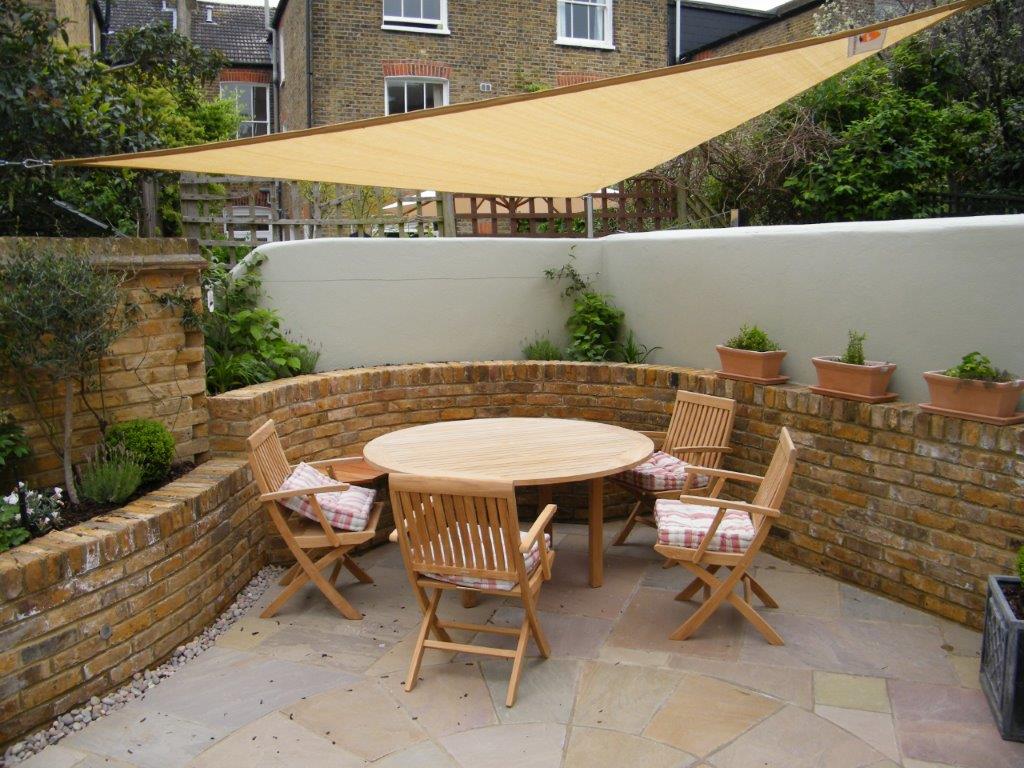
In a small garden, the principles are the same but the scale changes. Use fewer plant varieties but in bigger drifts. A single climbing rose over a wall does more work than six different plants competing for attention. Choose one or two statement perennials (delphiniums, perhaps, or a single spectacular peony) and surround them with reliable fillers like geraniums, alchemilla and nepeta.
Vertical planting becomes even more important. A wall covered in climbing hydrangea, star jasmine or Rosa 'Madame Alfred Carriere' adds an entire layer of planting without using any ground space. Window boxes and planters filled with trailing pelargoniums, herbs and violas extend the cottage feel to the house itself.
Pots and containers also work beautifully in a cottage scheme. Group terracotta pots of different sizes near a doorway, planted with lavender, trailing geraniums and a standard rose. The key is clustering them generously rather than spacing them evenly.
Maintaining a Cottage Garden Through the Year
Cottage gardens are not low maintenance. Let's be honest about that. The lush, overflowing look comes from active management, not neglect. But the work is enjoyable, seasonal, and most of it involves being outside with your hands in the soil, which is rather the point.
Spring (March to May)
Cut back last year's dead growth on perennials. Divide any overcrowded clumps of geraniums, sedums or asters. Stake delphiniums and any other tall perennials before they need it (once they've flopped, it's too late and it never looks right). Mulch borders with a thick layer of garden compost or well-rotted farmyard manure. This feeds the soil, suppresses weeds and retains moisture through summer.
Summer (June to August)
Deadhead roses, sweet peas and annuals regularly to keep them flowering. Cut back nepeta, geraniums and alchemilla after their first flush for a second round of bloom. Water new plantings during dry spells. Enjoy it. This is the season the garden was built for.
Autumn (September to November)
Leave seed heads standing for as long as they look good. They feed birds and add winter structure. Plant spring bulbs. Move or divide perennials. This is also the ideal time to plant bare-root roses, which establish far better than container-grown plants and cost roughly half the price.
Winter (December to February)
Prune climbing roses and deciduous shrubs. Plan any changes for the year ahead. Order bare-root plants and seeds. If you garden on clay, stay off the soil when it's waterlogged as compaction is hard to undo.
Common Mistakes to Avoid
After designing and planting cottage gardens for years, there are a handful of mistakes we see again and again.
Not going deep enough with borders. Shallow borders can't hold three tiers of planting. You end up with a thin line of flowers rather than the layered abundance that defines the style.
Choosing plants that don't suit your soil. Lavender on heavy clay. Astilbe on dry chalk. The plant doesn't care how much you paid for it. If the conditions are wrong, it will sulk or die. Work with your soil, not against it.
Forgetting about winter. A cottage garden that looks bare and sad from November to March was designed for photographs, not for living with. Include evergreen structure and winter-flowering plants from the start.
Over-tidying. The cottage garden aesthetic requires you to relax your standards slightly. A few self-seeded foxgloves popping up in the path, a rose sprawling slightly beyond its allotted space, aquilegia appearing in unexpected corners. These are features, not problems.
Ignoring the wildlife value. One of the great strengths of cottage gardens is how good they are for attracting wildlife into your garden. Single-flowered roses, open-faced daisies, lavender and catmint all provide nectar and pollen for bees, butterflies and hoverflies. Seed heads feed finches through winter. Dense planting gives ground cover for hedgehogs, frogs and slow worms. Designing with wildlife in mind doesn't mean compromising on aesthetics. Quite the opposite.
Getting Professional Help
A cottage garden might look informal, but getting the planting combinations, soil preparation and seasonal balance right is genuinely skilled work. If you're starting from scratch or reworking an existing garden, working with a designer means you skip the expensive trial-and-error phase and get a garden that performs from the first year.
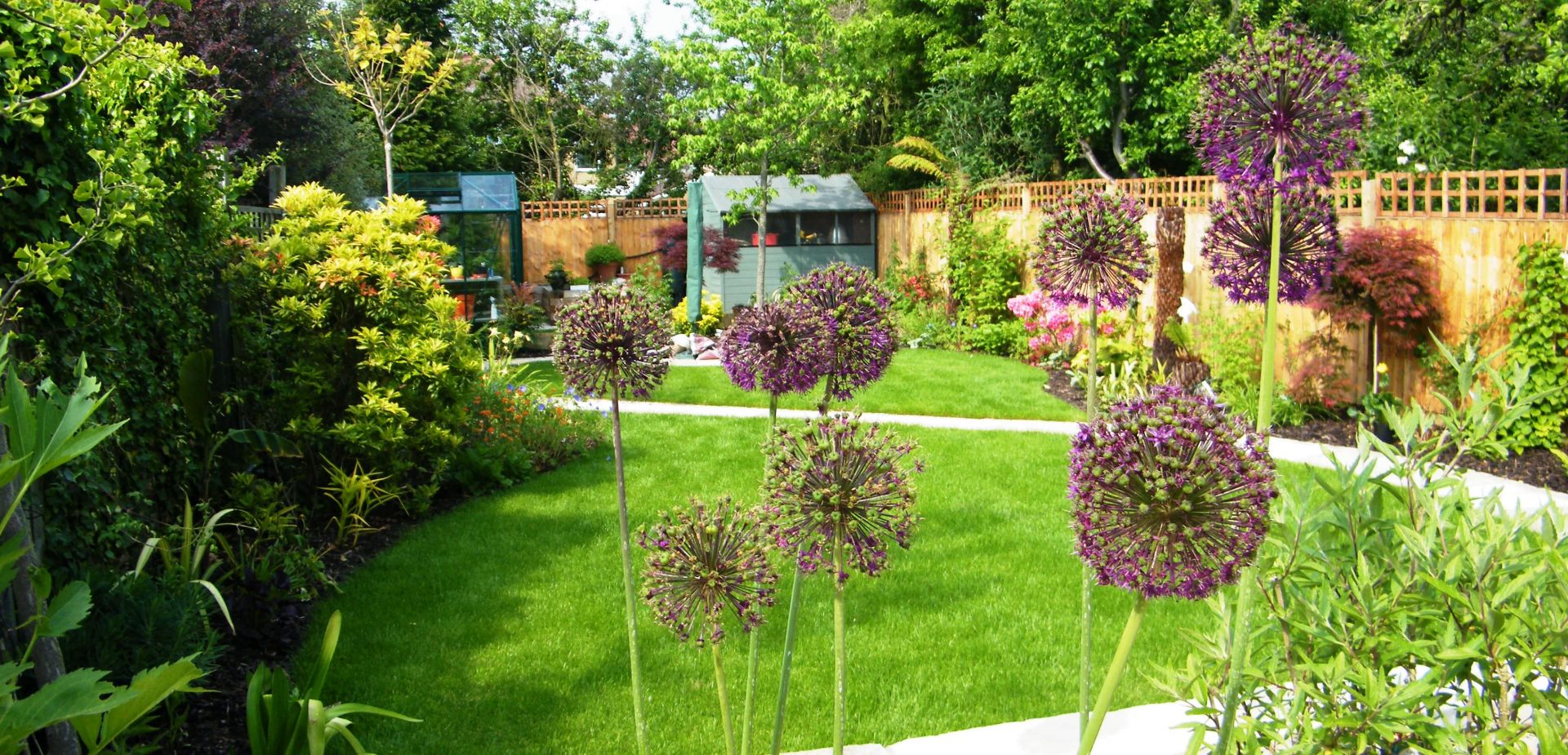
We work with homeowners across London, Kent, Surrey, Essex, Buckinghamshire and Sussex. Whether you want a full cottage garden scheme or just a planting plan for a single border, we'd love to hear from you. Get in touch for a free initial consultation and we'll talk through what's possible in your space.
For London gardens, we offer a dedicated planting design service that covers cottage-style planting schemes from initial plan through to supply and installation.