
Most UK gardens come with limited outdoor space. Terraced houses, new builds, and urban properties often have patios measuring 3m × 4m or smaller—just enough room for a table and a couple of chairs, if you're lucky. But a small patio doesn't have to feel cramped. With the right design approach, even the tiniest courtyard can become a genuinely usable outdoor room.
I've designed dozens of small patios across London, Kent, Surrey, and Essex, and the challenge is always the same: how do you fit dining, lounging, planting, and storage into 12 square metres without it feeling like a game of Tetris? The answer lies in treating your patio like an interior designer would treat a small flat—zoning, vertical space, light, and carefully chosen materials all working together to create the illusion of more room.
This guide covers the layout principles, material choices, planting strategies, and costs you need to know to design a small patio that feels twice its actual size.
Why Small Patios Need Different Design Rules
You can't just scale down a large garden design and expect it to work in a small space. Small patios have their own set of constraints:
- Sightlines are short. You see everything at once, so clutter, poor proportions, and bad material choices are immediately obvious.
- Multi-functional by necessity. A small patio has to serve as dining area, sun trap, planting space, and storage—often all at the same time.
- Boundaries dominate. Fences, walls, and neighbouring properties are always in view, so you need design tricks to push the eye away from hard edges.
- Microclimate matters more. A 3m × 3m north-facing patio will be cold and shaded for most of the year. South-facing gets baked in summer but feels expansive. You're designing for extremes.
The good news? Small spaces force you to make deliberate design decisions. Every plant, every slab, every piece of furniture has to earn its place. That discipline tends to produce better-looking patios than sprawling gardens where mistakes can hide.
Layout Principles for Small Patios
1. Zone Your Space (Even if It's Tiny)
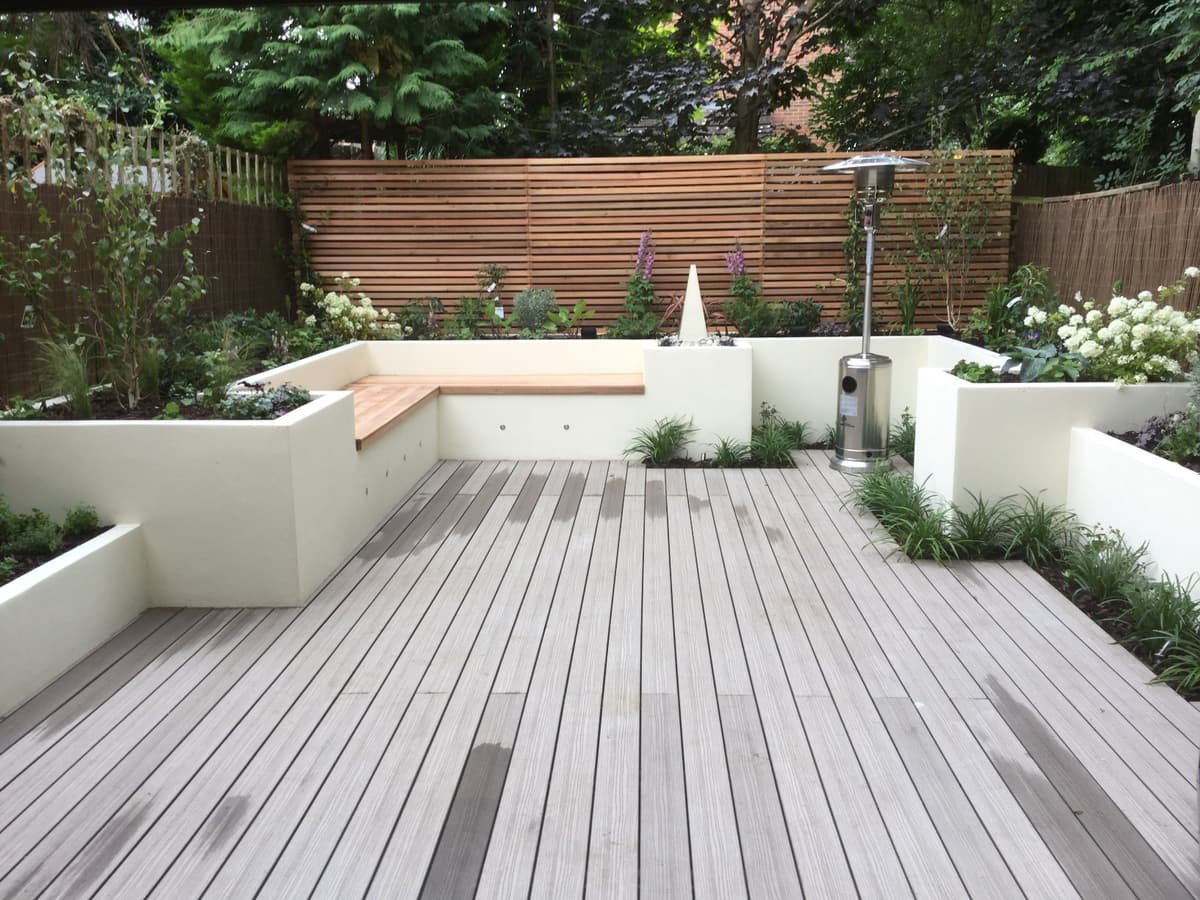
The single biggest mistake I see in small patio design is treating the entire space as one undifferentiated square. It feels flat and uninviting. Instead, divide your patio into distinct zones—dining, lounging, planting—even if each zone is only 1.5m wide.
How to create zones without walls:
- Change the flooring material (paving for dining, decking for lounging, gravel for planting)
- Use a single step up or down to separate areas
- Run a low raised bed or planter as a visual divider
- Lay an outdoor rug to define a seating area
A 3m × 4m patio can comfortably accommodate three zones: a 1.2m-wide dining strip along the house, a 1.5m lounging area with a bench or two chairs, and a 0.8m planting strip along the far boundary. Each zone feels distinct, and the eye travels through the space instead of bouncing off the back fence.
2. Keep Circulation Clear
You need at least 60cm of clear walkway around any seating or dining area. Any less and it feels cramped; chairs scrape walls when you push them back, and getting past someone seated becomes awkward.
For a dining table, allow 90cm–1m of clearance behind each chair so people can comfortably pull them out and sit down. That's the single biggest space-eater in a small patio, which is why built-in corner seating (where you slide in from the side) works so well—it saves 30–40cm per seat.
3. Use Corners, Not Centers
In a small space, placing furniture in the middle of the patio wastes precious square meterage. Push everything to the perimeter. Built-in corner benches, L-shaped seating, and wall-mounted planters all free up the centre of the patio for movement and make the space feel significantly larger.
If you do need a freestanding table, choose a round or oval one rather than square or rectangular. Curved edges take up less perceived space and allow better flow around them.
Material Choices That Make Small Patios Look Bigger
Paving Slabs: Bigger Is Better
Small patios benefit from large-format paving. Slabs measuring 600mm × 600mm or 900mm × 600mm have fewer joints, which reduces visual clutter and creates a calmer, more expansive feel. Tiny 300mm × 300mm pavers look busy and make the space feel smaller.
Laying pattern matters:
- Diagonal layout: Run slabs at 45° to visually widen a narrow patio
- Stacked bond (grid pattern): Clean and modern, makes rectangular spaces feel longer
- Avoid busy patterns: Herringbone and basket weave add visual noise in small spaces
Porcelain vs natural stone: Both work, but porcelain is lower maintenance (non-porous, won't stain, doesn't need sealing) and comes in large formats up to 1200mm × 600mm. Natural stone like sandstone or limestone has more character but needs annual sealing, especially on a small patio where spills and stains are harder to hide.
Colour Strategy
Light-coloured paving (cream, buff, light grey) reflects more light and makes a small patio feel airier. Dark grey or charcoal can look dramatic but absorbs light and heat, making a north-facing patio feel cave-like.
That said, if your patio is south-facing and sun-baked, dark paving can work beautifully—it creates a bold, contemporary look and the strong shadows add depth. Just be aware it gets scorching hot underfoot in July.
2026 paving costs (supply + installation):
- Porcelain paving: £80–£140/m²
- Sandstone paving: £70–£120/m²
- Limestone paving: £90–£150/m²
- Granite paving: £110–£180/m²
For a 12m² small patio, budget £960–£1,680 for porcelain or sandstone supply and installation, or £1,320–£2,160 for premium limestone or granite.
Mixing Materials
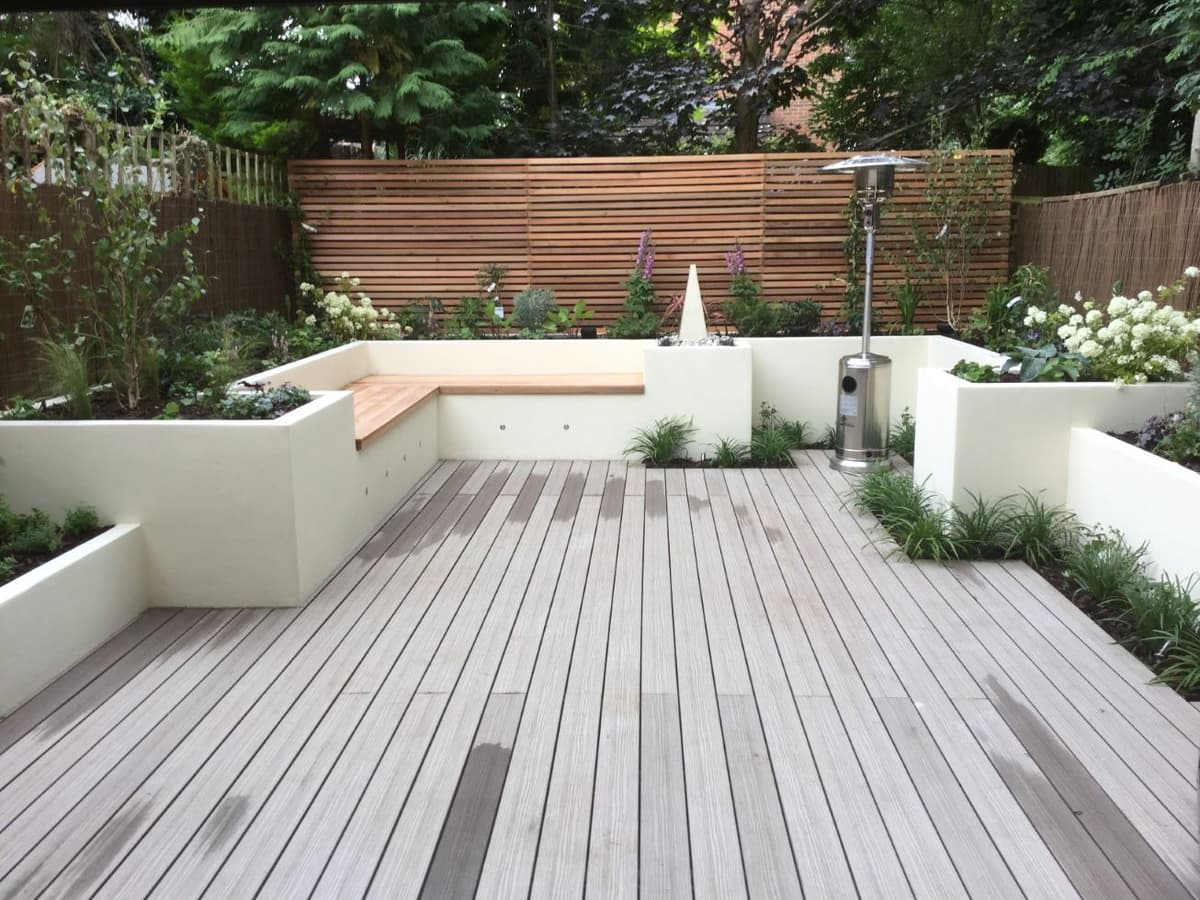
Combining two materials—paving and decking, or paving and gravel—can visually separate zones without needing walls or railings. A 1m-wide strip of composite decking along one side creates a lounging zone, while porcelain paving serves the dining area. The material change tells your brain "this is a different space" without taking up any extra room.
Gravel is particularly useful in small patios. A 30–40cm border of pale gravel (10mm pea gravel in honey or cream) around the perimeter softens hard edges, reflects light, and provides excellent drainage. It's also far cheaper than paving—expect £40–£60 per tonne (one tonne covers roughly 12m² at 50mm depth).
Planting Design for Small Patios
Go Vertical
Ground space is limited, so you need to plant upwards. Climbers, wall shrubs, and tall grasses all draw the eye up and away from tight boundaries.
Best climbers for small UK patios:
- Trachelospermum jasminoides (star jasmine) — evergreen, fragrant white flowers May–Jul, grows to 4–5m, tolerates shade, £25–£40 for 2-litre pot
- Clematis 'Étoile Violette' — violet-purple flowers Jun–Sep, grows to 3–4m, cut back hard each Feb, £18–£28
- Lonicera periclymenum 'Serotina' (honeysuckle) — fragrant cream/purple flowers Jul–Sep, grows to 5m, semi-evergreen, £15–£22
- Hydrangea petiolaris (climbing hydrangea) — white flowers Jun, grows to 8m+, self-clinging, excellent for north-facing walls, slow to establish but worth it, £28–£45
Fix trellis panels (£15–£30 each from garden centres) or horizontal wires (galvanised wire + vine eyes, £8–£12 per 3m run) to walls and fences to support climbers. Trellis adds instant structure while plants are establishing.
Raised Beds and Planters
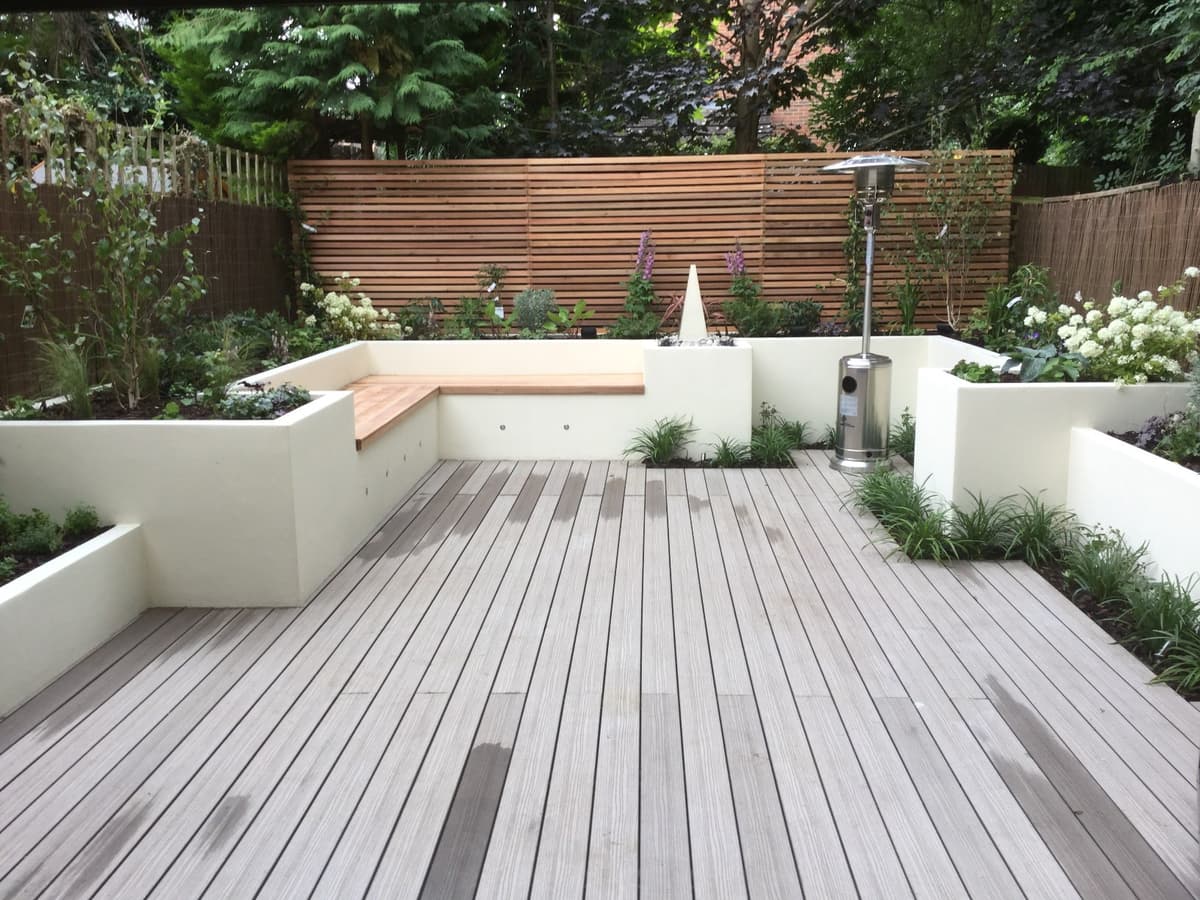
Raised beds serve double duty in small patios: they provide planting space without eating into floor area, and they double as informal seating (top the bed with a 30cm-wide coping stone and you've got perch seating for guests).
A 40–50cm-high raised bed along one boundary, planted with a mix of evergreen shrubs (Pittosporum 'Tom Thumb', Choisya 'Aztec Pearl', Sarcococca confusa) and seasonal perennials (Geranium 'Rozanne', Echinacea purpurea, Salvia nemorosa), creates year-round interest without taking up precious patio floor space.
Raised bed costs (2026 UK):
- Railway sleeper raised bed (2m × 0.6m × 0.4m high): £180–£280 materials + £120–£200 installation = £300–£480
- Brick or block raised bed (painted): £350–£550 supply + build for 2m length
- Corten steel planter (contemporary look): £280–£650 for 1.5m–2m length, pre-fabricated
Container Planting Strategy
If you can't fit raised beds, large containers are the next best option. Group 3–5 pots of varying heights (tall pots 50–70cm, medium 35–45cm, low 20–30cm) in one corner rather than dotting small pots everywhere. The grouped cluster reads as a single planting feature and feels more intentional.
Container planting combinations for small UK patios:
- Shade: Fatsia japonica (structure) + Hakonechloa macra 'Aureola' (grass) + Heuchera 'Marmalade' (foliage colour)
- Sun: Phormium 'Bronze Baby' (spiky form) + Lavandula 'Hidcote' (scent, flowers) + Thymus serpyllum (low carpeting)
- Year-round: Buxus sempervirens ball (evergreen structure) + seasonal underplanting (spring bulbs, summer Pelargonium, autumn Cyclamen hederifolium)
Use large pots (45cm+ diameter) to reduce watering frequency. Small pots dry out in hours during summer and become a daily chore.
Furniture and Storage for Small Patios
Built-In Seating Is Your Best Friend
Freestanding garden furniture is bulky and inflexible. A built-in corner bench made from treated timber (£80–£150 materials, weekend DIY project, or £250–£400 for a joiner to build) seats four people in the footprint of a single chair. Add storage underneath by hinging the seat—perfect for cushions, garden tools, or kids' toys.
Paint built-in seating the same colour as the fence or wall behind it (dark grey, charcoal, or deep green) and it visually recedes, making the patio feel less cluttered.
Folding and Stackable Furniture
If built-in seating isn't an option, choose furniture that packs away. Bistro sets with folding tables and stackable chairs can be hung on wall hooks when not in use, freeing up the entire patio for other activities (kids playing, yoga, drying laundry—whatever you need the space for).
Compact furniture options:
- Folding bistro set (60cm round table + 2 chairs): £120–£180
- Stackable dining chairs (aluminium or resin): £40–£80 each
- Wall-mounted drop-leaf table: £60–£120 (folds flat against wall when not in use)
Hidden Storage Solutions
Small patios accumulate clutter fast—watering cans, hand tools, plant pots, kids' toys. You need storage that doesn't eat into usable space:
- Storage benches: dual-purpose seating + storage, £100–£250
- Wall-mounted tool racks: keep tools off the floor, £15–£30
- Slim storage cabinets: 40cm-deep units fit along a fence, £80–£180
Lighting Design for Small Patios
Good lighting transforms a small patio from "place I occasionally sit during the day" to "outdoor room I use year-round". You need three layers:
1. Ambient Lighting (Overall Brightness)
String lights or festoon bulbs strung overhead create a soft, even glow. Warm white (2700K) is essential—cool white looks clinical and uninviting. Run them in a zigzag pattern across the patio or along the top of fences.
Cost: Solar string lights £15–£30 (8–10 hours runtime in summer, 3–4 hours in winter). Mains-powered festoon lights £40–£80 + electrician to install outdoor socket (£120–£200 if you don't have one).
2. Task Lighting (Functional Light)
A single wall-mounted downlight above the dining table provides enough light to eat, read, or work outdoors. Choose a dimmable fitting so you can adjust brightness to suit the mood.
Cost: LED wall downlight £25–£60 + installation £80–£150.
3. Accent Lighting (Drama and Depth)
Uplights placed at the base of feature plants, or spotlights aimed at a focal point (a piece of wall art, a water feature, a beautiful tree), draw the eye to specific areas and create depth. In a small patio, accent lighting pushes the perceived boundary outwards by highlighting distant points.
Cost: Solar spike spotlights £12–£25 each (3–4 needed for a small patio). Mains-powered LED spotlights £30–£60 each + wiring.
Small Patio Design Costs (2026 UK Prices)
Here's what you can expect to pay for professional design and build of a small patio (10–15m²) in London, Kent, Surrey, or Essex:
Budget Transformation (£3,500–£6,500)
- Basic ground preparation and levelling
- Porcelain or sandstone paving (10–12m²)
- Simple raised bed or gravel border
- Basic planting (3–5 climbers, 10–15 perennials)
- DIY furniture or budget bistro set
- Solar string lights
Mid-Range Redesign (£7,000–£12,000)
- Full excavation, drainage, and levelling
- Premium porcelain or natural stone paving (12–15m²)
- Raised bed with brick or sleeper construction
- Built-in corner seating with storage
- Comprehensive planting (5–8 climbers, 20–30 perennials/shrubs, seasonal pots)
- Trellis and wall-mounted planters
- Three-layer lighting (mains-powered)
High-End Small Courtyard (£13,000–£22,000+)
- Structural work (wall repairs, damp-proofing, drainage system)
- Bespoke paving design with mixed materials (limestone, granite, decking)
- Custom-built raised beds with integrated seating and lighting
- Automated irrigation system
- Mature planting (specimen trees, instant hedging, feature shrubs)
- Built-in outdoor kitchen or pizza oven (compact models)
- Architectural lighting design with smart controls
Garden design fees (small patios): £600–£1,500 for concept plan + 3D visuals. Full design service including planting plans and project management: £1,500–£3,000.
Common Small Patio Design Mistakes
1. Buying Furniture Before Measuring
A 6-seater dining set looks beautiful online. It will not fit in your 3m × 3.5m patio. Measure first, then shop. Allow 60cm clearance around all furniture.
2. Treating All Four Boundaries Equally
You don't need to plant every wall. Choose one boundary as your "green wall" (the one you see from inside the house) and go all-in with climbers, trellis, and planting. The other three can be simpler. This creates a focal point and prevents the space feeling boxed in.
3. Using Too Many Materials
Paving + decking + gravel + brick edging + sleeper raised beds = visual chaos. Stick to two, maximum three materials. Simplicity makes a small space feel more expensive and considered.
4. Neglecting Drainage
A poorly drained small patio becomes unusable after rain. The patio should slope gently away from the house (1:80 gradient minimum) and you need either a soakaway, linear drain, or permeable paving. Budget £300–£600 for proper drainage when building a new patio.
5. Planting at Ground Level Only
If all your plants are in beds at floor level, you're missing 80% of your available planting space. Climbers, wall shrubs, and tall grasses bring height and movement without taking up floor area.
Small Patio Design: Key Takeaways
- Zone the space even if it's tiny—dining, lounging, and planting areas should feel distinct
- Use large-format paving (600mm+) in light colours to maximise perceived space
- Push furniture to the perimeter—built-in corner seating is the single best investment
- Plant vertically with climbers, wall shrubs, and tall containers to create height without eating floor space
- Layer your lighting—ambient, task, and accent layers make a small patio feel like a real outdoor room
- Keep it simple—two materials, three colours maximum, and deliberate plant choices
A well-designed small patio should feel generous, not cramped. It's about creating distinct spaces, using vertical planting, choosing the right materials, and making every square metre count. Get those foundations right and even a 3m × 4m courtyard can become the most-used room in your house.
How Soil Sisters Can Help
We design small patios across London, Kent, Surrey, and Essex, specialising in urban courtyards and compact outdoor spaces where every centimetre counts. Our approach starts with understanding how you actually want to use your patio—dining, lounging, kids' play space, container gardening—and designing around that, not the other way around.
Every small patio design includes a scaled concept plan, 3D visuals, detailed planting plan, and materials specification. We work with trusted local contractors for the build phase, and handle project management from groundworks through to final planting.
Small patio design service: £1,200–£2,500 depending on complexity. Build costs typically range from £6,000–£15,000 for a complete transformation of a 10–15m² urban patio.
Get in touch to discuss your small patio project, or call us on 0203 834 9807 for a free initial consultation.
Frequently Asked Questions
How small is too small for a usable patio?
You can create a functional patio in as little as 2.5m × 2.5m (6.25m²), provided you're realistic about what it can accommodate. That's enough space for a compact bistro table and two chairs, plus a narrow raised bed or a few large pots. Below 2m × 2m, you're better off treating the space as a threshold or walkway with container planting, rather than trying to squeeze in furniture.
What's the cheapest way to improve a small patio?
If you already have serviceable paving, the cheapest transformation is paint, plants, and lighting. Paint fences and walls in a single cohesive colour (grey, charcoal, dark green), add 5–8 large pots with a mix of evergreen structure plants and seasonal colour, and string up solar festoon lights. Budget £200–£400 for materials and you'll achieve a significant visual improvement in a weekend.
Should I use decking or paving for a small patio?
Both work, but paving tends to feel more permanent and requires less maintenance. Composite decking (£80–£140/m² installed) is low-maintenance and creates a warm, tactile surface, but it can make a small space feel even smaller if you use dark boards. Light-coloured porcelain paving (£80–£120/m²) reflects more light and feels more spacious. If you love the look of decking, use it as an accent—a 1m-wide deck strip for lounging, with paving for the dining area.
How do I make a north-facing small patio feel less gloomy?
North-facing patios lack direct sunlight, so every design choice needs to maximise available light. Use the lightest-coloured paving you can (cream, pale buff, white), paint walls and fences in off-white or very pale grey, and choose shade-tolerant plants with bright foliage (Hakonechloa macra 'Aureola', Hostas, Heucheras). Mirrors on walls bounce light around and create the illusion of more space, and good lighting (warm white festoons + uplights) makes the patio usable in the evening.
Can I fit a dining table in a 3m × 3m patio?
Yes, but it'll be tight. A 60cm-diameter round bistro table + two chairs needs roughly 1.6m × 1.6m of floor space (including clearance to pull chairs out). That leaves 1.4m around the edges for circulation and planting. It's doable, but you won't have room for a separate lounging area. If dining is your priority, consider built-in bench seating along two walls forming an L-shape—you can fit a small rectangular table (1m × 0.6m) in the corner and seat four people in a 3m × 3m space.
What plants work best in small shaded patios?
Shade-tolerant evergreens provide structure year-round: Sarcococca confusa (winter-flowering, fragrant), Fatsia japonica (architectural leaves), Choisya 'Aztec Pearl' (compact, scented flowers). For climbers: Hydrangea petiolaris (climbing hydrangea, slow but stunning), Hedera helix (ivy, many variegated forms). Perennials: Hakonechloa macra 'Aureola' (golden grass, lights up shade), Epimedium (delicate flowers, ground cover), Digitalis (foxgloves, self-seed in cracks), Hosta 'Francee' (bold foliage, slug-resistant variety).
Do I need planning permission for a small patio?
Generally no, as long as your patio is at ground level and the paving is permeable or drains to a lawn/border (not straight into the road). If you're raising the patio more than 30cm above ground level and it's within 2m of a boundary, you may need planning permission. Listed buildings and conservation areas have stricter rules—check with your local planning authority before starting work.
How much does it cost to replace an existing small patio?
Removing old paving, disposing of waste, re-levelling, and laying new paving for a 12m² patio typically costs £2,400–£4,200 (materials + labour). That includes new sub-base, mortar bed, and paving. If you're keeping the same footprint and the existing base is sound, you can sometimes lay new porcelain tiles directly over old concrete paving using exterior adhesive, which reduces costs to £1,200–£2,000 for a 12m² area.
What's the best flooring for a small patio with dogs?
Porcelain paving in a textured finish (not polished) is ideal—non-porous so urine doesn't soak in, hard-wearing, and easy to hose down. Avoid natural stone (porous, stains easily) and timber decking (scratches, absorbs smells). Choose mid-to-dark grey rather than cream or white, as it hides dirt and wear better. Allow 10% extra budget for more frequent cleaning and maintenance with pets.
Should I DIY my small patio or hire professionals?
If you're confident with levelling, drainage, and have experience laying paving, a small patio is a manageable DIY project over a long weekend. Budget £800–£1,500 for materials (paving, sub-base, sand, cement) and hire a mini digger (£80–£120/day) to excavate. If the ground is uneven, drainage is poor, or you've never laid paving before, hire professionals—a badly laid patio will puddle, sink, and crack within a year. Professional installation for 12m² costs £1,800–£3,200 including labour, and comes with a guarantee.