
A large garden is a privilege. It is also a problem. When you have 200, 400, or 600 square metres of grass stretching out behind your house, the instinct is often to do nothing, because the scale of the decision feels overwhelming. Where do you even start?
We have designed large gardens across Kent, Surrey, Essex and London for the past twelve years, and the brief is nearly always the same: "We have all this space, but we don't know what to do with it." The garden feels like a burden rather than an asset. The lawn takes two hours to mow. There is no structure, no privacy, no sense of arrival. The whole plot reads as one long, shapeless rectangle, and every attempt to "do something" with it ends up looking lost in the middle of all that grass.
This guide covers how to design a large garden in the UK—the zoning principles that actually work, the costs you need to budget for, the plants that earn their place at scale, and the mistakes we see repeatedly (and how to avoid them).
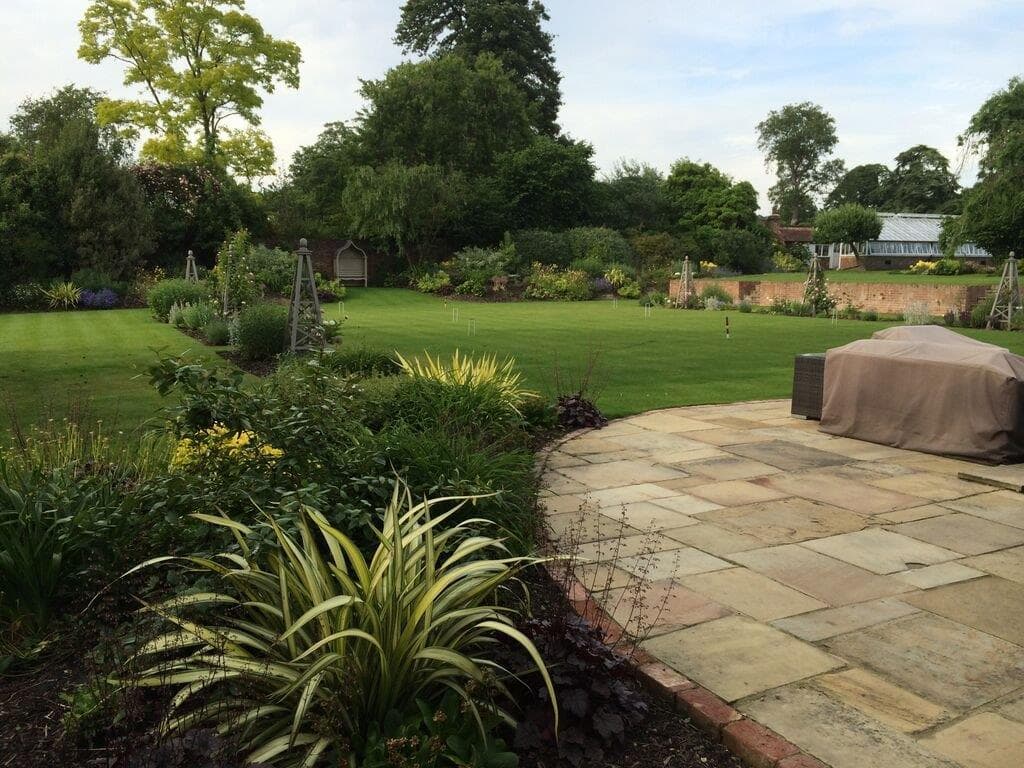
What Counts as a Large Garden?
There is no strict definition, but in our work a large garden is anything over 200 square metres where the design challenge shifts from "how do I fit everything in" to "how do I stop this feeling empty".
Typical large garden profiles we see in the South East:
- Detached new-builds (Sevenoaks, Tunbridge Wells, Bromley): 250-400 sqm rectangular plots with builder's turf and a 4-metre patio
- Period properties (Kent villages, Surrey countryside): 400-800+ sqm mature gardens with established trees, often sloping
- Rural conversions (barn conversions, farmhouses): 600+ sqm plots with awkward boundaries, outbuildings, or paddock access
- Large town houses (Dulwich, Blackheath, Richmond): 300-500 sqm long, narrow plots behind Victorian or Edwardian terraces
If you can stand at your back door and not clearly see the end of your garden, or if it takes more than 90 minutes to mow, you have a large garden.
The Single Biggest Mistake: Treating It as One Space
The most common error in large garden design is leaving the plot as a single open lawn. It looks tidy. It feels safe. But it also feels empty, windswept, and oddly smaller than it actually is, because your eye travels straight to the back fence and registers the full, uninterrupted distance.
Why a single lawn does not work:
- No sense of discovery. You see everything from the house. There is nowhere to explore, no reason to walk to the far end.
- Awkward proportions magnified. If your garden is long and narrow (the classic terraced garden problem), one unbroken lawn makes it feel like a bowling alley.
- Maintenance burden. A 400 sqm lawn takes 90-120 minutes to mow every week from April to October. That is 60+ hours a year on a single task.
- No privacy or shelter. Large flat lawns are exposed. You feel overlooked, and the wind cuts straight through.
The fix is counterintuitive: you make the garden feel bigger by breaking it into smaller, distinct zones.
How to Zone a Large Garden: The Layout Principles That Work
Zoning is not about drawing lines on a plan. It is about creating a series of outdoor rooms, each with a different purpose, connected by paths or transitions that make you want to move through the space.
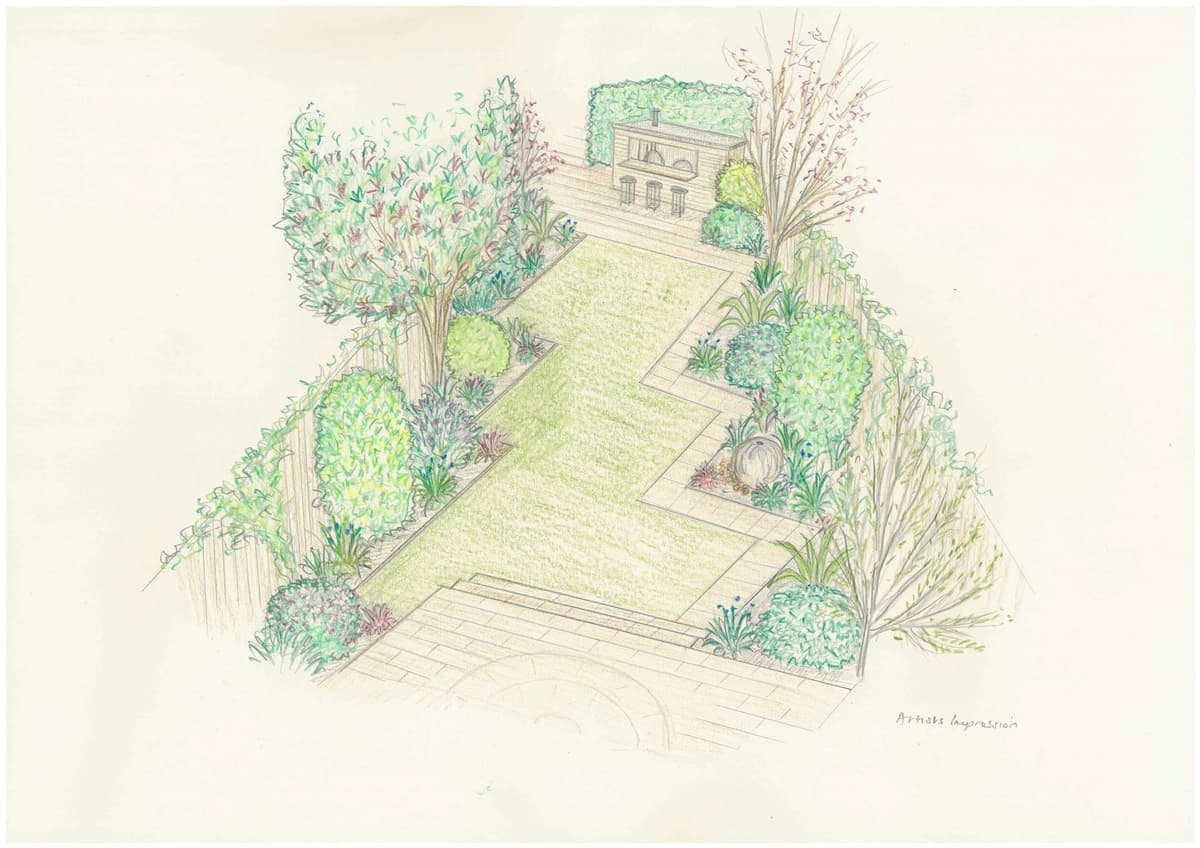
Three-Zone Framework (Works for 90% of Large Gardens)
Zone 1: The Entertaining Terrace (closest to the house)
- Function: Outdoor dining, family meals, drinks with friends
- Size: 30-50 sqm for 6-8 people comfortably
- Materials: Porcelain paving (£100-£170/sqm installed), Indian sandstone (£80-£145/sqm), or composite decking (£120-£200/sqm)
- Key feature: Level access from the house, ideally extending the floor line of your kitchen or sitting room
This is the workhorse zone. It needs to be big enough that you do not feel cramped when you have a table and six chairs out, but not so large that it dominates the garden. A 4-metre square patio is too small for most large gardens. Aim for at least 5m x 6m, or 6m x 7m if you entertain regularly.
Zone 2: The Garden Proper (the middle ground)
- Function: Open lawn, planting beds, pathways, play area for children or dogs
- Layout: This is where you add structure—curved borders, island beds, specimen trees, or a mown path through longer grass
- Planting strategy: Layered borders (1.5-3m deep) at the edges, with a clear lawn or gravel path down the centre
The middle zone is the transition. It should feel like you are moving through the garden, not just looking at it. Break up the sightline with a medium-height shrub (Viburnum tinus, Photinia 'Red Robin', or a multi-stem Amelanchier), or a small ornamental tree placed asymmetrically to create a sense of depth.
Zone 3: The Destination (the far end)
- Function: Seating nook, wildflower meadow, vegetable garden, or wildlife area
- Purpose: This is the reason you walk to the end. It needs a focal point—a bench, a summerhouse, a greenhouse, or a specific view framed by planting
The destination zone rewards the journey. It should feel different from the terrace—quieter, more enclosed, more private. Many of our clients ask for a "secret garden" feel at the far end. That works. It gives the large plot a sense of narrative: public (terrace) → semi-private (garden) → private (retreat).
Handling Awkward Proportions
Long, narrow gardens (60m x 8m):
- Avoid a straight central path—it emphasises the length. Use a gently curving route or offset the path to one side.
- Plant bold, structural shrubs (Fatsia japonica, Phormium, or clipped box balls) at intervals down the length to break the sightline into segments.
Wide, shallow gardens (30m x 15m):
- Use planting to create depth. Run deep borders (2-3m) along the sides, narrowing the perceived width and drawing the eye toward the far boundary.
- Place a focal point (tree, sculpture, arbour) at the centre back to anchor the view.
Square gardens (20m x 20m):
- Divide into quadrants or thirds using hedging, trellis, or tall perennial planting (Miscanthus, Verbena bonariensis in drifts).
- Avoid centring everything—asymmetry creates movement and interest.
Plant Choices for Large Gardens: What Actually Works at Scale
Small gardens reward intricate, jewel-box planting. Large gardens need structure, repetition, and plants that hold their own across distance.
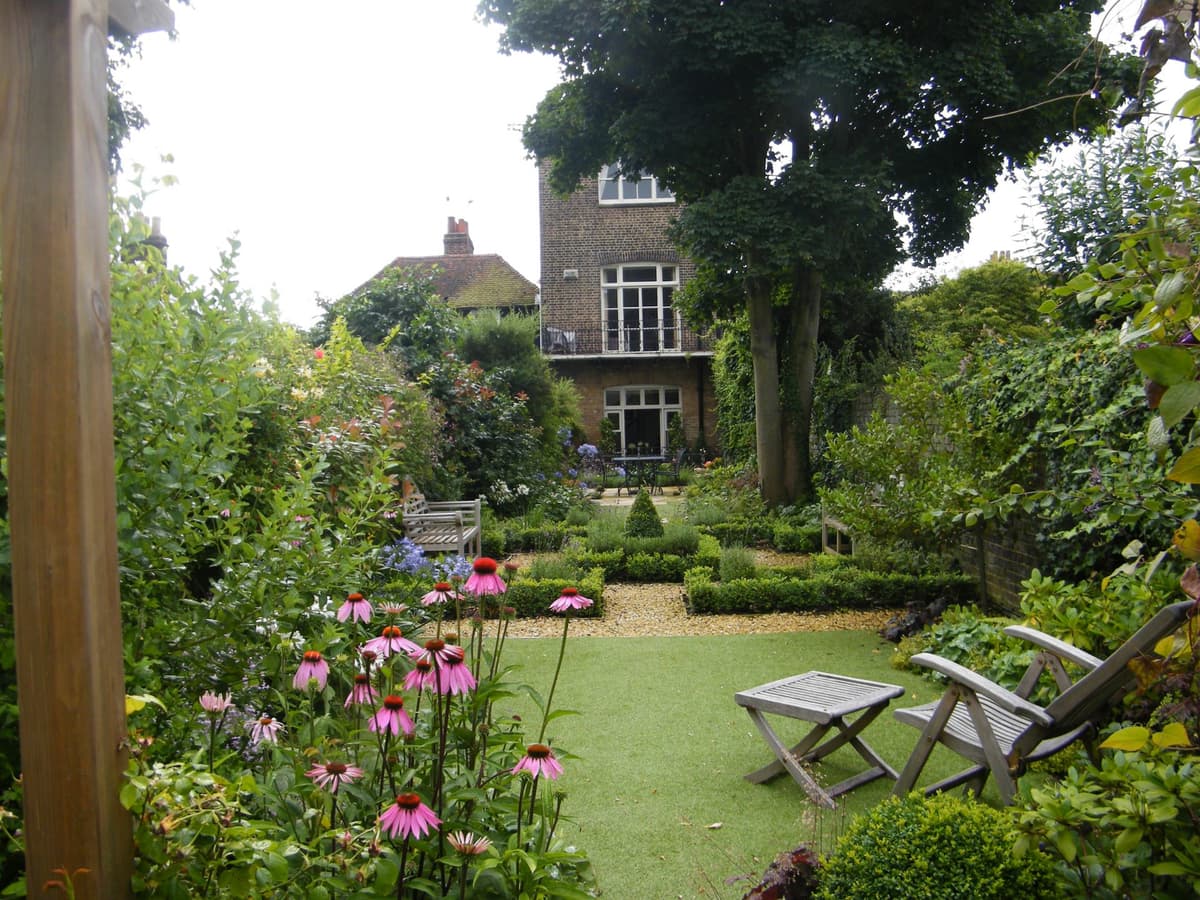
Structural Plants (The Backbone)
These are evergreens or architectural plants that provide year-round presence and define the bones of the garden.
| Plant | Type | Height | Use | Cost (2026) |
|---|---|---|---|---|
| Taxus baccata (Yew) | Evergreen hedge/topiary | 1-5m+ | Formal hedging, screening, structure | £35-£80 per plant (80-120cm) |
| Carpinus betulus (Hornbeam) | Deciduous hedge (holds leaves in winter) | 2-5m | Screening, pleached trees, formal hedging | £40-£90 per plant (125-150cm) |
| Photinia x fraseri 'Red Robin' | Evergreen shrub | 2-3m | Year-round colour, screening, mixed borders | £25-£50 per plant (80-100cm) |
| Phormium tenax (New Zealand Flax) | Architectural evergreen | 1-2m | Bold focal points, gravel gardens, contemporary planting | £20-£45 per plant |
| Cornus controversa 'Variegata' | Deciduous tree | 4-6m | Specimen tree, layered structure, focal point | £120-£250 per plant (150-200cm) |
Mid-Layer Planting (The Detail)
These are the flowering shrubs and tall perennials that add seasonal colour and texture without needing constant intervention.
| Plant | Season | Height | Conditions | Cost (2026) |
|---|---|---|---|---|
| Hydrangea paniculata 'Limelight' | Jul-Oct | 1.5-2m | Sun/part shade, moist soil | £18-£35 per plant |
| Perovskia atriplicifolia (Russian Sage) | Jul-Sep | 1-1.2m | Full sun, dry soil, gravel gardens | £10-£18 per plant |
| Sanguisorba officinalis 'Red Thunder' | Jun-Aug | 1.2m | Sun/part shade, naturalistic planting | £8-£14 per plant |
| Miscanthus sinensis 'Morning Light' | Aug-Oct | 1.5m | Ornamental grass, structure, movement | £12-£22 per plant |
| Verbena bonariensis | Jun-Oct | 1-1.5m | Airy see-through plant, prairie style | £6-£10 per plant (or self-seeds freely) |
Ground Cover and Edging (The Finish)
These fill gaps, suppress weeds, and soften hard edges.
| Plant | Use | Height | Cost (2026) |
|---|---|---|---|
| Geranium 'Rozanne' | Ground cover, long flowering (May-Oct) | 40cm | £8-£12 per plant |
| Alchemilla mollis (Lady's Mantle) | Edging, self-seeds, softens paving | 40-50cm | £6-£10 per plant |
| Stachys byzantina (Lamb's Ear) | Silver foliage, drought tolerant | 30cm | £6-£9 per plant |
Trees for Large Gardens: The Long-Term Investment
A large garden without trees feels flat. Trees add height, shade, seasonal drama, and wildlife value.
Best trees for South East gardens (200-600 sqm plots):
- Multi-stem Amelanchier lamarckii (Snowy Mespilus): White blossom in April, autumn colour, 4-6m. Perfect for awkward corners. £150-£350 (3-4m height).
- Single-stem Betula utilis var. jacquemontii (Himalayan Birch): White bark, upright habit, 8-12m. Needs space. £80-£180 (2-3m height).
- Malus 'Evereste' (Crab Apple): Spring blossom, autumn fruit, compact crown, 5-7m. Good for smaller large gardens. £60-£120 (1.5-2m height).
- Quercus ilex (Holm Oak): Evergreen, architectural, slow-growing, 10-15m+. Best for rural or period properties. £180-£400 (3-4m height).
Planting tip: In a 400 sqm garden, plant 2-4 trees maximum. Too many trees create a gloomy, enclosed feel. Too few leaves the garden exposed and flat.
Large Garden Design Costs (2026 South East Prices)
Clients always ask: "What will this cost?" The honest answer is: it depends on your material choices, site access, existing levels, and whether you are doing a full build or a phased approach. But here are the brackets we work within.
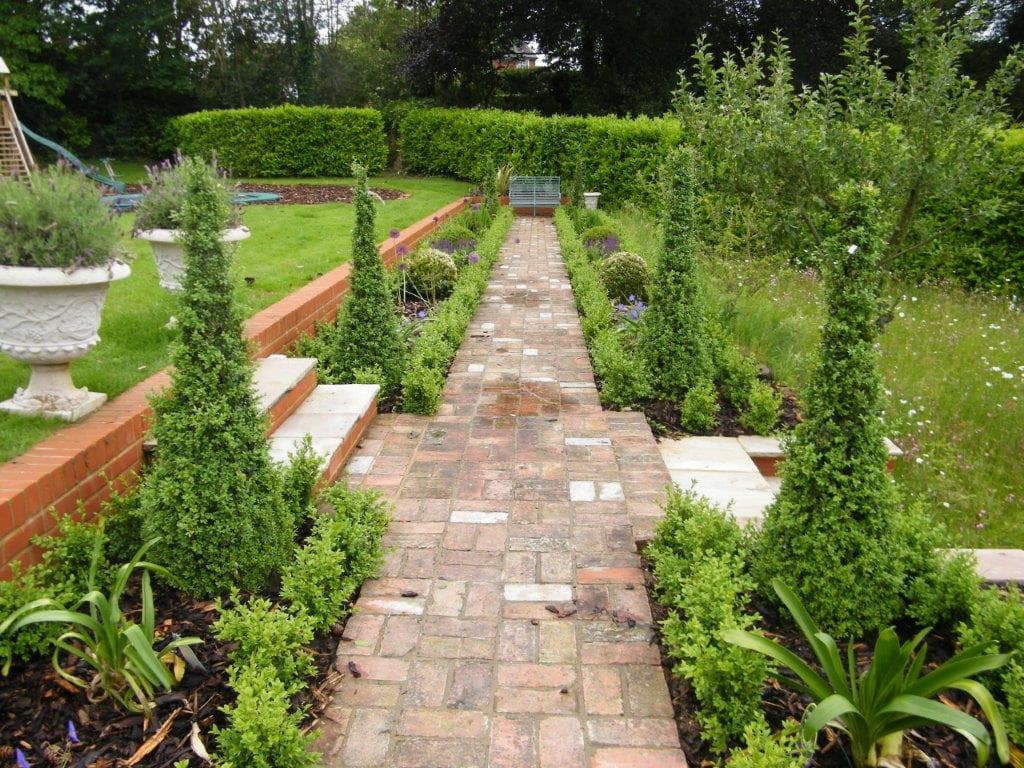
Design Fees
| Garden Size | Design-Only Fee | What You Get |
|---|---|---|
| 200-300 sqm | £2,500-£4,000 | Concept plan, planting plan, materials schedule |
| 300-500 sqm | £4,000-£6,500 | As above + 3D visuals, detailed planting plan with quantities |
| 500+ sqm | £6,500-£10,000+ | Full design package, phased build plan, tender documents |
Build Costs (Design + Build)
| Garden Size | Budget Build | Mid-Range Build | Premium Build |
|---|---|---|---|
| 200-300 sqm | £25,000-£40,000 | £40,000-£65,000 | £65,000-£100,000+ |
| 300-500 sqm | £40,000-£65,000 | £65,000-£100,000 | £100,000-£180,000+ |
| 500+ sqm | £60,000-£100,000 | £100,000-£180,000 | £180,000-£300,000+ |
What drives cost:
- Hard landscaping materials: Porcelain paving is 30-50% more expensive than Indian sandstone. Composite decking costs more upfront but lasts 25+ years.
- Site access: If materials have to go through the house or down a narrow side return, labour costs increase by 15-20%.
- Groundworks: Sloping sites need cut-and-fill, retaining walls, or terracing. Budget £8,000-£25,000 for significant level changes.
- Trees and specimen plants: A 4-metre multi-stem tree costs £250-£500 per tree, plus £150-£250 to plant and stake correctly.
Phased Build Strategy
Most large garden projects are phased. You do not need to do everything at once. A sensible approach:
Phase 1 (Year 1): Terrace, main lawn area, boundaries (fencing/hedging), essential trees
Budget: £25,000-£50,000
Phase 2 (Year 2-3): Deep planting beds, paths, destination zone (summerhouse, vegetable garden, seating area)
Budget: £15,000-£40,000
Phase 3 (Year 3-5): Refinements, lighting, irrigation, additional planting layers
Budget: £8,000-£20,000
Maintenance Realities for Large Gardens
A 400 sqm garden is not four times the work of a 100 sqm garden, but it is more work, and the work is different.
Realistic time commitment:
- Lawn mowing: 90-120 minutes per week (Apr-Oct) for 300-400 sqm lawn
- Border maintenance: 2-3 hours per month (weeding, deadheading, pruning) if well-planted
- Seasonal tasks: Hedge cutting (2-3 times per year, 4-6 hours per session), mulching (annual, 1-2 days), leaf clearing (autumn, ongoing)
Reducing the burden:
- Replace half the lawn with meadow planting. Mow twice a year instead of weekly. Costs £40-£80/sqm to establish (including soil prep and plug plants), but saves 30+ hours per year.
- Use ground cover plants in borders (Geranium, Alchemilla, Nepeta) to suppress weeds and reduce bare soil.
- Install automated irrigation for beds over 50 sqm. Costs £1,500-£4,000 depending on zone size, but saves hours of hand-watering in dry spells.
- Hire a gardener for structural tasks. Budget £150-£250 per day for an experienced gardener. One day per month (£1,800-£3,000 per year) covers hedge cutting, heavy pruning, and seasonal tidy-ups.
Common Large Garden Challenges (and How We Solve Them)
1. "The garden feels exposed and overlooked"
Solution: Layered screening. Avoid a single tall hedge at the boundary—it feels like a prison wall. Instead, use a 1.5-2m hedge (Taxus, Carpinus, Fagus) at the boundary, then plant a 3-4m tree 3-5 metres inside the plot (Amelanchier, Betula, Sorbus). This creates depth and blocks sightlines without closing the garden in.
2. "We never go to the end of the garden"
Solution: Create a destination worth visiting. A bench is not enough. Add a summerhouse, a greenhouse, a fire pit seating area, or a productive vegetable garden. Give it a clear path and make sure it is visible (or partly visible) from the house to draw you out.
3. "The garden slopes awkwardly"
Solution: Work with the slope, do not fight it. Terracing is expensive (£200-£400 per linear metre for a 1-metre retaining wall). Instead, use mown paths that switch back across the slope, or create a single level terrace at the top or bottom and leave the rest as naturalised planting on the slope.
4. "It is too expensive to do everything at once"
Solution: Phased build (see costs section above). Prioritise the terrace and main lawn in Phase 1. Add planting, paths, and the destination zone in later phases. A well-designed garden improves in stages—it does not need to be finished on day one.
Large Garden Styles: Which One Suits Your Plot?
Formal Large Garden (Best for period properties, flat sites)
- Key features: Clipped hedging, symmetrical layout, axial views, formal lawn with defined edges
- Plants: Taxus baccata (yew), Buxus (box), standard roses, pleached Carpinus (hornbeam)
- Cost premium: 20-30% higher due to precision groundwork and formal hedging
Naturalistic Large Garden (Best for rural sites, sloping plots, wildlife focus)
- Key features: Curved paths, mixed planting, meadow areas, informal pond, native hedging
- Plants: Cornus sanguinea, Crataegus, ornamental grasses, Verbena bonariensis, Echinacea
- Cost saving: Lower hard landscaping costs (gravel paths instead of paving), but higher planting density
Contemporary Large Garden (Best for modern architecture, flat sites, low-maintenance brief)
- Key features: Clean lines, limited plant palette, large-format paving, architectural planting, integrated lighting
- Plants: Phormium, Miscanthus, Stipa, clipped Taxus balls, multi-stem Betula
- Cost premium: 15-25% higher due to premium materials (porcelain, composite, corten steel)
How to Get Started with Your Large Garden Design
Step 1: Define your priorities. What do you actually want from the space? Entertaining, play area, vegetable growing, wildlife, low maintenance, or all of the above?
Step 2: Measure the plot. You need accurate dimensions. Use a 30-metre tape measure, or hire a surveyor if the plot is over 500 sqm or has significant level changes (costs £300-£600).
Step 3: Identify existing assets. Which trees, shrubs, or features are worth keeping? A mature tree can be the anchor of your design. A builder's patio probably is not.
Step 4: Set a realistic budget. Use the tables above as a guide. If your budget is below £20,000 for a 400 sqm plot, you are looking at a DIY or phased approach, not a full design-and-build.
Step 5: Work with a designer. Large gardens are expensive to get wrong. A good designer will save you money in the long run by avoiding costly mistakes (wrong materials, poor drainage, planting that fails). Design fees are 8-12% of total build cost. Budget accordingly.
We design large gardens across Kent, Surrey, Essex and London. If you have a plot over 200 sqm and you are not sure where to start, book a free site visit. We will walk the space with you, talk through what works and what does not, and give you a clear sense of what is possible within your budget.
Free consultation: Call us on 0203 834 9807 or contact us here.
Frequently Asked Questions
What size garden is considered large in the UK?
Any garden over 200 square metres (roughly 20m x 10m) where the design challenge shifts from fitting everything in to creating structure and preventing the space from feeling empty. In the South East, large gardens typically range from 250-600 sqm for suburban plots, and 600+ sqm for rural properties.
How much does it cost to design a large garden?
Design-only fees range from £2,500 for a 200-300 sqm plot to £10,000+ for gardens over 500 sqm with complex topography. Full design-and-build costs start at £25,000 for budget builds and range from £40,000-£180,000+ depending on size, materials, and site conditions. Phased builds spread the cost over 2-3 years.
How do I stop a large garden feeling empty?
Break it into zones (terrace, garden, destination) using planting, paths, and structural features like hedging, trees, or screens. A single open lawn makes large gardens feel bigger but emptier. Three distinct "rooms" create a sense of discovery and make the space feel layered and purposeful.
What are the best trees for large gardens in the UK?
Multi-stem Amelanchier lamarckii (4-6m, spring blossom, autumn colour), Betula utilis var. jacquemontii (8-12m, white bark), Malus 'Evereste' (5-7m, spring blossom, autumn fruit), and Quercus ilex (10-15m+, evergreen, architectural). Plant 2-4 trees in a 400 sqm garden for structure without overcrowding.
How do I reduce maintenance in a large garden?
Replace part of the lawn with wildflower meadow (mow twice per year instead of weekly), use ground cover plants (Geranium, Alchemilla) in borders to suppress weeds, install automated irrigation for beds over 50 sqm, and hire a gardener for structural tasks (hedge cutting, heavy pruning) 1-2 days per month.
Do I need planning permission for a large garden redesign?
Generally no. Garden landscaping, planting, patios, and paths do not require planning permission. You do need permission for structures over 2.5m high (summerhouses, pergolas), buildings within 2m of the boundary over 2.5m high, or if your property is listed or in a conservation area. Check with your local planning authority before building. See our garden room planning permission guide for more detail.
How long does it take to design and build a large garden?
Design phase: 6-10 weeks from initial brief to final plans. Build phase: 4-8 weeks for a straightforward 300 sqm garden, 8-16 weeks for larger or complex sites (sloping ground, mature tree work, drainage). Planting establishes over 2-3 growing seasons. Plan for 6-12 months from first meeting to a finished, planted garden.