
If you have ever been told your north-facing garden is a problem, forget it. We have designed dozens of shady plots across Kent, Surrey and London, and some of the most beautiful, atmospheric gardens we have ever created face north. The trick is not fighting the shade. It is working with it.
A north-facing garden simply means the back of your house faces north, so the garden sits largely in the shadow of the building for much of the day. In summer, the far end of the garden and the boundaries often catch evening sun. In winter, direct light can be scarce. That is not a limitation. It is a brief, and a good designer works brilliantly within a brief.
This guide covers everything you need to know to turn a shady, north-facing plot into a genuinely lovely garden. Layout principles, the best plants for shade in the UK, hard landscaping choices, costs, and the common mistakes we see homeowners make before they call us.
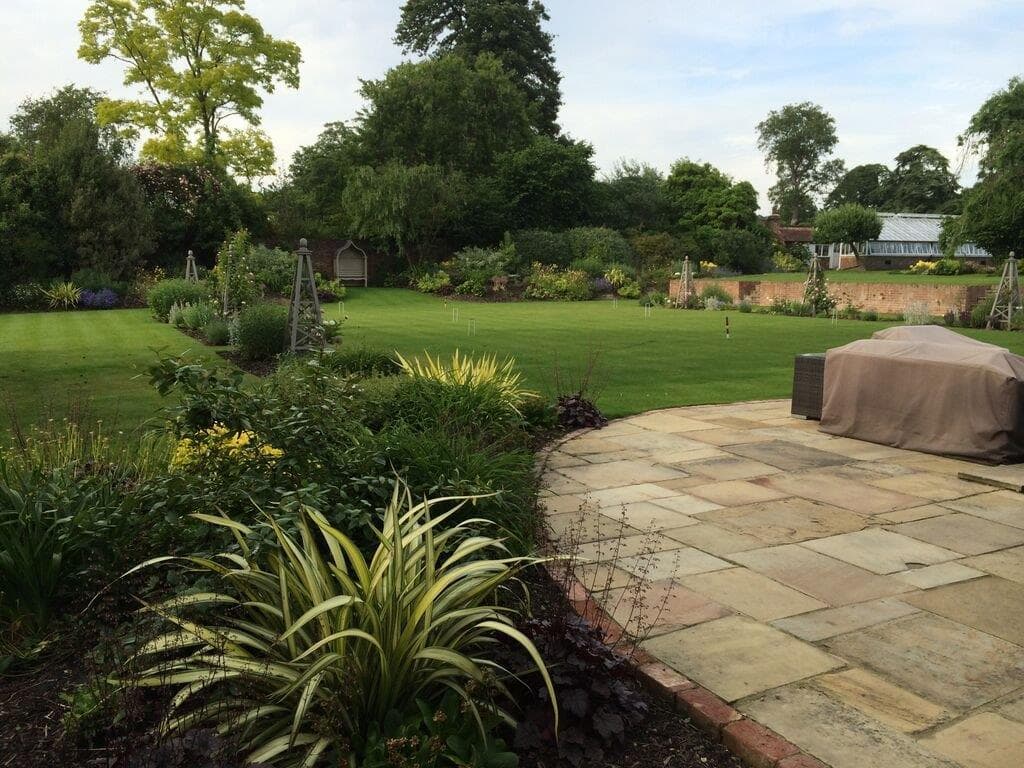
Why North-Facing Gardens Get a Bad Reputation
Estate agents mention it as a negative. Buyers worry about it. But the reality is more nuanced than south-facing good, north-facing bad.
A south-facing garden in central London can be a sun-scorched, overheated rectangle where you are squinting into direct light all afternoon. A north-facing plot gives you cool, dappled conditions that feel restful and green. Your patio does not bake. Your plants do not fry. You sit comfortably outside on the hottest days of summer without needing a parasol.
The challenges are real but manageable. Less direct sunlight means fewer options for sun-loving plants. Soil stays damper for longer. Moss can colonise hard surfaces. And in winter, a north-facing garden can feel genuinely dark.
Every one of those problems has a design solution. That is what the rest of this guide is about.
Understanding Light in a North-Facing Garden
Before you design anything, you need to understand exactly how light moves through your plot. This is the single most important step, and it is the one most people skip.
Go outside at 9am, 12pm, 3pm and 6pm on a sunny day. Note where the light falls at each point. Take photos from the same spot. You will almost certainly discover that your garden is not uniformly shady. Most north-facing gardens in South East England have at least one corner or strip that catches afternoon or evening sun, particularly in summer when the sun tracks higher and further west.
That sunny patch is where your seating goes. Not against the back wall of the house, which is the instinctive choice but almost always the shadiest spot in a north-facing plot. Move the patio away from the building. Put it where the light actually is, even if that means it sits in the middle or at the far end of the garden.
Light Zones to Map
We divide every north-facing garden into three light zones when we start a design:
Deep shade is the strip immediately behind the house, typically 2 to 4 metres deep depending on the height of the building. This area gets almost no direct sun. It is the place for ferns, hostas, woodland plants and a simple, clean path or paved area that you walk through rather than sit in.
Partial shade is the middle section. It gets some indirect light and possibly an hour or two of direct sun at the edges. This is where the richest planting goes, mixing shade-tolerant shrubs with a few plants that cope with dappled light.
Brightest zone is the far end and the side boundaries, where the sun reaches in the afternoon and evening. This is where you put your main seating, your containers of colour, and any plants that need more light.
Layout Principles for Shady Gardens
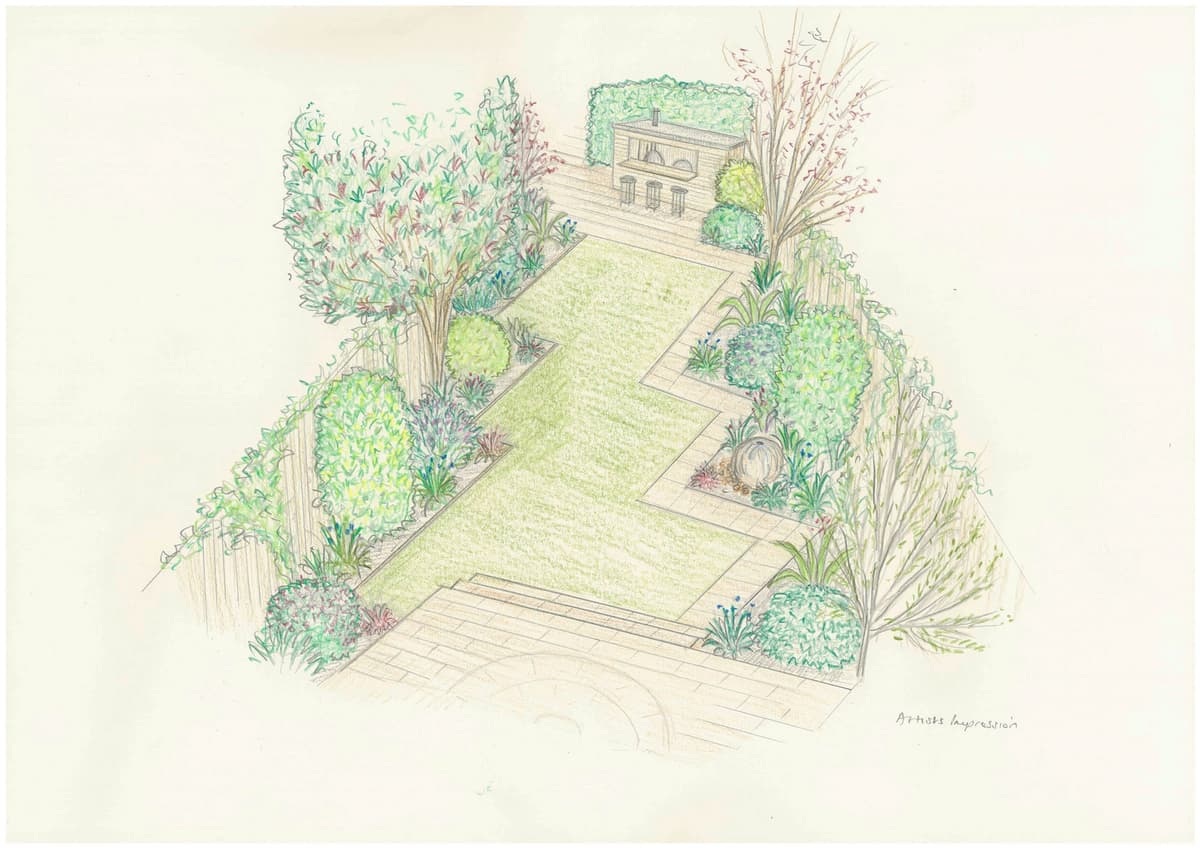
The layout of a north-facing garden matters more than in a sunny plot. You cannot rely on bright flowers and green lawn to carry the design. Structure, materials and spatial flow do the heavy lifting.
Zone the Space Into Rooms
Dividing a shady garden into two or three distinct areas makes it feel larger and gives each zone a purpose. The transition from the house might be a clean paved area with a few pots of Japanese-inspired planting. The middle section could be a planted walkway with climbers on the boundary walls. The far end becomes your seating area, positioned to catch whatever sun is available.
Changes of level help enormously. Even a single step up or down creates the sense of moving into a different space. If your plot slopes, terracing gives you flat, usable platforms and the retaining walls become planting pockets for trailing ferns and creeping perennials. Our guide to sloping garden design covers the practicalities of terracing in detail.
Use Diagonal Lines
A north-facing garden behind a terraced house is typically 4 to 6 metres wide. Laying paving or a path on the diagonal makes the space feel wider. A 4-metre-wide garden reads as 5.6 metres corner to corner when you angle the layout at 45 degrees. It is a simple trick, but it genuinely works.
Keep Boundaries Green, Not Bare
Bare fences and brick walls make a shady garden feel cold and enclosed. Covering them with climbers trained on horizontal wires transforms the boundaries from barriers into living walls. This does not cost you any floor space, which matters in a small garden. The planting sits flat against the wall, and the boundary effectively disappears behind greenery.
Best Plants for a North-Facing Garden in the UK
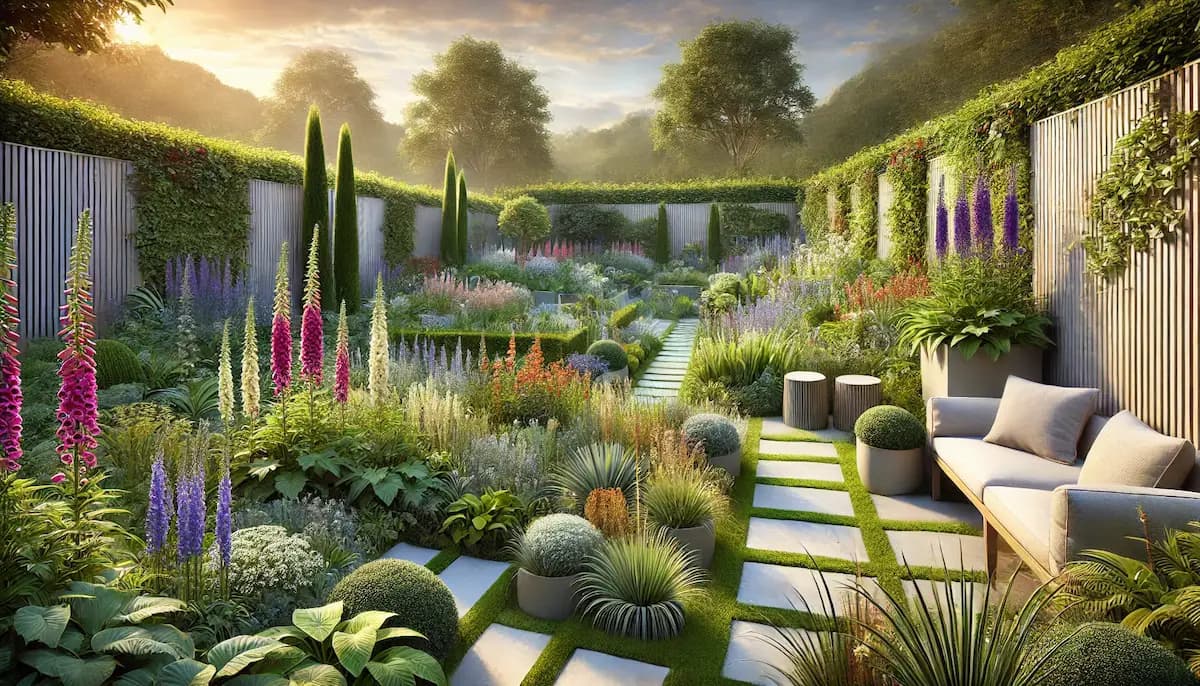
This is where north-facing gardens genuinely excel. The range of shade-loving plants that thrive in the UK is enormous, and many of them are among the most elegant, textural plants in horticulture. You will not get a blaze of Mediterranean colour, but you can create something far more sophisticated.
Climbers for Shady Walls
Your boundary walls are your biggest asset. Cover them and you transform the feel of the entire garden.
Hydrangea anomala subsp. petiolaris (climbing hydrangea) is the undisputed queen of the north wall. Self-clinging, deciduous, covered in lacy white flower heads in June and July. It takes a couple of years to establish, then grows vigorously to 8 metres or more. Happy on a fully north-facing wall. Expect to pay around 15 to 25 pounds for a 2-litre pot.
Trachelospermum jasminoides (star jasmine) handles partial shade well, though it prefers a sheltered spot. The fragrance in July is extraordinary. Evergreen, so you get year-round cover. Needs wires or trellis for support. Around 20 to 30 pounds for a decent plant.
Clematis montana grows like wildfire in partial shade and produces masses of pale pink or white flowers in May. Vigorous enough to cover a large wall in two to three seasons. Prune immediately after flowering. From 12 to 18 pounds.
Pileostegia viburnoides is a lesser-known evergreen, self-clinging climber that flowers in late summer with creamy white panicles. Completely shade-tolerant. Slow to start but magnificent once established. Around 18 to 25 pounds.
Shrubs That Love the Shade
Fatsia japonica gives you instant architectural drama with its huge, glossy palmate leaves. Evergreen, tough as old boots, completely unbothered by deep shade. Grows to about 2.5 metres. Around 15 to 40 pounds depending on size.
Sarcococca confusa (Christmas box) is a compact evergreen shrub with tiny white flowers in January and February that fill the entire garden with an intense, sweet fragrance. Plant it near a path or doorway where you will walk past it in winter. From 8 to 15 pounds.
Camellia japonica varieties flower from February to April in shades of pink, red and white. They need acidic or neutral soil, which rules out chalky parts of the North Downs, but they are perfect for the clay soils found across much of Kent, Surrey and South London. Expect to pay 25 to 60 pounds for a well-sized specimen.
Aucuba japonica Crotonifolia (spotted laurel) is sometimes dismissed as old-fashioned, but the gold-speckled evergreen foliage lights up a dark corner like nothing else. Completely shade-proof. Red berries in autumn on female plants. From 10 to 25 pounds.
Skimmia japonica gives you red buds through winter, white flowers in spring, and red berries in autumn (on female plants). Compact, evergreen, shade-loving, and fragrant. You need a male and female plant for berries, or choose the self-fertile Reevesiana. Around 10 to 20 pounds.
Perennials for the Middle Ground
This is where your garden comes alive with texture and seasonal interest.
Hostas are the classic shade perennial for good reason. Halcyon has blue-grey leaves that glow in low light. Sum and Substance is chartreuse-gold and enormous. Frances Williams is blue-green edged with gold. Slugs are the enemy. Use copper tape around containers, nematodes in the soil, and beer traps if you are feeling traditional. From 6 to 15 pounds per plant.
Dryopteris erythrosora (autumn fern) unfurls copper-coloured fronds in spring that age to deep green. Semi-evergreen and completely reliable. One of the best ferns for a designed garden. Around 8 to 12 pounds.
Brunnera macrophylla Jack Frost has silver, heart-shaped leaves veined with green and sprays of forget-me-not-blue flowers in spring. It genuinely illuminates dark ground. Around 8 to 12 pounds.
Hakonechloa macra Aureola is a Japanese forest grass with arching, golden-green leaves that ripple in the slightest breeze. It looks stunning cascading over the edge of a raised bed or step. Slow-growing but worth the wait. Around 8 to 14 pounds.
Astrantia major produces intricate, pincushion flowers from June to September in shades of pink, white and deep ruby. Brilliant for cutting, and the seed heads look architectural through winter. Perfectly happy in partial shade. From 6 to 12 pounds.
Digitalis purpurea (foxglove) self-seeds freely and provides vertical drama in May and June. Biennial, so plant in successive years for continuous display. Native, brilliant for pollinators, and completely at home in shade. Seeds cost pennies. Plants from 3 to 6 pounds.
Ground Cover for Difficult Spots
Bare soil in a shady garden quickly becomes mossy or muddy. Ground cover plants solve this while adding texture.
Geranium macrorrhizum forms dense, weed-suppressing mats of aromatic foliage with pink or white flowers in early summer. Semi-evergreen, drought-tolerant once established, and tough as anything. Divide and spread every few years. From 5 to 8 pounds.
Epimedium x versicolor Sulphureum has delicate yellow flowers in spring above heart-shaped leaves that turn bronze in autumn. Superb under trees or along the base of a shady wall. From 8 to 12 pounds.
Vinca minor (lesser periwinkle) trails along the ground with blue or white flowers from April to June. Evergreen, vigorous, and happy in the deepest shade. Be warned, it can be invasive in good conditions. Plant where you want it to spread and it will do exactly that. From 4 to 8 pounds.
Hard Landscaping for North-Facing Gardens
Material choices matter more in a shady garden because surfaces stay damp for longer. The wrong material can become slippery, green with algae, or look perpetually grubby.
Paving
Porcelain paving is the best choice for a north-facing garden. It is non-porous, resists algae growth, barely needs cleaning, and comes in a range of colours and finishes. Expect to pay 40 to 80 pounds per square metre for supply, and 80 to 130 pounds per square metre installed including groundworks. Our garden patio ideas guide covers material comparisons in more detail.
Natural stone (sandstone, limestone) looks beautiful but needs more maintenance in shade. Sandstone in particular can become slippery without annual cleaning. If you want natural stone, choose a sawn finish rather than riven, as the smoother surface is easier to keep clean.
Avoid timber decking in a fully shaded north-facing garden unless you choose composite. Timber decking in shade becomes dangerously slippery within a season. Composite decking handles moisture much better, though it still needs occasional cleaning. See our garden decking ideas for costs and material comparisons.
Gravel and Aggregate
Gravel works well in shady gardens. It drains freely, does not get slippery, and the crunch underfoot adds sensory interest. Use a 10mm to 20mm angular gravel on a compacted sub-base with a weed membrane beneath. Cost is typically 25 to 45 pounds per square metre installed.
Lighting
Good lighting transforms a north-facing garden. Because you get less natural light, artificial lighting becomes more important earlier in the day, particularly from autumn onwards.
Use warm white LEDs (2700K to 3000K). Uplighting through foliage creates beautiful shadow patterns on walls and fences. Recessed path lights along walkways make the garden feel safe and inviting. Festoon lights strung across a seating area give warmth and atmosphere.
A basic low-voltage LED lighting scheme for a small garden costs from 800 to 2,000 pounds installed. A more comprehensive scheme with individual plant uplights, path lighting and feature spots might run to 3,000 to 5,000 pounds. Our guide to garden lighting covers the options in detail.
What Does a North-Facing Garden Design Cost?
Costs vary depending on garden size, materials and how much planting you want. Here are realistic 2026 figures for the South East.
| Garden Size | Design Only | Design and Build |
|---|---|---|
| Small (up to 30 sqm) | 1,500 to 3,000 pounds | 8,000 to 18,000 pounds |
| Medium (30 to 80 sqm) | 2,500 to 5,000 pounds | 18,000 to 40,000 pounds |
| Large (80 sqm+) | 4,000 to 8,000 pounds | 40,000 to 80,000+ pounds |
North-facing gardens do not necessarily cost more than sunny ones. You may spend slightly more on shade-tolerant specimen plants, which tend to be slower-growing and therefore pricier at a given size. But you save on sun-related features like pergolas, shade sails and irrigation systems. The overall budget tends to even out.
For a detailed breakdown of fees and materials, see our guide to garden design costs in London.
Common Mistakes in North-Facing Garden Design
We see the same errors repeatedly when homeowners tackle a shady garden without professional guidance.
Putting the patio against the house. It is the shadiest spot. You will never want to sit there. Move the seating to where the light actually reaches.
Planting sun-lovers and hoping for the best. Lavender, roses, most Mediterranean plants and anything that needs full sun will sulk, stretch, refuse to flower, and eventually die. Do not plant them in deep shade. There are hundreds of beautiful alternatives.
Choosing pale fences and expecting them to stay that way. Light-coloured fences in a shady, damp garden go green with algae within months. Either commit to regular cleaning, choose a darker stain that disguises the algae, or cover the fence with climbers so you never see it. Our garden fence ideas guide has more on colours and materials.
Ignoring the soil. North-facing gardens in the South East typically sit on heavy clay that stays wet. Improve drainage before you plant. Dig in generous amounts of organic matter, use grit in planting holes for shrubs, and consider raised beds if the soil is truly waterlogged. Clay soil is actually very fertile once you improve its structure.
Laying a lawn in deep shade. Grass needs at least four hours of direct sunlight to thrive. In a heavily shaded plot, a lawn becomes a mossy, patchy mud strip. Replace it with hard landscaping, ground cover planting, or artificial turf if you want the green look without the maintenance battle.
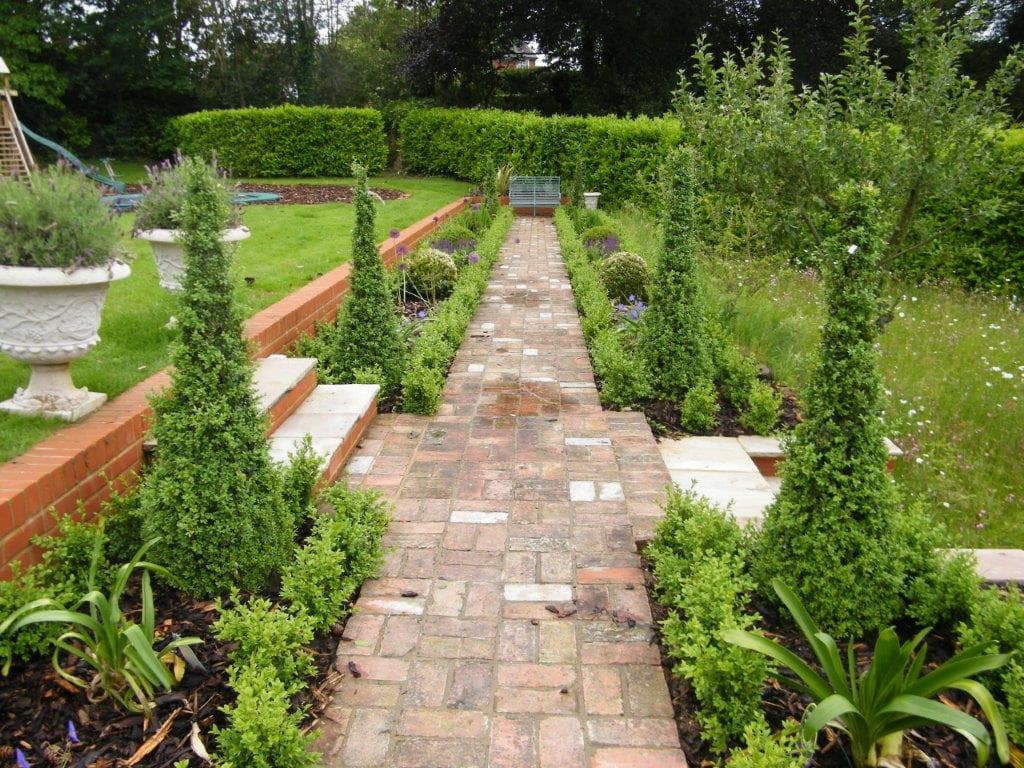
Design Ideas for Specific North-Facing Situations
Narrow Terraced House Garden
The typical Victorian or Edwardian terraced house has a garden roughly 4 to 6 metres wide and 8 to 12 metres long. North-facing versions are among the trickiest plots in residential garden design.
Use the diagonal layout trick to gain perceived width. Zone into a paved area near the house (for bins, storage, washing line), a planted middle section with climbers on the walls, and a seating area at the sunny far end. Keep the palette simple: one paving material, one fence colour, a limited range of plants repeated for cohesion. Our courtyard and small garden design guide covers layout techniques for tight spaces.
Suburban Semi-Detached Garden
More space to play with, typically 8 to 12 metres wide and 15 to 25 metres long. The far end of the garden often gets decent light in summer. Consider a woodland-style planting scheme through the shady middle section, using native and naturalistic plants that create the feeling of walking through a clearing. Plant a wildlife-friendly section with a log pile, native shrubs and a small pond if there is room.
Basement Courtyard
Basement courtyards below street level are the most challenging shade gardens. They are enclosed on all sides and get very little direct light. The key is to keep the palette minimal, use mirrors to bounce what light there is, choose the toughest shade plants (ferns, fatsia, ivy, box), and invest in good lighting that extends usability into the evening.
Month-by-Month Interest in a Shady Garden
A well-designed north-facing garden should look good in every month, not just summer. Here is how to plan for year-round interest.
| Month | Key Interest | Star Plants |
|---|---|---|
| January to February | Fragrance, early flowers | Sarcococca, snowdrops, winter aconites, Hamamelis |
| March to April | Spring bulbs, fresh foliage | Hellebores, primroses, brunnera, fern unfurling |
| May to June | Climbers flowering, peak leaf | Clematis montana, climbing hydrangea, foxgloves, astrantia |
| July to August | Foliage at its best, hostas peak | Hostas, Hakonechloa, hydrangeas, astilbe |
| September to October | Autumn colour, berries | Autumn fern, Aucuba berries, Skimmia buds, cyclamen |
| November to December | Evergreen structure, bark | Fatsia, camellia buds, ivy, holly, Cornus stems |
How We Design North-Facing Gardens
Every project starts with a site visit. We assess the light at different times of day, test the soil, measure the plot, photograph the existing conditions, and talk to you about how you want to use the space. We need to understand your life, not just your garden.
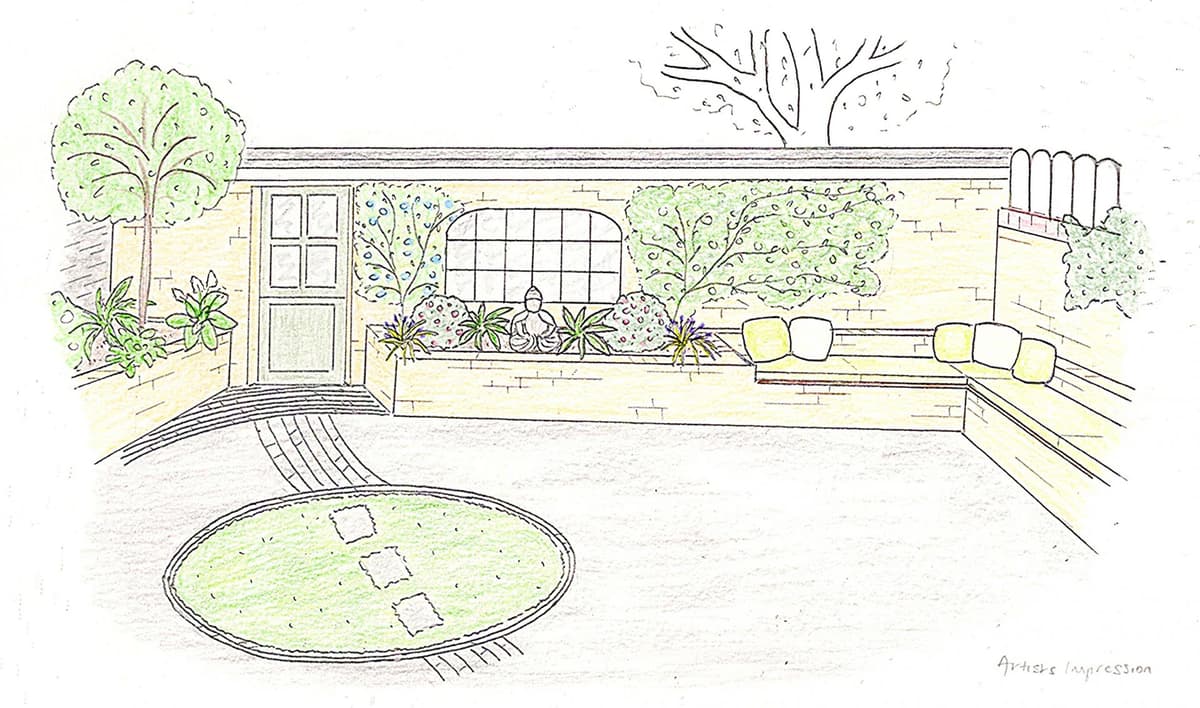
From there, we produce hand-drawn concept sketches and then detailed 3D visualisations that show you exactly how the finished garden will look. For a north-facing garden, this is especially valuable because it lets you see how light and shadow will fall across the design at different times of year.
We design across Kent, Surrey, Essex and London. If you have a shady garden you are not sure what to do with, book a free consultation and we will show you what is possible. Call us on 0203 834 9807.
Frequently Asked Questions
Can you grow vegetables in a north-facing garden?
Some vegetables cope with partial shade. Lettuce, spinach, radishes, chard, kale and most herbs (mint, parsley, chives) will produce a crop with as little as three to four hours of light. Tomatoes, peppers and courgettes need full sun and will not perform well in a north-facing plot.
Is a north-facing garden a problem for selling a house?
A beautifully designed north-facing garden is a selling point, not a drawback. Buyers respond to how a garden looks and feels, not which compass direction it faces. A well-planted, well-lit, well-maintained shady garden will always outperform a neglected south-facing one.
How do I stop my north-facing garden getting waterlogged?
Improve the soil with organic matter to increase drainage. Add grit to planting holes on heavy clay. Consider a simple French drain along the lowest edge if water pools. Raised beds lift plants above the wettest ground. And choose plants that actually enjoy moist conditions, there are plenty of them.
Do I need planning permission for a wall or fence in a north-facing garden?
Rear boundary fences up to 2 metres high do not normally need planning permission in England. Front boundaries beside a road are limited to 1 metre. If your garden is in a conservation area, check with your local council before installing any boundary treatment. Our planning permission guide covers the rules in more detail.
What is the best colour to paint a fence in a shady garden?
Dark greens, charcoals and blacks recede and make boundaries disappear, which makes the garden feel larger. Light colours show algae and dirt quickly in damp shade. If you want a light fence, commit to cleaning it at least once a year, or better still, cover it with climbers.