
A pergola is one of those rare garden features that earns its place almost immediately. It gives you vertical structure where you need it, shade where there was glare, and a framework for the climbers that soften everything else. But it only works if you get three things right: position, proportion, and material.
We have designed dozens of gardens across Kent, Surrey, Essex and London where a pergola was the anchor that made the whole space legible. Sometimes it shelters a dining terrace. Sometimes it frames a view or marks the transition from paving to lawn. And sometimes it is the thing that gives a flat, featureless plot the architecture it was missing.
This guide walks through everything you need to know about pergola design in the UK, from where to site it to which climbers will actually thrive in your conditions. Not the glossy magazine version. The version that works when your garden faces north-east, your neighbour's extension casts shade until 2pm, and your budget is real.
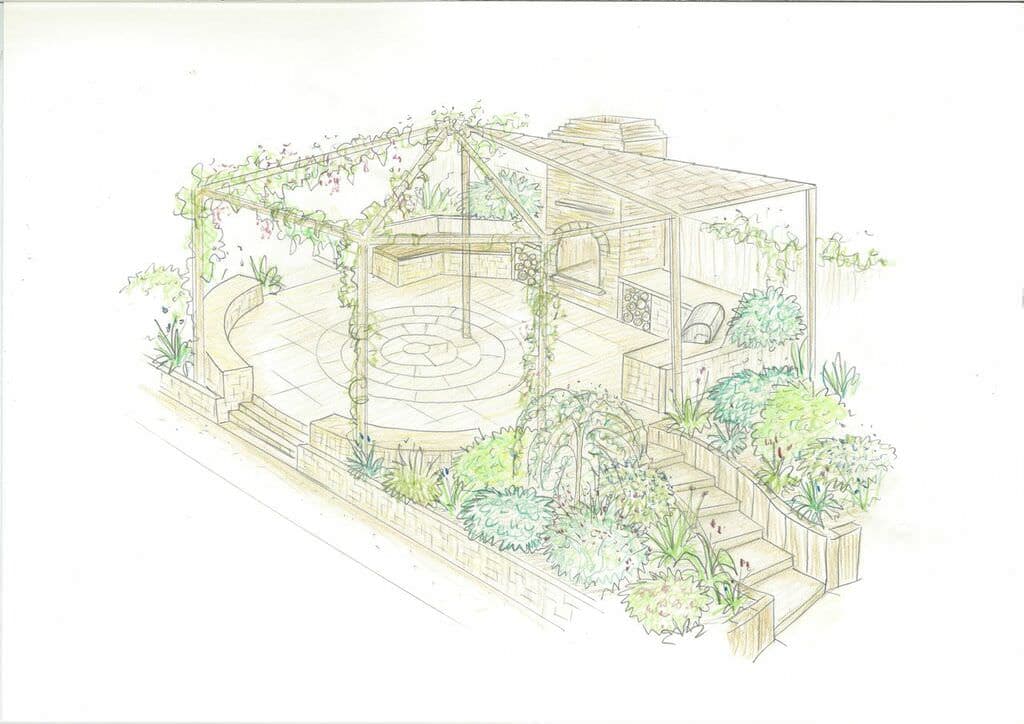
What a Pergola Actually Does in a Garden
A pergola is a structure with vertical posts supporting horizontal beams (rafters) and cross-pieces (purlins), creating an open-topped canopy. Unlike a gazebo or garden room, it does not have a solid roof. Instead, it offers dappled shade and a framework for climbing plants.
The three reasons we specify pergolas in our designs:
- Vertical structure. Gardens that feel flat benefit immediately from a well-placed pergola. It draws the eye up, creates layers, and breaks the monotony of fence-hedge-lawn.
- Shade without enclosure. A solid roof makes a space feel closed in. A pergola gives enough shade for comfortable outdoor dining while keeping sightlines open and light levels high.
- Planting opportunity. Climbers like roses, wisteria, and clematis need something substantial to grow on. A pergola provides that framework while looking intentional from day one, even before the plants establish.
When NOT to use a pergola
Before you commit, consider whether you actually need one:
- If your garden is already heavily shaded, a pergola draped in climbers will make it darker. A simple raised bed with tall grasses or an architectural shrub like Fatsia japonica gives you vertical interest without losing light.
- If your outdoor space is tiny (under 15 sqm), a pergola can overwhelm. An arch or a wall-mounted trellis with a single climber achieves a similar effect without dominating the space.
- If you want proper weather protection, a pergola will not deliver it. Consider a covered garden room with a solid roof, a louvred pergola (which costs 3-4x more), or a simple cantilever parasol instead.
Where to Position a Pergola
Placement is everything. A pergola in the wrong spot is expensive scaffolding. In the right spot, it transforms how the garden feels and how you use it.
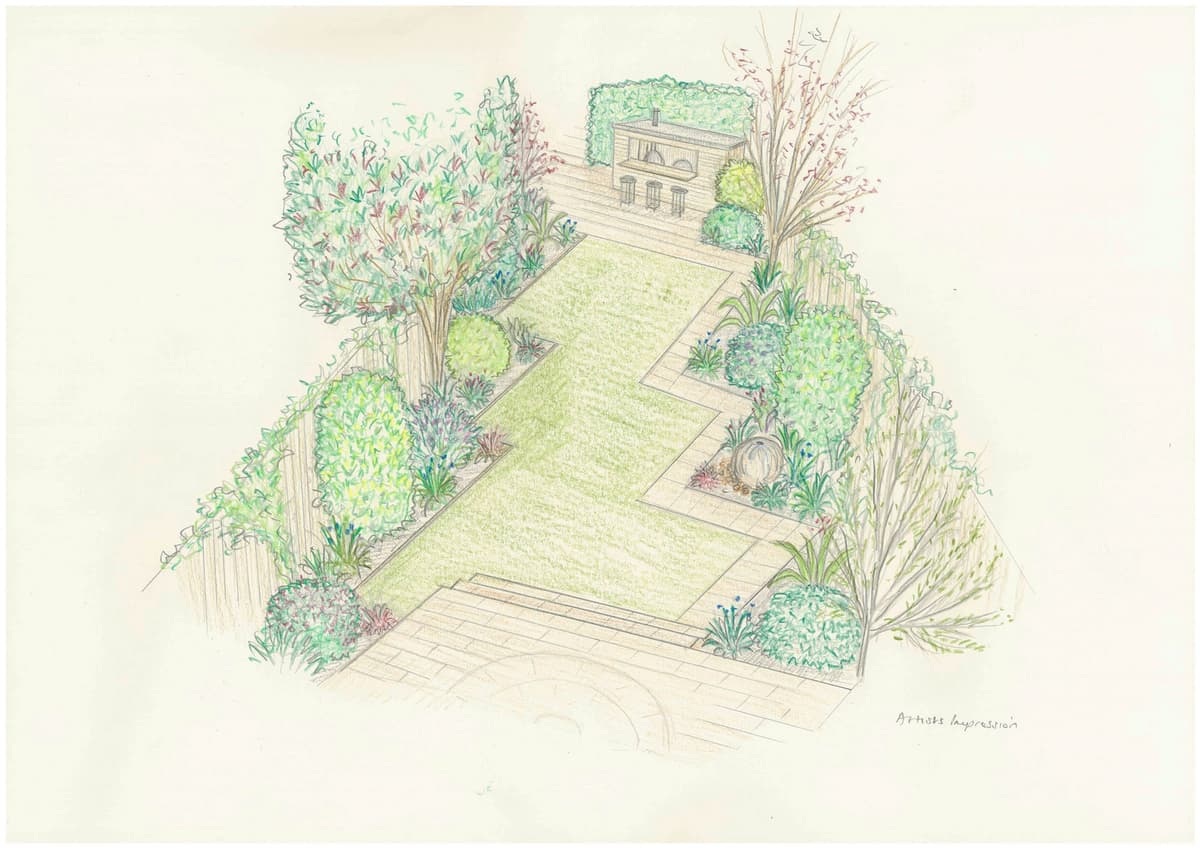
Attached vs Freestanding
Attached pergolas connect to the house wall and extend over a patio or terrace. They create a seamless transition between indoors and outdoors, shelter the back door, and make the terrace feel like an outdoor room.
Pros: Easy access to the house, cost-effective (fewer posts required), integrates naturally with the building.
Cons: Limits light into adjacent rooms, needs wall fixings that can be tricky on certain facades, and the scale needs to match the house.
Freestanding pergolas stand independently in the garden. They work beautifully as a destination — a sheltered seating area at the end of a path, a shaded dining spot surrounded by planting, or a focal point framing a view.
Pros: Flexibility of placement, does not affect the house, creates a distinct zone in larger gardens.
Cons: More posts required (higher cost), needs stronger foundations, and you lose the direct connection to indoor living spaces.
Our rule: If your patio or terrace is immediately outside the house and you eat or sit there regularly, attach the pergola. If the best sitting spot is further into the garden or you want to create a second outdoor room, go freestanding.
Sun, Shade, and Aspect
Pergolas work best where you need shade but still want some sun. A pergola over a south or west-facing terrace offers relief from midday glare while letting morning and evening light through. If your terrace faces east, a pergola adds structure without blocking the morning sun. But on a north-facing terrace, a pergola will make the space feel cave-like unless you use it solely for structural effect and keep planting minimal.
Check the shadow line. Walk your garden at different times of day and note where shadows fall. The ideal position for a pergola is where you get sun from late morning through early afternoon but want dappled shade by 2pm.
Integration with Hard Landscaping
A pergola should sit naturally within your garden layout, not look like an afterthought:
- Align with existing features. If you have a rectangular terrace, align the pergola with one edge rather than plonking it in the middle. If you have a path, let the pergola frame or extend it.
- Leave space for planting. A pergola surrounded by bare paving looks stark. Leave at least 60cm of planting bed along one or two sides for climbers and ground-level interest.
- Consider levels. If your terrace is raised, the pergola posts can double as retaining wall supports or balustrade uprights, saving cost and improving the overall structure. For guidance on managing sloping sites, see our sloping garden design guide.
Materials: Timber vs Aluminium
Your material choice shapes the entire aesthetic of your garden. Get this wrong and the pergola will look out of place no matter how well you position it.
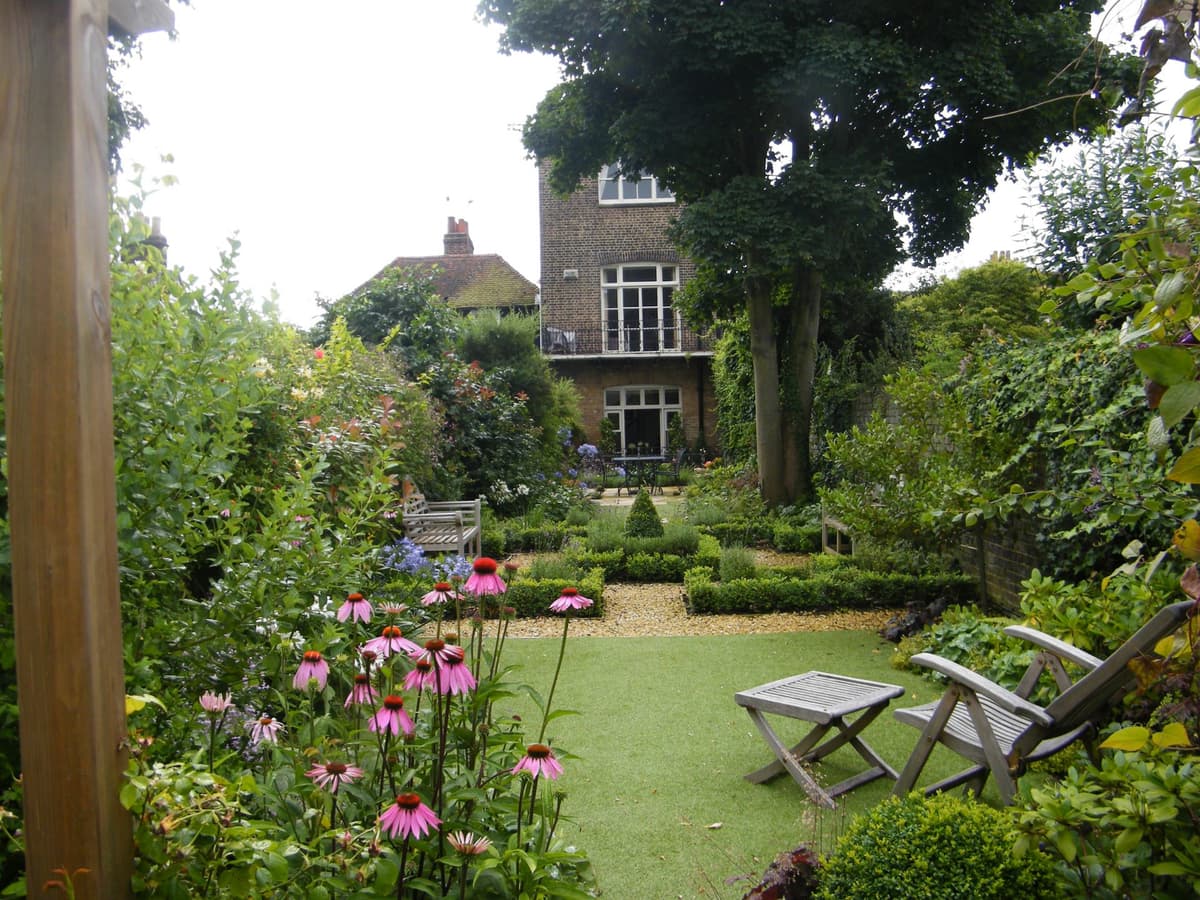
Timber Pergolas
Timber is the traditional choice. Oak, sweet chestnut, and pressure-treated softwood are the most common options in the UK.
Oak: The best option for a permanent, high-quality structure. It weathers to a silvery grey, needs no treatment, and lasts 30+ years. Cost: £150-£250 per linear metre installed for 150mm x 150mm posts.
Sweet chestnut: Similar durability to oak but lighter in colour and slightly cheaper. £120-£200 per linear metre installed.
Pressure-treated softwood: The budget option. Needs annual staining or oiling to prevent rot. Lasts 10-15 years if maintained properly. £60-£100 per linear metre installed.
When to choose timber:
- Traditional or cottage-style gardens
- Period properties where metal would jar
- You want a natural material that ages gracefully
- You plan to grow vigorous climbers (timber provides better fixing points for wires)
Drawbacks:
- Needs maintenance (especially softwood)
- Can warp or split if not properly seasoned
- Heavier, so requires stronger foundations
Aluminium Pergolas
Aluminium is lighter, rust-proof, and virtually maintenance-free. Modern powder-coated finishes in anthracite grey, black, or bronze integrate well with contemporary properties.
Cost: £180-£350 per linear metre installed for a standard freestanding structure. Louvred aluminium pergolas with adjustable roofs start at £8,000 for a 3m x 3m unit.
When to choose aluminium:
- Contemporary or new-build properties
- You want zero maintenance
- The pergola will be attached to glazed doors or modern extensions
- You prefer clean lines and minimal visual weight
Drawbacks:
- More expensive upfront
- Less characterful; can look generic if you choose a standard catalogue design
- Harder to fix climbing plant supports (though not impossible)
Our recommendation: For most traditional gardens in the South East, go with oak or sweet chestnut. The initial cost is higher, but the structure will outlast you and it looks right in a UK garden. For modern builds or minimal upkeep, aluminium makes sense, but spend on a bespoke design rather than an off-the-shelf kit.
Sizing and Proportions
A pergola that is too small looks apologetic. One that is too large dominates. The trick is balancing coverage with the scale of your garden.
Standard Dimensions
Height: 2.2m to 2.5m from ground level to the underside of the main beams. This gives comfortable headroom (most people are under 1.9m) and allows tall climbers to drape without you walking into them.
Width: For a dining pergola, allow at least 3m x 3m. This fits a table for six with space to move chairs. For a walkway or transitional pergola, 1.8m to 2m wide is sufficient.
Rafter overhang: Beams should extend 20-40cm beyond the posts. This gives the structure better proportions and provides more shade.
Rafter spacing: 30-50cm between parallel rafters. Closer spacing creates more shade; wider spacing lets in more light and gives climbers room to weave through.
Proportion to Garden Size
- Small gardens (under 50 sqm): Limit the pergola to no more than 15-20% of the total garden area. A 2.5m x 2.5m structure is often the maximum. See our small garden design guide for more on making the most of compact spaces.
- Medium gardens (50-100 sqm): A 3m x 4m pergola works well, either attached to the house or freestanding as a focal point.
- Large gardens (100+ sqm): You can go larger (4m x 5m or more), but consider two smaller structures in different zones rather than one giant canopy. For more on zoning large gardens, see our dedicated guide.
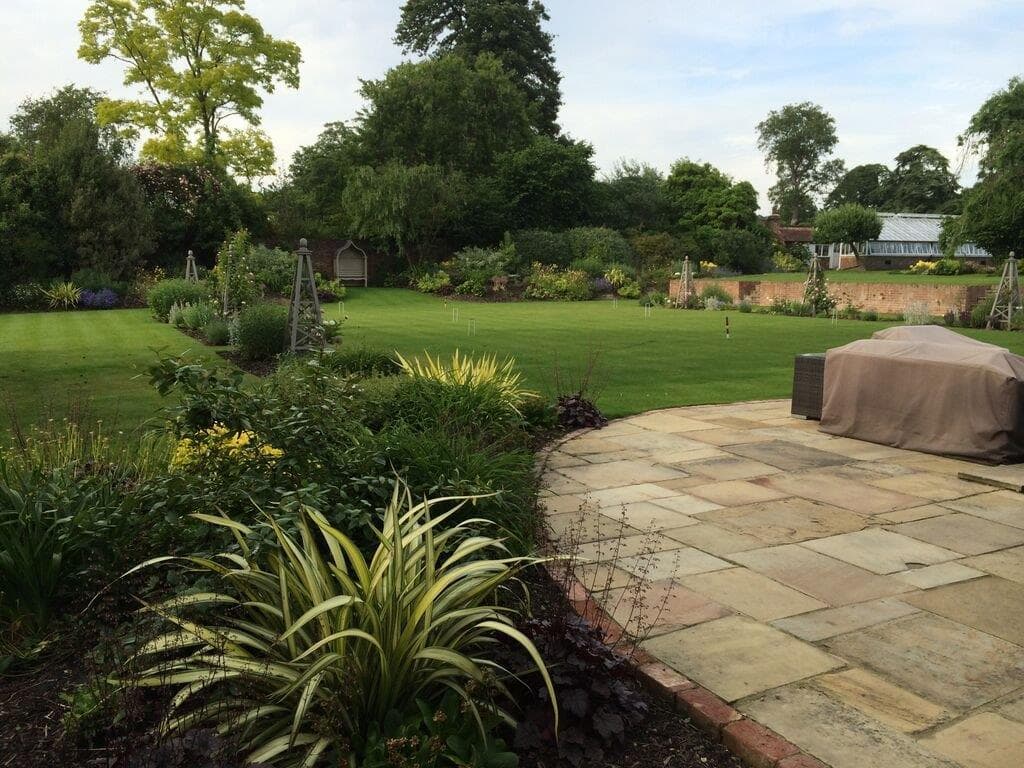
Common Sizing Mistakes
- Making it too narrow. A 2m x 4m pergola feels like a corridor, not a room. Aim for squarer proportions unless you are deliberately creating a walkway.
- Forgetting furniture clearance. Measure your table and chairs, then add 80cm on all sides. That is your minimum footprint.
- Matching it to the patio exactly. If your terrace is 4m wide, do not make the pergola 4m wide. Either go slightly smaller (3.5m) to leave planting space at the edges, or extend it beyond the paving to create a larger sheltered zone.
Planting: What to Grow on Your Pergola
An unplanted pergola is a missed opportunity. The right climbers add colour, scent, shade, and soften the structure without turning it into a maintenance headache.
Best Climbers for Full Sun (South or West-Facing Pergolas)
Wisteria sinensis: The classic choice. Fragrant violet-blue or white flowers in late May. Vigorous, needs annual pruning. Will cover a 4m x 4m pergola in 4-5 years.
Rosa 'Albertine': Rambling rose with coppery-pink blooms in June. Scented, disease-resistant, and tolerates some neglect. Needs tying in but manageable.
Vitis vinifera 'Purpurea' (ornamental grape vine): Large purple leaves in summer, stunning autumn colour. Provides dense shade by July. Needs hard pruning in winter.
Trachelospermum jasminoides (star jasmine): Evergreen, scented white flowers in summer, slower-growing but worth the wait. Good for milder areas of the South East.
Best Climbers for Part Shade (East-Facing or Dappled Shade)
Hydrangea petiolaris (climbing hydrangea): Self-clinging, white lacecap flowers in June. Slow to establish but bombproof once settled. Good for shadier pergolas.
Clematis montana: Vigorous, smothers a pergola in pink or white flowers in May. Needs cutting back hard every few years but minimal day-to-day care.
Lonicera periclymenum 'Serotina' (honeysuckle): Scented, flowers from June to September, happy in part shade. Twining habit, easy to manage.
Planting and Training
- Plant climbers 30-40cm away from the posts, not right against them. This gives roots space and reduces the risk of rot at the base of timber posts.
- Use galvanised wire or trellis fixed to the posts to guide young plants up to the pergola beams. Once they reach the top, they will find their own way across.
- Prune annually to stop climbers getting congested and to maintain airflow. Wisteria needs summer and winter pruning. Roses need deadheading and light thinning in late winter. Clematis depends on the type — montana group needs cutting back after flowering.
- Do not plant more than two or three different climbers on one pergola. You want a cohesive look, not a botanical scrum.

Pergola Design Alternatives
Sometimes a full pergola is overkill. Here are the options we suggest when a pergola does not quite fit the brief:
Garden arch: A single arch over a path or gateway gives vertical structure and a planting frame for £150-£400 installed. Perfect for smaller gardens or marking a transition between spaces.
Wall-mounted trellis with climbers: If your terrace is narrow or you want climbing plants without freestanding posts, a heavy-duty trellis fixed to the house wall does the job for £200-£600 depending on size and materials.
Covered terrace with solid roof: If you want all-weather shelter, skip the pergola and build a covered terrace with a tiled, glass, or polycarbonate roof. More expensive (£8,000-£15,000+) but usable year-round.
Simple parasol or cantilever shade: For temporary shade on a terrace, a quality cantilever parasol (£400-£1,200) gives flexibility without the commitment of a built structure.
Planning Permission and Regulations
Most pergolas in the UK fall under permitted development and do not need planning permission. But there are important limits.
Permitted Development Rules (England, 2026)
You do NOT need planning permission if:
- The pergola is no higher than 2.5m if positioned within 2m of a boundary, or up to 3m high if more than 2m from the boundary.
- It is positioned behind the principal elevation (not in the front garden unless your house has an unusual orientation).
- Total garden coverage (including sheds, summerhouses, and other outbuildings) stays below 50% of the total garden area.
- It is not on a listed building or within the grounds of a listed building.
You WILL need planning permission if:
- Your property is in a conservation area, national park, Area of Outstanding Natural Beauty, or World Heritage Site.
- The pergola exceeds the height limits above.
- Permitted development rights have been removed (check your property's planning history).
Always check with your local planning authority before you build. Most councils offer free pre-application advice. For more on planning regulations for garden structures, see our garden room planning permission guide.
Costs: Off-the-Shelf vs Bespoke
Off-the-Shelf Pergola Kits
Flat-pack timber or aluminium pergolas from garden centres or online retailers.
- Timber (softwood): £300-£800 for a 3m x 3m kit. You will need to assemble and install yourself or pay a landscaper £400-£600 for installation.
- Aluminium: £1,200-£3,500 for a basic 3m x 3m freestanding structure. Installation included in some cases; add £500-£800 if not.
Pros: Quick to source, lower upfront cost.
Cons: Generic design, limited sizes, lower quality materials, often looks kit-built.
Bespoke Pergola Builds
Custom-designed and built to your exact specifications by a garden designer or specialist carpenter.
- Timber (oak or sweet chestnut): £2,500-£5,500 for a 3m x 4m bespoke structure, fully installed with foundations.
- Aluminium (bespoke fabrication): £4,000-£8,000+ for a custom-designed aluminium pergola with integrated lighting, powder-coated finish, and concealed fixings.
- Louvred aluminium pergola (motorised roof): £8,000-£15,000+ for a 3m x 3m to 4m x 4m structure with adjustable slats, drainage, and optional side screens.
What you get with bespoke:
- Exact sizing to fit your terrace
- Higher-quality materials
- Integrated details (built-in seating, lighting, plant supports)
- A structure that looks like it belongs in your garden, not a catalogue
Our pricing (Soil Sisters design + build):
Design fee for a standalone pergola project: £800-£1,500 (includes site survey, scaled drawings, planting plan).
Design + build (timber pergola, 3m x 4m, oak): £4,200-£6,500 including foundations, installation, and initial climber planting.
For a full breakdown of what garden design costs in the South East, see our guides to garden design costs in London, Kent, and Surrey.
Common Pergola Design Mistakes
We have seen plenty of pergolas that do not work. Here are the pitfalls to avoid:
- Positioning it where you never sit. If you rarely use the end of your garden, do not put a freestanding pergola there. Site it where you actually spend time.
- Making it too small for the furniture. Measure your dining set first. A 2.5m x 2.5m pergola does not comfortably fit a table for six.
- Using softwood and skipping maintenance. Pressure-treated softwood needs annual treatment. If you will not do it, spend more on oak or go aluminium.
- Overplanting. Three vigorous climbers on a 3m pergola will strangle each other. One or two is enough.
- Ignoring the view. A pergola should frame something worth looking at (lawn, border, mature tree) or create a focal point itself. If it just frames your neighbour's fence, rethink the placement.
- Forgetting foundations. Pergolas need proper footings. Fence-post spikes are not sufficient. Budget for concrete pads or ground screws, or the structure will move within a year.
Next Steps: Designing Your Pergola
If you are considering a pergola for your garden, here is what we recommend:
- Decide on function first. Is this for shade over your dining terrace, a focal point in a larger garden, or a framework for climbers?
- Measure your space and mark out the proposed footprint with string or canes. Sit with it for a few days and check sightlines from the house and key seating areas.
- Choose your material based on your garden style and maintenance willingness.
- Get a design. A scaled drawing helps you understand proportion, positioning, and how the pergola integrates with your existing landscaping.
- Check planning requirements with your local authority if there is any doubt.
- Budget realistically. A properly built bespoke pergola is a multi-thousand-pound investment, but it will still be there in 20 years.
We design and build pergolas across Kent, Surrey, Essex, and London. If you are working out whether a pergola is right for your garden, or you know you want one but need help with positioning and specification, get in touch for a free initial consultation. Call us on 0203 834 9807 or contact us here.
Frequently Asked Questions
How much does a pergola cost in the UK?
Off-the-shelf timber pergola kits start at £300-£800 plus installation (£400-£600). Bespoke oak or sweet chestnut pergolas built to your exact specifications cost £2,500-£6,500 depending on size and finish. Aluminium pergolas range from £1,200 for a basic kit to £8,000+ for a louvred model with motorised roof.
Do I need planning permission for a pergola?
In most cases, no. Pergolas are permitted development in England if they are no taller than 2.5m (when within 2m of a boundary) or 3m (when further away), positioned behind the front elevation of your house, and total garden coverage stays under 50%. Listed buildings, conservation areas, and properties with removed permitted development rights will require planning permission.
What is the best wood for a pergola in the UK?
Oak is the best choice for a permanent structure. It weathers to a silvery grey, needs no treatment, and lasts 30+ years. Sweet chestnut offers similar durability at a slightly lower cost. Pressure-treated softwood is the budget option but requires annual maintenance and will only last 10-15 years.
How do I stop a pergola looking bare?
Plant climbers at the base of the posts and train them up onto the beams. Wisteria, climbing roses, and clematis montana are reliable choices for UK gardens. Allow 2-3 growing seasons for full coverage. In the meantime, add planting beds around the base and consider draping festoon lights across the beams for visual interest.
Can I attach a pergola to my house?
Yes. Attached pergolas are fixed to the house wall and extend over a patio or terrace. They are cost-effective (fewer posts required) and create a seamless transition between indoors and outdoors. Make sure the wall fixings are suitable for your house construction (brick, rendered blockwork, or timber frame) and check that you are not blocking too much light into adjacent rooms.
What plants grow well on a pergola in shade?
Climbing hydrangea (Hydrangea petiolaris), honeysuckle (Lonicera periclymenum), and Clematis montana all perform well in part shade or east-facing aspects. For deeper shade, consider training ivy or climbing Hydrangea, though growth will be slower.