
Rain gardens are moving from niche eco-project to mainstream UK garden design. At RHS Chelsea 2026, visible water management dominated the show gardens — swales, bioswales, permeable paving, and storm-water planting beds replaced the manicured lawns and hidden drainage of previous years.
For UK gardeners dealing with flash summer downpours followed by weeks of drought, a rain garden makes practical sense. It captures, slows, and filters rainwater where it falls instead of sending it straight into overloaded drains. The result is a garden that handles heavy rain without waterlogging, supports wildlife, and needs minimal irrigation.
This guide covers rain garden design for SE England gardens, including London clay considerations, plant selection for UK conditions, costs, and how to integrate a rain garden into an existing layout.
What Is a Rain Garden?
A rain garden is a shallow planted depression designed to capture and absorb rainwater runoff from roofs, driveways, patios, and paved areas. Water pools temporarily after heavy rain (typically for 12-48 hours), then drains into the soil rather than running straight into storm drains or causing surface flooding.
Rain gardens are not ponds. The water is temporary, and the planting is designed to tolerate both wet and dry conditions. In a well-designed rain garden, the surface is dry most of the year, with occasional pooling after heavy rain.
Rain garden vs bioswale: A bioswale is a linear rain garden — a shallow channel that moves water slowly through planted areas. Both use the same principle of temporary pooling and gradual infiltration.
Why Rain Gardens Work in the UK
UK rainfall patterns are shifting. The Met Office reports more intense summer downpours combined with longer dry spells. Traditional drainage systems struggle with flash flooding, while gardens designed for consistent moisture suffer during droughts.
Rain gardens address both problems:
- Flood management: Capturing roof and paved-area runoff reduces surface flooding and takes pressure off combined sewers
- Drought resilience: Water retained in the soil supports plants through dry spells without irrigation
- Wildlife habitat: Temporary pooling attracts frogs, newts, dragonflies, and bees to moisture-loving plants
- Pollution filtering: Plants and soil filter pollutants from roof and road runoff before water reaches groundwater
- Visual appeal: A well-designed rain garden looks like a naturalistic planted bed, not a drainage feature
SE England gardens face particular challenges. London clay is heavy, slow-draining soil that waterlogs easily in winter and cracks in summer. A rain garden designed for clay uses raised bioswales, amended soil, and clay-tolerant plants that handle both extremes.
Rain Garden Design: Where to Position It
Rain gardens work best positioned to catch runoff from hard surfaces. The ideal location is:
- Downslope from a paved area, roof, or driveway — gravity moves water into the rain garden naturally
- At least 5m away from building foundations — prevents water seeping into basements or undermining walls
- In full sun to part shade — most rain garden plants need at least 4-6 hours of sun
- Not over tree roots or services — avoid damaging gas, water, or electric lines
For a typical SE England terraced garden, the best spot is often:
- At the base of a patio or decking, where a shallow swale can catch water running off the paved area
- Along the side boundary, where a linear bioswale channels water from the back of the house toward the rear garden
- In a corner bed fed by a downpipe, replacing a traditional soakaway
Roof downpipes are the easiest rain garden water source. Disconnect the downpipe from the drain, and redirect it into the rain garden via a short channel or buried pipe. After heavy rain, the garden fills and drains naturally over 24-48 hours.
Sizing and Depth
Rain garden size depends on the catchment area (the paved surfaces draining into it). As a rule of thumb:
- Rain garden size = 10-20% of the catchment area (e.g., a 30m² patio needs a 3-6m² rain garden)
- Depth = 15-30cm below surrounding ground level (enough to pool water temporarily without creating a pond)
For SE England clay soils, err on the larger side (closer to 20% of catchment) because clay drains slowly. A 4m² rain garden can handle runoff from a 20-25m² patio or a single-storey roof area.
Example: A terraced house with a 6m x 5m patio (30m²) would need a rain garden of approximately 3-6m². A shallow swale at the patio edge, 4m long x 1m wide x 20cm deep, is sufficient.
Soil and Drainage
Rain gardens need free-draining soil that infiltrates water within 12-48 hours. Heavy clay requires soil amendment or a raised bioswale design.
London Clay and Heavy Soils
If you have London clay (common across South London, Essex, parts of Kent and Surrey), dig out 30-40cm of existing soil and replace it with a rain garden mix:
- 50% topsoil (existing or imported)
- 30% sharp sand (not builder's sand)
- 20% compost or composted bark
This mix drains faster than pure clay but still holds moisture. For very heavy clay, consider a raised bioswale: build up the rain garden 15-20cm above ground level using timber or stone edging, filled with amended soil. Water pools on the surface and infiltrates into the raised bed rather than sitting on impermeable clay.
Chalk and Sandy Soils
If you have free-draining chalk (North Kent, parts of Surrey) or sandy soil (coastal Essex), add organic matter to slow infiltration and retain moisture:
- 60% existing soil
- 40% compost, leaf mould, or well-rotted manure
This prevents water draining too quickly and gives plants a moisture reservoir during dry spells.
Rain Garden Plants for UK Conditions
Rain garden plants need to tolerate both waterlogging (for 12-48 hours after rain) and drought (during summer dry spells). Most moisture-loving pond plants won't work because the rain garden dries out. Most drought-tolerant Mediterranean plants won't work because they can't handle wet feet.
The sweet spot is UK native and naturalised perennials that grow in damp meadows, woodland edges, and stream margins — plants adapted to variable UK moisture.
Top Rain Garden Plants for SE England
Perennials that tolerate wet and dry:
- Achillea millefolium (yarrow) — white/pink flat flower heads, 60cm, drought-tolerant once established
- Echinacea purpurea (purple coneflower) — pink-purple daisy flowers, 90cm, featured at Chelsea 2026
- Eupatorium maculatum 'Atropurpureum' (Joe Pye weed) — dusky pink clusters, 1.5-2m, moisture-lover that tolerates dry
- Geranium pratense (meadow cranesbill) — blue-violet flowers, 60-90cm, UK native, clay-tolerant
- Iris sibirica (Siberian iris) — purple/blue/white flowers, 60-90cm, loves moisture, tolerates dry summer
- Lythrum salicaria (purple loosestrife) — magenta spikes, 1-1.5m, UK native, waterside plant that handles dry
- Pennisetum alopecuroides (fountain grass) — arching seed heads, 60-90cm, featured at Chelsea 2026
- Persicaria bistorta 'Superba' (bistort) — pink poker flowers, 60-90cm, damp meadow plant
- Verbena bonariensis — purple flowers on tall stems, 1.5m, self-seeds, Chelsea 2026 favourite
Grasses for rain gardens:
- Carex pendula (pendulous sedge) — arching foliage, 90cm, UK native, tolerates waterlogging
- Deschampsia cespitosa (tufted hair grass) — airy seed heads, 60-90cm, UK native meadow grass
- Molinia caerulea (purple moor grass) — upright habit, 60-90cm, tolerates wet and dry
- Panicum virgatum (switchgrass) — architectural structure, 1-1.5m, prairie grass adapted to variable moisture
Shrubs for structure:
- Cornus alba 'Sibirica' (red-barked dogwood) — red winter stems, 1.5-2m, loves moisture, tolerates dry
- Salix purpurea 'Nana' (dwarf purple willow) — silver-purple foliage, 1-1.5m, moisture-lover
- Viburnum opulus (guelder rose) — white flowers, red berries, 2-3m, UK native, damp woodland edge
Planting Layout
Rain gardens look best with layered naturalistic planting, not formal rows. Use:
- Tall perennials and grasses (90cm-1.5m) at the back or centre: Eupatorium, Verbena bonariensis, Pennisetum
- Mid-height perennials (60-90cm) in drifts: Echinacea, Geranium, Iris sibirica, Lythrum
- Groundcover and low grasses (30-60cm) at the edges: Achillea, Carex, Deschampsia
Plant in drifts of 3-7 plants of the same species for visual impact. Aim for 5-7 plants per square metre for a mature look within 2-3 years.
Rain Garden Construction: Step-by-Step
1. Mark out the rain garden area. Use a hose or spray paint to outline the shape. Kidney-shaped or curved edges look more natural than rectangular beds.
2. Dig out the depression. Remove 15-30cm of soil across the entire rain garden area. Slope the sides gently (1:3 or 1:4 gradient) so water flows in easily and plants aren't sitting in a bowl.
3. Amend the soil. For clay soils, mix removed topsoil with sharp sand and compost (50:30:20 ratio). For chalk or sand, add compost (60:40 ratio). Backfill the rain garden with amended soil, leaving the depression 15-20cm below surrounding ground level.
4. Create an inlet. Dig a shallow channel (5-10cm deep) from the downpipe or paved edge to the rain garden. Line with pebbles or cobbles to slow water flow and prevent erosion.
5. Edge the rain garden (optional). Use timber, stone, or cobbles to define the edge. Not essential, but helps visually separate the rain garden from surrounding planting.
6. Plant. Space plants 30-40cm apart for perennials, 60-90cm for shrubs. Water in well.
7. Mulch. Apply 5cm of composted bark or wood chip mulch to suppress weeds and retain moisture. Avoid pebbles or gravel — they make weeding difficult and don't add organic matter.
8. Test after heavy rain. Check that water pools temporarily (12-48 hours) and drains away. If water sits for 3+ days, improve drainage by adding more sand or raising the bed.
Rain Garden Costs UK 2026
Rain garden costs depend on size, soil type, and whether you're DIY-ing or hiring a designer and landscaper.
DIY rain garden (4m², simple kidney shape, London clay):
- Soil amendments (1 tonne sharp sand, 0.5 tonne compost): £80-120
- Plants (25-30 perennials and grasses, 2-litre pots): £200-300
- Edging (timber or cobbles, optional): £50-100
- Mulch (1 cubic metre composted bark): £40-60
- Total DIY cost: £370-580
Professional rain garden design and build (10m², bioswale, amended soil, 50-60 plants):
- Garden designer (site visit, design, planting plan): £800-1,500
- Landscaper (excavation, soil amendment, edging, planting): £2,000-3,500
- Plants and materials: £400-700
- Total professional cost: £3,200-5,700
For larger rain gardens (15m²+) or complex bioswale systems with multiple inlets, costs can reach £8,000-12,000+.
If you're installing a rain garden as part of a full garden redesign, expect design fees from £1,500 and build costs from £100/m² for hard landscaping integration.
Planning Permission and Regulations
Rain gardens rarely need planning permission because they're planted beds, not structures. However:
- Building regs: If you're disconnecting a downpipe from the main drain, check with Building Control. Most domestic rain gardens are exempt, but large installations (10m²+) may need approval.
- Conservation areas: No specific restrictions, but if you're altering a listed building's drainage, consult your conservation officer.
- Shared drains: If your downpipe connects to a shared Victorian drain, you may need permission from neighbours before disconnecting it.
For most SE England domestic gardens, a rain garden is permitted development — no approvals needed. For guidance on garden building regulations, see our garden room planning permission guide.
Maintenance
Rain gardens need minimal maintenance once established (after 2-3 growing seasons):
- Spring (March-April): Cut back dead perennial stems, top up mulch, divide overcrowded clumps
- Summer (June-August): Weed as needed (mulch reduces weeding significantly), deadhead spent flowers
- Autumn (October-November): Leave seed heads for wildlife and winter structure
- Winter (December-February): No maintenance needed — enjoy the winter stems and frost on grasses
Rain gardens don't need irrigation once established. In prolonged drought (3+ weeks without rain), water deeply once every 10-14 days.
Rain Gardens and Wildlife
Rain gardens are magnets for UK wildlife:
- Pollinators: Echinacea, Verbena bonariensis, Achillea, and Lythrum attract bees, butterflies, and hoverflies
- Birds: Seed heads from Pennisetum, Deschampsia, and Echinacea feed finches and sparrows in winter
- Amphibians: Temporary pooling attracts frogs and newts (not breeding habitat, but foraging and shelter)
- Dragonflies: Moisture-loving plants near a rain garden support dragonfly and damselfly populations
If you want to maximise wildlife value, add a small log pile at the edge of the rain garden for hibernating frogs and beetles. For more wildlife garden ideas, see our wildlife garden design guide.
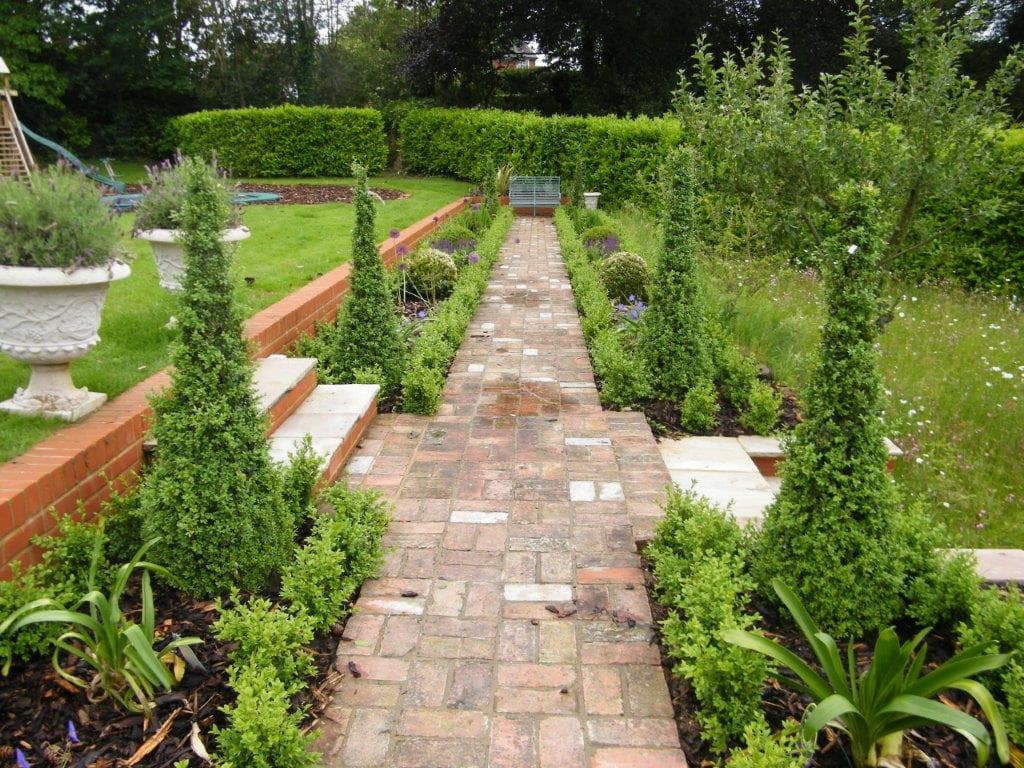
Integrating a Rain Garden into Your Existing Garden
Rain gardens work in almost any garden style:
- Contemporary gardens: Use a linear bioswale along a patio edge with architectural grasses (Pennisetum, Molinia) and a gravel mulch for clean lines
- Cottage gardens: Curved kidney-shaped rain garden with drifts of Geranium, Lythrum, and Iris sibirica blends with informal borders
- Wildlife gardens: Rain garden planted with UK natives (Lythrum, Carex, Eupatorium, Viburnum) creates damp meadow habitat
- Small gardens: A narrow bioswale (50cm wide, 3m long) along a boundary fence captures patio runoff without taking up valuable space
For front gardens, a rain garden between the driveway and front door handles car-park runoff and replaces a tired lawn with low-maintenance planting.
Rain Garden vs Traditional Drainage
Traditional drainage (underground pipes, soakaways, gullies) hides water and sends it straight into the combined sewer system. During heavy rain, sewers overflow, and untreated wastewater enters rivers.
Rain gardens keep water on-site, reducing pressure on sewers and filtering pollutants before water reaches groundwater. They also look better than a plastic gully.
If you're redesigning a garden with poor drainage, a rain garden is a more sustainable and visually appealing solution than installing French drains or raising the patio level.
Common Rain Garden Mistakes
Planting pond plants: Pond marginals (Caltha, Zantedeschia, Pontederia) won't survive in a rain garden because it dries out. Stick to damp-meadow perennials that tolerate both wet and dry.
Making it too deep: A rain garden deeper than 30cm becomes a pond. Keep it shallow (15-25cm) so water drains within 48 hours.
Positioning too close to foundations: Water pooling near walls can cause damp or subsidence. Keep rain gardens at least 5m from buildings.
Using impermeable clay without amendment: Pure London clay won't drain fast enough. Always amend with sand and compost, or build a raised bioswale.
Planting too densely: Rain garden plants need space to spread. Plant 30-40cm apart, not 15cm. They'll fill in within 2 seasons.
Is a Rain Garden Right for Your Garden?
A rain garden makes sense if you have:
- Paved areas or downpipes generating runoff
- Waterlogging or poor drainage in parts of the garden
- A sunny or part-shaded spot at least 4m² in size
- Heavy clay soil (rain gardens handle clay better than traditional borders)
- Interest in wildlife and sustainable gardening
Rain gardens don't suit gardens with:
- Deep shade (less than 3 hours of sun) — most rain garden plants need sun
- Steep slopes (over 10%) — water runs off too fast to pool
- Very small gardens (under 15m² total) — a rain garden takes up proportionally too much space
For most SE England gardens, a rain garden is a practical, low-maintenance solution that handles UK rainfall extremes while supporting wildlife and reducing flood risk.
Get Professional Rain Garden Design
If you're planning a full garden redesign or need help integrating a rain garden into an existing layout, professional design ensures correct sizing, drainage, and plant selection for your soil type and site conditions.
At Soil Sisters, we design rain gardens and bioswales for SE England gardens, with particular expertise in London clay and waterlogged sites across Kent, Surrey, Essex, and London. Our design service includes site assessment, detailed planting plans, and liaison with landscapers to ensure the rain garden is built to drain properly.
Design fees start from £1,500 for a rain garden integrated into a full garden design. For existing gardens, we can add a rain garden as a standalone feature for £800-1,200 (design only) or £3,000-6,000 (design and build).
Contact us for a free consultation: 0203 834 9807
Rain Gardens: The 2026 Chelsea Trend That Works in Real UK Gardens
Rain gardens dominated RHS Chelsea 2026 because they solve real problems: flash flooding, drought stress, and overloaded drainage systems. For UK gardeners, a rain garden is one of the few design trends that genuinely improves how a garden functions while looking better than the drainage feature it replaces.
If you're redesigning a garden in 2026, a rain garden should be on the brief.