
Town gardens are some of the trickiest spaces to get right. They tend to be narrow, overlooked, partly shaded by neighbouring buildings, and squeezed into awkward rectangular plots behind terraced or semi-detached houses. But they are also some of the most rewarding gardens to design, because every decision you make has an immediate, visible impact.
We have designed dozens of town gardens across London, Kent, Surrey and Essex, and the same lesson keeps repeating itself: a small garden done well feels bigger than a large garden done badly. The trick is not to cram in everything you have seen on Instagram. It is to edit ruthlessly, think in three dimensions, and choose materials and plants that earn their place year-round.
This guide covers everything you need to know about designing a town garden in the UK. Layout principles, planting for shade and privacy, realistic costs, and the specific challenges that come with urban plots in the South East.
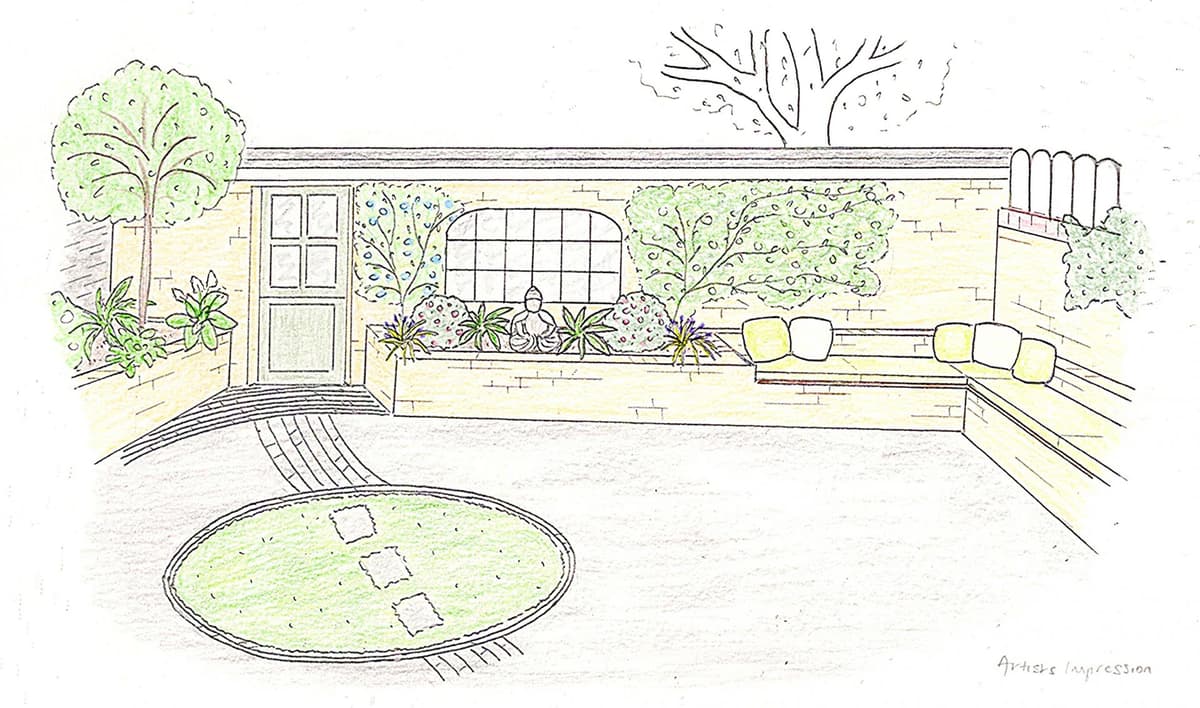
What Makes Town Gardens Different
A town garden is not just a small garden. It comes with a specific set of conditions that rural or suburban plots rarely share.
Shade from buildings. Neighbouring walls, extensions and upper floors cast shadows that move through the day. Many town gardens get direct sun for only three or four hours, often only in the middle of the day. This is not a dealbreaker, but it shapes every plant choice you make.
Overlooking. Upper-floor windows from adjacent properties mean privacy is a constant concern. You need screening that works without making the garden feel like a bunker.
Narrow proportions. The classic Victorian terraced garden is roughly 5 to 7 metres wide and 10 to 15 metres long. That long, thin shape creates sightline problems and makes the space feel like a corridor unless you break it up.
Access constraints. Getting materials through the house or down a side return adds to build costs. If the only way in is through the kitchen, your landscaper needs to plan for it, and you need to budget accordingly.
Urban soil. Town garden soil is often compacted, full of rubble from previous builds, and either heavy London clay or thin topsoil over builders substrate. Testing your soil before you plant is not optional. It is essential.
Layout Principles for Narrow Town Gardens
The single most common mistake in town garden design is treating the space as one long strip. That approach makes the garden feel smaller than it is, because your eye travels straight to the back fence and registers the full, unflattering length.
Instead, divide the garden into zones. Two or three distinct areas, each with its own purpose, will make the space feel larger and more interesting.
The diagonal trick
Setting your paving or decking at a 45-degree angle to the house forces the eye to travel diagonally across the garden rather than straight down it. A diagonal is always longer than the width, so the space feels broader. This is one of the oldest tricks in small garden design and it works every time.
Zoning a typical 6m x 12m plot
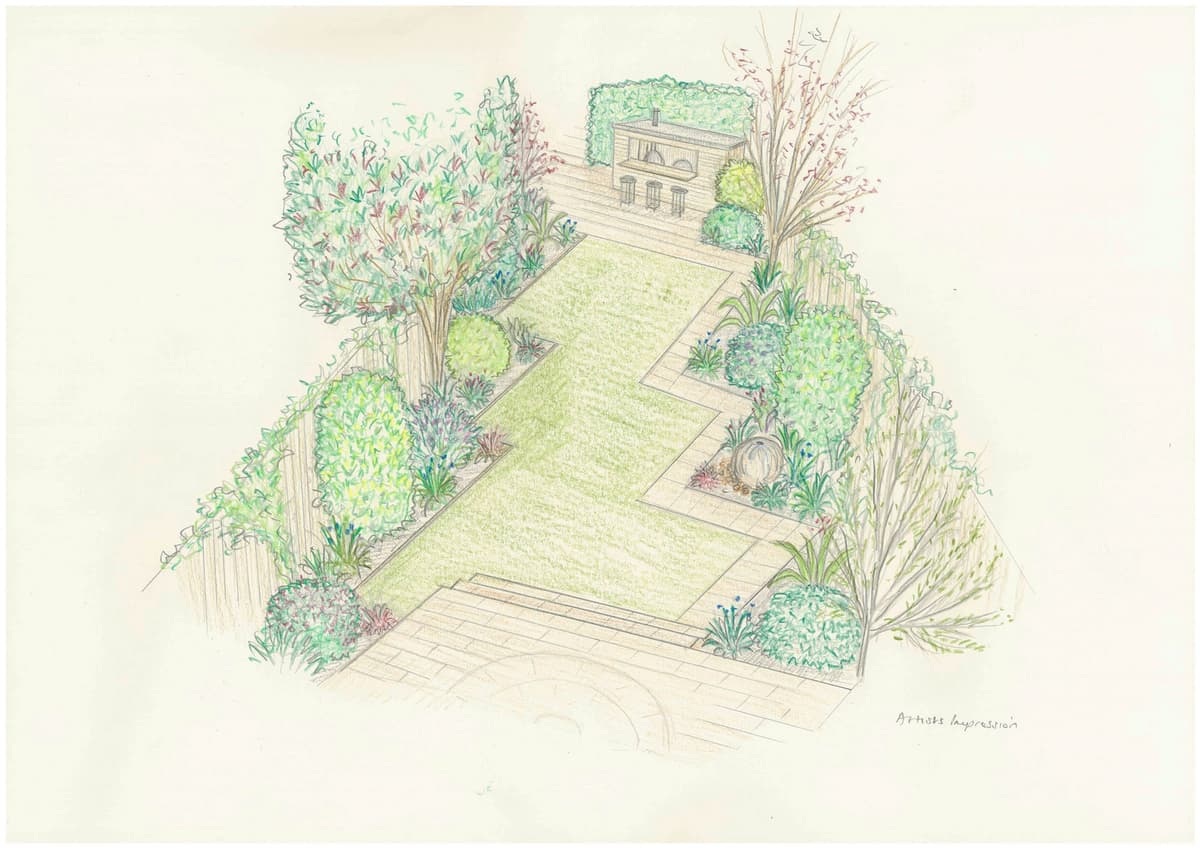
For a standard terraced house garden of around 70 square metres, we would typically create three zones:
Zone 1: The entertaining terrace. Immediately outside the back door, paved or decked, large enough for a table and four chairs. This is where you spend most of your time, so it needs to feel generous. Allow at least 3m x 3m.
Zone 2: The planted middle. A transitional area with deep planting beds on both sides, perhaps a small lawn panel or gravel garden. This is where the garden does its visual heavy lifting, screening the back fence and creating that sense of journey.
Zone 3: The destination. A bench, a water feature, a garden room, or simply a focal point that draws you down the garden. Having a reason to walk to the end makes the whole space feel purposeful.
Plants That Actually Work in Town Gardens
Plant selection is where town gardens succeed or fail. You need plants that tolerate shade, cope with urban pollution, look good for most of the year, and do not outgrow their spot within two seasons. That is a demanding brief, but there are some outstanding performers.
Structural evergreens for year-round backbone
Every town garden needs evergreen structure. Without it, the garden disappears in winter, which is precisely when you look at it most from the house.
- Fatsia japonica (Japanese aralia). Tolerates deep shade, pollution, and neglect. The glossy palmate leaves give a tropical feel without any of the tenderness. Grows to around 2.5m. From about £15 for a 3-litre pot.
- Sarcococca confusa (sweet box). Evergreen, shade-loving, and produces tiny white flowers in January that fill the whole garden with scent. Perfect for underplanting and path edges. Around £12 for a 2-litre pot.
- Pittosporum tenuifolium Tom Thumb. Compact, with dark burgundy foliage that looks striking against pale paving. Needs a sheltered spot in colder parts of Kent and Essex. From £18.
- Taxus baccata (yew). The ultimate structural evergreen. Can be clipped into hedges, topiary or left as a specimen. Thrives in shade. Slower than privet but infinitely better looking.
Shade-tolerant perennials
The planting palette for shaded town gardens is richer than most people realise. These are not consolation plants. They are genuinely beautiful.
- Hakonechloa macra (Japanese forest grass). Lime-green cascading foliage that catches any available light. Spectacular in raised beds or spilling over the edge of a wall. Around £10 per plant.
- Brunnera macrophylla Jack Frost. Silver-frosted heart-shaped leaves with forget-me-not blue flowers in spring. Thrives in dry shade once established.
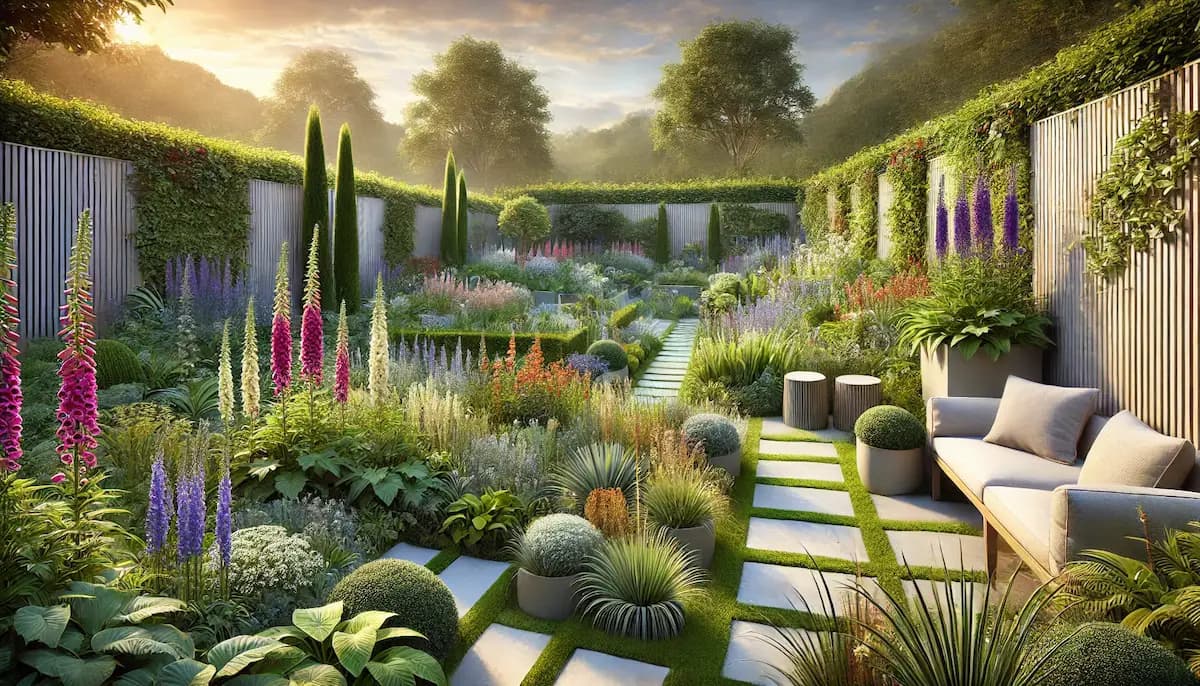
- Digitalis purpurea (foxglove). Self-seeds freely, tolerates dappled shade, and adds vertical drama in early summer. Free if you let it do its thing.
- Heuchera varieties. Evergreen, available in dozens of foliage colours from lime to deep plum. Useful for edging and containers. From £8 per plant.
- Astrantia major. Elegant, papery flowers from June to September. Happy in partial shade. Looks refined rather than showy, which suits a town garden perfectly.
Climbers for vertical interest and screening
Walls and fences are your biggest planting surfaces in a town garden. Use them.
- Trachelospermum jasminoides (star jasmine). Evergreen, heavily scented white flowers in July, and tolerates a north or east wall once established. The best wall climber for town gardens in the South East. From £20 for a 2-litre pot.
- Hydrangea anomala subsp. petiolaris (climbing hydrangea). Self-clinging, tolerates full shade, and produces lace-cap white flowers in June. Slow to start but magnificent once established.
- Clematis armandii. Evergreen with scented white flowers in March. Needs a sheltered wall. Dramatic in a small garden.
Privacy Screening Without Losing Light
The instinct in an overlooked town garden is to put up the tallest fence or hedge you can manage. Resist it. A 2-metre solid fence on all sides turns your garden into a dark box. You want screening that filters views without blocking light.
The most effective approach combines several layers:
Pleached trees. Hornbeam (Carpinus betulus) or lime (Tilia cordata) trained on clear stems with a flat canopy of foliage at head height. They screen upper-floor windows without shading the ground. Budget around £150 to £350 per tree for semi-mature specimens.
Trellis extensions. Adding 300mm to 600mm of trellis above an existing fence is often permitted under permitted development rules (check your local council, as conservation areas may differ). Growing a climber through it gives you privacy without the oppressive feel of solid timber.
A well-placed tree. A single multi-stem tree, such as Amelanchier lamarckii or a silver birch (Betula utilis var. jacquemontii), planted towards the centre of the garden can break sightlines from overlooking windows far more effectively than perimeter screening alone.
Hard Landscaping Materials and Costs
In a town garden, hard landscaping typically accounts for 50 to 70 percent of the total build cost. The surfaces you choose set the tone for the entire space.
Paving options for town gardens
| Material | Cost per sqm (supply only) | Best for | Notes |
|---|---|---|---|
| Porcelain paving | £40 to £80 | Contemporary schemes | Non-porous, low maintenance, huge colour range. The default choice for most London town gardens now. |
| Natural sandstone | £30 to £60 | Traditional and cottage schemes | Beautiful ageing, but porous. Needs sealing in damp, shaded spots to prevent algae. |
| Limestone | £50 to £90 | Clean, minimal designs | Elegant but susceptible to acid staining from leaf fall. Choose a honed finish for grip. |
| Concrete pavers | £20 to £35 | Budget-conscious projects | Improved dramatically in recent years. The best ones are hard to tell from natural stone. |
| Composite decking | £80 to £140 | Raised areas, roof terraces | No annual maintenance. Lighter than stone, which matters on upper levels. |
Installation typically adds £40 to £70 per sqm on top of material costs, depending on ground preparation, sub-base requirements, and access difficulty. For a typical town garden terrace of 15 to 20 sqm, expect to pay £1,200 to £3,000 installed, using mid-range materials.
What does a full town garden design and build cost?
Costs vary enormously depending on specification, but here are realistic ranges for the South East in 2026:
| Garden size | Design only | Design and build |
|---|---|---|
| Small (30 to 50 sqm) | £1,500 to £3,000 | £8,000 to £18,000 |
| Medium (50 to 80 sqm) | £2,500 to £4,500 | £15,000 to £30,000 |
| Large town garden (80 to 120 sqm) | £3,500 to £6,000 | £25,000 to £50,000+ |
These figures include design fees, hard landscaping, planting, lighting and project management. They do not include garden rooms, outbuildings or major structural work like underpinning retaining walls. For a detailed breakdown of what garden design costs in the capital, see our complete guide to garden design costs in London.
Lighting a Town Garden
Garden lighting transforms a town garden more dramatically than almost any other intervention. A well-lit garden effectively doubles your living space from April through October, and it looks beautiful from the house all year round.
The key rule: use warm white LEDs at 2700K. Anything cooler looks clinical and harsh. Anything warmer looks orange.
For a typical town garden, plan for:
- Uplighters on feature plants or walls. Two or three 3W LED spike spots are enough to transform the space. Budget £30 to £60 per fitting plus installation.
- Step or path lights. Recessed low-level fittings along steps or path edges. Essential for safety, subtle when done well.
- Festoon or catenary lights. Strung across a seating area, these create atmosphere without the formality of architectural lighting. Budget £50 to £150 for a quality set.
Our garden lighting design guide covers specifications and installation in more detail.
Dealing with Common Town Garden Problems
Compacted or rubble-filled soil
If you dig down 300mm and hit solid rubble, brick or concrete, you have two options. Remove and replace (expensive, especially with limited access), or build raised beds over the top. Raised beds filled with quality topsoil and compost give you perfect growing conditions regardless of what is underneath. They also add structure and height variation to the garden. Use sleepers, rendered blockwork, or corten steel for the beds depending on your design style.
Drainage
Town gardens often have poor drainage because the soil is compacted and there is a high ratio of hard surface to planted area. If water pools on your patio after rain, you probably need a linear channel drain connected to the existing surface water system. Cost: around £500 to £1,500 installed, depending on length and complexity. This is not optional. Standing water ruins paving and kills plants.
Boundary disputes
Before you do anything to a shared boundary wall or fence, check who owns it. The title deeds or Land Registry plan will show this. If it is a party wall, you may need your neighbours consent for certain works. If you are in any doubt, the permitted development rules are worth understanding before you start.
Town Garden Design Ideas by Style
Contemporary minimalist
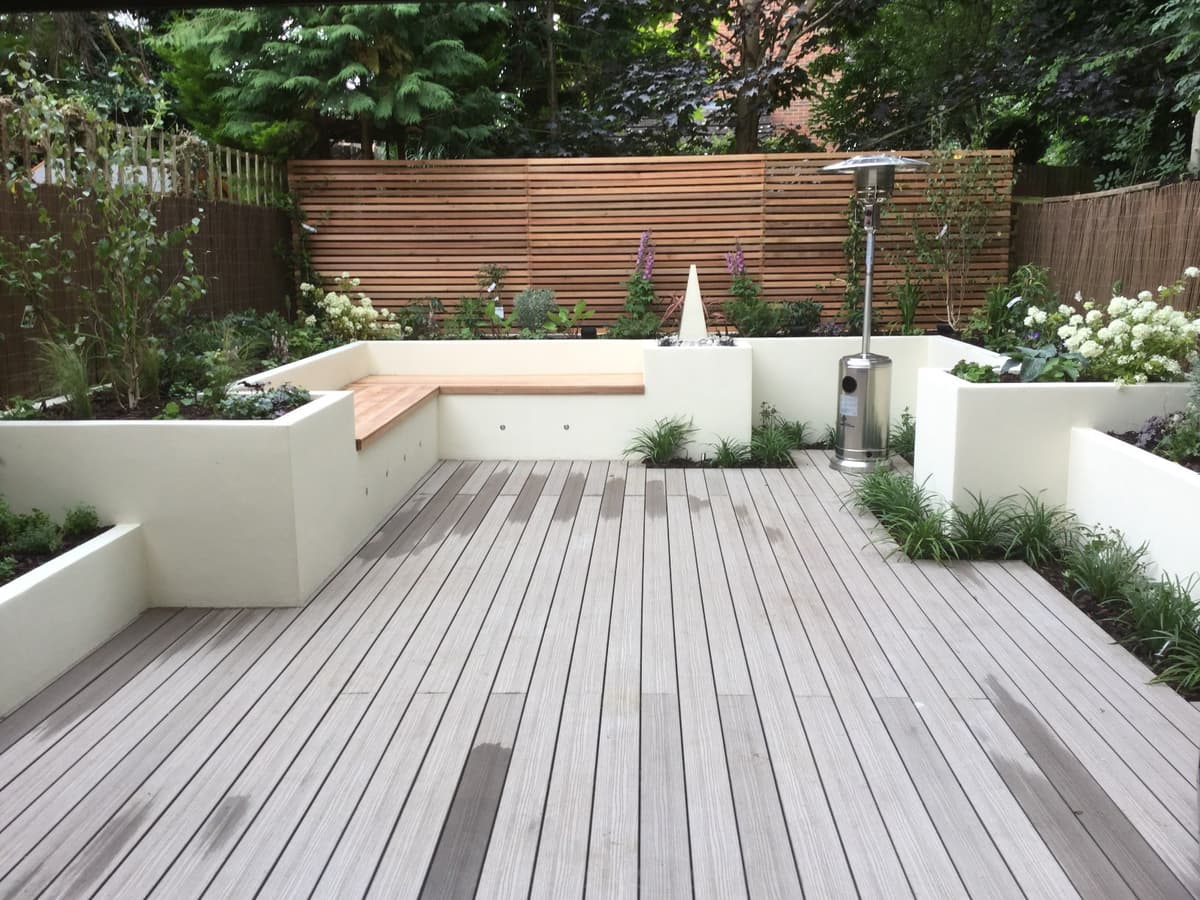
Porcelain paving in a pale grey, rendered raised beds, a single multi-stem Amelanchier, architectural planting of grasses (Hakonechloa, Calamagrostis) and evergreen ground cover (Pachysandra terminalis). A built-in bench with hidden storage. This look relies on restraint and quality materials.
Cottage town garden
It sounds contradictory, but a cottage planting style can work beautifully in a town garden. The secret is structure underneath the abundance. Box or yew balls at the corners, a simple stone path, and then let foxgloves, geraniums, roses and Alchemilla mollis do their thing. Read our cottage garden design guide for planting plans that work in confined spaces.
Tropical urban jungle
Sheltered town gardens in London and the South East can support surprisingly exotic planting. Fatsia japonica, tree ferns (Dicksonia antarctica), Trachycarpus fortunei (Chusan palm), and banana (Musa basjoo) all thrive in the microclimate that buildings create. Pair with large-leafed perennials like Rodgersia and Ligularia for maximum drama. Our tropical garden design guide covers hardiness and overwintering in detail.
Low-maintenance modern
Composite decking, self-watering planters, evergreen structural planting (Pittosporum, Euonymus, box) and a simple water feature. No lawn, no annual bedding, minimal pruning. Perfect for busy professionals who want the garden to look good without a weekend commitment.
Planning Your Town Garden Project
The best time to start designing a town garden is autumn or early winter. This gives you time to get the design right, source materials, and have the build completed in time for spring planting. Most landscapers in the South East are booked two to three months ahead during peak season (March to June), so early planning is worth it.
What we include in a town garden design
When you work with Soil Sisters on a town garden, you get:
- A full site survey including aspect, soil assessment and drainage check
- A scaled hand-drawn plan and 3D visualisation so you can see the finished garden before building starts
- A detailed planting plan with species, quantities and layout
- A materials specification with supplier recommendations
- Build support, including contractor recommendations or full project management if you choose our design and build service
We work across Kent, Surrey, Essex and London and the South East. If you have a town garden you want to transform, get in touch for a free initial consultation, or call us on 0203 834 9807.
Frequently Asked Questions
How much does it cost to design a town garden?
Design fees for a typical town garden in the South East range from £1,500 to £4,500 depending on the size and complexity of the plot. A full design and build for a 50 sqm town garden typically costs between £15,000 and £30,000 including hard landscaping, planting, lighting and project management.
What plants grow well in a shaded town garden?
Shade-tolerant evergreens like Fatsia japonica, Sarcococca and climbing hydrangea form the backbone. For perennials, Hakonechloa macra, Brunnera, Heuchera and ferns (Dryopteris, Polystichum) all thrive in partial to full shade. Star jasmine (Trachelospermum jasminoides) is the best wall climber for sheltered urban gardens.
How do I make a small town garden feel bigger?
Set paving or decking at a diagonal angle to the house, divide the garden into two or three zones rather than treating it as one space, use planting to blur the boundaries, and add a focal point at the far end to draw the eye. Avoid straight lines running the full length of the garden.
Do I need planning permission to redesign my town garden?
Most town garden redesigns fall within permitted development rights and do not need planning permission. The main exceptions are garden rooms over 2.5m high within 2m of a boundary, hard surfaces over 5 sqm that are not permeable, and any work in a conservation area or to a listed property. Our guide to garden room planning permission covers the rules in detail.
Can I have a lawn in a town garden?
You can, but think carefully about whether it is worth it. A lawn panel under about 15 sqm struggles to look good in a shaded, heavily used town garden. If you do want grass, consider shade-tolerant seed mixes and accept that it will not look like a bowling green. Artificial turf or a gravel garden are lower-maintenance alternatives that often work better in compact urban plots.