
Your garden designer's brief is where your project either takes off or stalls. Get it right in the first meeting and you'll see concept sketches that feel like your garden, not someone else's template. Get it vague and you'll waste the second meeting clarifying what you should have said the first time.
This guide walks you through exactly what to prepare before your consultation, the questions designers actually need answered, and how to communicate your ideas when you're not sure what's possible.
What a Garden Design Brief Actually Is
A garden design brief isn't a wish list. It's the working document that keeps your designer anchored to what you need while they figure out how to deliver it.
At Soil Sisters, we ask clients to think through five areas before we meet: how you'll use the space, what's not working now, your style preferences, practical constraints (budget, timing, site issues), and who'll be using the garden in five years.
The brief evolves. Your first conversation produces a rough brief. The designer refines it after the site visit. You both sign off on the final version before concept work begins. That agreed brief is what protects you from scope creep and protects the designer from endless revisions.
Before Your First Meeting: What to Prepare
1. Document Your Current Garden
Take photos from every angle, not just the pretty bits. Shoot from upstairs windows to show the layout. Photograph problem areas: the boggy corner, the wind tunnel between buildings, the neighbour's looming leylandii.
If you have a plot plan or house plans showing the garden boundary, dig them out. If not, Google Earth will do for an initial discussion.
Note down measurements for the main garden dimensions (length, width, any level changes). A designer can survey it properly later, but rough dimensions help them gauge scale.
2. Work Through the "How Will You Use It?" Checklist
Be specific. "Somewhere to sit" isn't enough. Where will you sit for morning coffee versus evening drinks? How many people need to fit round the table when you host? Do you eat outside three times a summer or five nights a week?
If you have children, what ages? A sandpit for a two-year-old is dead space when they hit seven. If you're planning a family, say so. If the garden's for two adults and a dog, say that too.
Think seasonally. Will you use it year-round or May to September only? Does it need to look good from the house in January? That changes the planting strategy.
3. Identify What's Not Working Now
This is the diagnostic bit. Why are you hiring a designer?
Common answers: awkward layout (long thin garden, all lawn, nowhere to sit), drainage problems (puddles, boggy patches), overlooked (neighbours, road, flats), no privacy between different zones, tired planting, or just "it doesn't feel like ours".
Be honest about maintenance. If you're not going to deadhead roses or prune climbers, say so. A good designer plans around your actual commitment level, not your aspirational one.
4. Define Your Budget Range
Designers work faster when they know the budget upfront. It's not about what they think you can afford — it's about what designs are realistic.
For scale:
- Design-only fees (concept plan, planting plan, no build): £1,500–£4,500 depending on garden size and plan detail
- Small garden redesign and build (up to 50 sqm): £8,000–£25,000
- Medium garden (50–150 sqm): £25,000–£60,000
- Large garden (150 sqm+): £60,000–£150,000+
If your budget's £15k and you want decking, a pergola, new planting, and a water feature, the designer can tell you what's achievable. If it's £50k for a 30 sqm courtyard, they'll propose higher-spec materials and built-in features.
Designers aren't offended by budget constraints. They're offended by finding out halfway through concept work that everything's too expensive.
For detailed cost breakdowns by region, see our guides for Kent, Surrey, and UK-wide garden designer costs.
5. Gather Visual Inspiration (But Know Its Limits)
Pinterest boards and Instagram saves are useful for communicating style, not for dictating layout.
When you share images, tell the designer what you like about each one. "I like the gravel and the loose planting" is actionable. "I want this garden" isn't, because that garden works for its site, soil, aspect, and client, not necessarily yours.
Useful reference points:
- Gardens you've visited and loved (Sissinghurst, Great Dixter, a neighbour's front garden)
- Material preferences (natural stone not porcelain, timber not composite, rendered walls not brick)
- Planting styles (cottage garden abundance vs architectural minimalism, evergreen structure vs seasonal colour)
For planting style ideas, see our guides on Mediterranean garden design, cottage gardens, contemporary designs, and wildlife-friendly gardens.
Avoid showing the designer 40 saved images. Pick five that represent the range of what appeals to you. If they're all contemporary minimal courtyards, that's a clear brief. If they're cottage, tropical, Japanese, Mediterranean, and prairie, the designer needs to know which direction to weight.
6. List Any Non-Negotiables and Deal-Breakers
Non-negotiables are the must-haves. A level terrace for a table and six chairs. Space for the dog to run. Screening from the road. Raised beds for vegetables. Bike storage.
Deal-breakers are the won't-haves. No gravel (too much maintenance). No decking (bad experience). No yew hedging (too slow). No roses (allergic partner).
Stating these upfront saves everyone time. Designers can work around constraints; they can't read minds.
What Happens During the Initial Consultation
The Site Visit Walkthrough
The designer will walk the garden with you, often for 60–90 minutes. They're looking at aspect (where the sun hits at different times), microclimates (that warm corner, the frost pocket), soil (clay, sand, chalk), drainage, existing plants worth keeping, views to borrow or block, and how the garden relates to the house.
They'll ask about the practical stuff: where the drains are, whether there's exterior power, if that boundary's yours or shared, whether the patio's on a concrete base or just slabs on sand.
This is when you mention the things you forgot to write down. The tree roots that cracked the old patio. The boggy patch in winter. The cat from next door that digs up bulbs.
The Questions Designers Ask
Expect:
- Who uses the garden and how? (Kids, pets, entertaining, vegetable growing, just looking at it from inside.)
- What time of day will you be out there? (Morning coffee, afternoon sun, evening drinks.)
- Maintenance commitment — honest answer. (An hour a week? A day a month? Just mowing?)
- Storage needs. (Bins, bikes, tools, furniture in winter, log store.)
- Dislikes. (Anything you hate or have bad associations with.)
- Future plans. (Extending the house, getting a dog, children growing up and leaving, planning to downsize in five years.)
There's no wrong answer to these. But vague answers produce vague designs.
For maintenance-focused design, see our low-maintenance garden guide and gravel garden design for truly hands-off planting.
What You Should Ask the Designer
Turn it around. Interview them.
Process and timeline:
- What's your design process? (Concept stage, revisions, final plan, construction drawings.)
- How many revisions are included at each stage?
- What's the timeline from brief to build-ready plans? (Usually 6–10 weeks for full design.)
- How involved are you during the build? (Some designers hand over plans and step back; others project-manage or visit weekly.)
Fees and costs:
- What do your fees cover? (Concept plan only, planting plan, construction drawings, contractor liaison.)
- How do you charge? (Fixed fee, day rate, percentage of build cost.)
- What's not included? (Site survey if the garden's large or complex; planning permission applications; actual build costs.)
- Can you give a ballpark build cost now, or after the survey?
Their work and approach:
- Can I see examples of projects similar to mine? (Small urban garden, sloping site, family garden, contemporary courtyard.)
- Have you worked with my soil type/aspect before? (Particularly relevant for London clay, very shaded sites, or coastal wind.)
- Do you have preferred contractors, or can I use my own? (Some designers work with specific landscapers; others produce plans for any contractor to quote from.)
- What happens if I'm not happy with the first concept? (Most include 1–2 revision rounds; check what happens if you want a complete rethink.)
Practicalities:
- How much garden access does the build need? (Through the house, side access, crane over the roof for large materials.)
- What's the likely disruption period? (A courtyard patio might be one week; a full garden redesign could be 4–8 weeks.)
- Who handles planning permission if needed? (Rare for gardens, but relevant for large structures, walls over 2m, or listed buildings/conservation areas.)
For planning permission considerations, see our garden room planning permission guide.
After the Consultation: The Survey and Concept Stage
Site Survey
For small gardens (under 100 sqm), the designer may measure it themselves during the consultation. For larger or complex sites, they'll instruct a professional surveyor to produce an accurate base plan showing boundaries, levels, existing trees and structures, and services (drains, utilities).
Survey costs range from £200 for a simple plot to £1,500+ for large or sloping gardens needing topographical detail.
Concept Design
This is where the brief becomes a visual proposal. Expect to wait 2–4 weeks for the first concept.
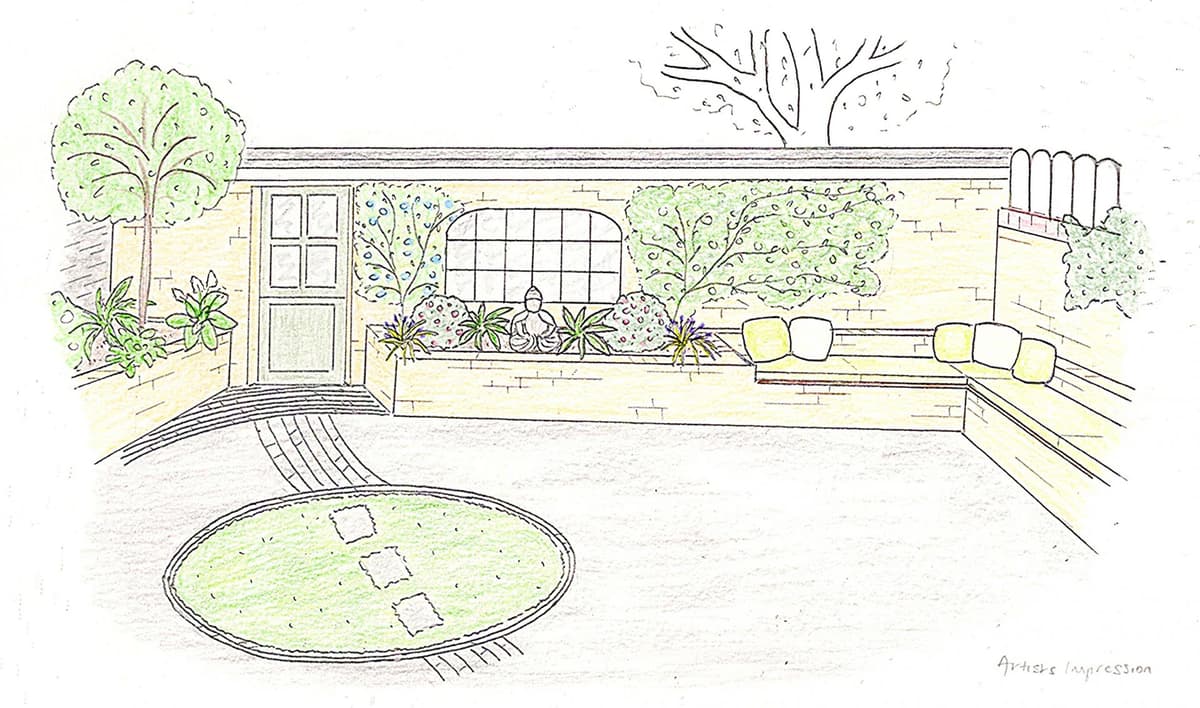
A concept plan shows layout: where the terrace goes, paths, lawn or planting areas, major features (pergola, pond, raised beds), and how the space is zoned. It's usually a scaled plan view, sometimes with a mood board of materials and planting style references.
Most designers present two concept options. One might prioritise entertaining space, the other more planting. You pick elements from each, they refine, and you move to the detailed design phase.
Revisions and Sign-Off
If the first concept's off-target, this is when you say so. A good designer won't be precious. They'll ask what's not working and why, then adjust.
Common revision requests:
- The terrace is too small (or too big)
- We need more lawn for the kids (or less lawn to reduce maintenance)
- The path layout feels awkward
- The style's too formal (or too loose)
Once you're happy with the concept, the designer develops it into a detailed layout plan, planting plan, and if needed, construction drawings for a contractor to price and build from.
For examples of how the design process works in practice, see our before and after garden transformations.
Common Mistakes When Briefing a Designer
1. Not Mentioning Budget
"We'll see what the ideas cost" is a recipe for disappointment. A designer working blind will either undershoot and propose something underwhelming, or overshoot and deliver a concept you can't afford. You'll waste time, they'll waste time, and you still won't have a garden.
2. Describing Style in Opposite Terms
"We want it low-maintenance but with lots of colour year-round" is contradictory. Year-round colour needs staggered planting (spring bulbs, summer perennials, autumn grasses, winter structure), which requires maintenance. Low-maintenance usually means evergreen structure with a short seasonal peak.
Be honest about the trade-off. A good designer can get close to both, but not if you insist they're equally important.
For realistic low-maintenance options, see winter garden design for evergreen structure and low-maintenance planting strategies.
3. Not Differentiating Between Nice-to-Have and Essential
If everything's a must-have, the designer can't prioritise within budget. Separate essentials from aspirations. Essentials get designed in from the start. Aspirations get noted for phase two when funds allow.
4. Assuming the Designer's Seen the Site Before You Meet
If you book a consultation and don't send photos or context upfront, the designer's arriving cold. Send them a few photos and a short note (garden size, what you're trying to achieve, any major constraints) a few days before the meeting. They'll turn up with better questions.
5. Treating the Consultation as a Free Design
The initial consultation is a briefing session and site assessment, not a concept reveal. If a designer sketches a few ideas on the day, great. But don't expect a full layout plan at the first meeting. That comes after survey, research, and design time.
Red Flags to Watch For
- A designer who doesn't ask about budget or dismisses the question. (They're guessing what you can afford, and they'll guess wrong.)
- One who pushes a signature style regardless of your brief. (You'll get their garden, not yours.)
- Anyone who promises a full design on the spot. (Good design needs time.)
- Designers who won't show you similar past projects. (Either they don't have them, or they're not confident in the work.)
- Those who can't explain their fees clearly. (Vague fee structures lead to invoice shock later.)
For more on avoiding common pitfalls, see our guide to garden design mistakes we fix most often.
What Makes a Good Brief
A good brief is honest, specific, and realistic.
It's honest about how you'll actually use the garden, not how you imagine you might. It's specific about must-haves and constraints. It's realistic about budget, maintenance commitment, and timeline.
The best briefs also acknowledge what the client doesn't know. "We're not sure if a pergola would work here" or "We don't know what plants would thrive in this shade" are useful things to say. That's what you're hiring expertise for.
How Soil Sisters Approaches the Brief
We ask clients to complete a briefing questionnaire before we visit. It covers the basics: how you'll use the garden, style preferences, budget range, and any deal-breakers.
When we meet on-site, we spend the first half listening and the second half explaining what's feasible, what's tricky, and what trade-offs might be needed. We're not selling you a vision on day one. We're making sure we understand the brief before we start designing.
After the consultation, we send a written summary of the agreed brief. If we've misunderstood something, this is the moment to correct it. Once the brief's confirmed, we survey the site (if needed), then start the concept phase.
We include one concept revision as standard. If the first design's off-target, we'll rework it. If you want to explore a completely different direction, that's a new concept (additional fee).
The goal is a design that works for your site, your budget, and how you'll actually live in the garden, not a portfolio piece that looks great but doesn't function.
We work across Kent, Surrey, Essex, and London. See our portfolio for examples of how we turn briefs into built gardens.
What Happens If You Change Your Mind
Briefs evolve. You might realise halfway through concept design that you do want a veg patch after all, or that the pergola's not worth the budget.
Small changes are normal. The designer tweaks the layout. Large changes — a complete rethink of the layout or style — usually trigger a new concept fee because it's effectively starting again.
Be upfront if something's not working. It's cheaper to revise the concept than to build a garden you don't love.
Key Takeaways
- Prepare before the consultation. Photos, measurements, budget, how you'll use it, style references. The more clarity you bring, the better the first concept.
- Be specific about must-haves and deal-breakers. Designers can't guess what matters most to you.
- State your budget upfront. It shapes everything from materials to layout to planting scale.
- Treat the consultation as a discovery session, not a free design. You're briefing the designer and assessing fit, not getting a finished plan.
- Ask questions. How they charge, what's included, their design process, how involved they are during the build, examples of similar projects.
- Expect the brief to evolve. First conversation produces a rough brief. Site visit refines it. Final brief is agreed before concept work starts.
- Be honest about maintenance. A designer who knows you'll spend an hour a week will plan accordingly. One who thinks you'll deadhead and prune will design a garden that becomes a mess.
A good brief is the foundation of a good design. It's worth the time to get it right.
Ready to start your garden project? We work across Kent, Surrey, London, and Essex. Free initial consultation.
Call 0203 834 9807 or book a consultation.